
Xi Jinping’s Himalayan Dam Push Raises Colossal Ecological and Seismic Threat to India, Bangladesh, Nepal and Bhutan.
Chinese Geologists have raised Active Fault Near World’s Biggest Hydropower Project on Brahmaputra; Calls Grow for International Safety Audit. Jinping should take a call right now to save Himalayas and its people.
SHIMLA/NEW DELHI:
China’s unprecedented dam-building drive under President Xi Jinping is pushing the fragile Himalayan ecosystem into an entirely new and potentially dangerous phase, with the proposed mega hydropower project on the Yarlung Tsangpo in Tibet now facing serious questions over its geological and seismic safety.
The concerns have acquired greater urgency after Chinese government-backed geologists flagged an active fault in the region of the world’s largest hydropower project, warning that the geological structure could affect the stability of the massive infrastructure being built on the Yarlung Tsangpo, which becomes the Siang in Arunachal Pradesh and the Brahmaputra in Assam before flowing into Bangladesh.
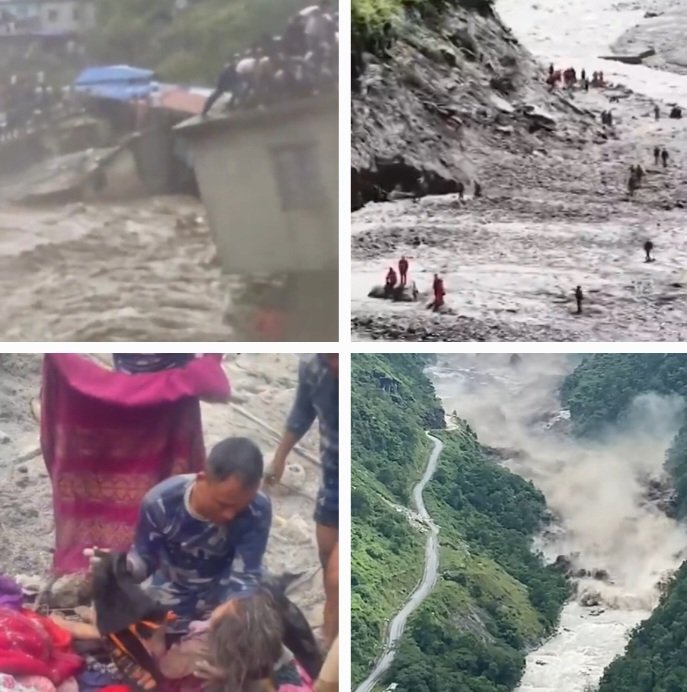
The warning comes at a particularly disturbing time for the Himalayas, where a catastrophic glacial permafrost collapse and flash flood along the Nepal-Tibet border near Gyirong has killed hundreds and left thousands missing, underscoring how rapidly unstable Himalayan terrain can turn into a deadly downstream disaster.
What is worrisome for Nepal is about 14 of its hydropower projects worth 758 MW capacity including those under operation and execution and 17 kv transmission line were wiped out by the devastating floods, whose exact reasons remain yet be full established.
This raises uncomfortable questions for Nepal : The fate of its downstream projects, highways and its population remains at the mercy of Chinese upstream massive buildup of its roads, tunnels and hydropower projects in Tibet region. Will China intend to push Nepal into its satarpy selling power at its own terms?
The Mega project project in question, approved by the Chinese government in December 2024, represents one of the most ambitious infrastructure interventions ever attempted in the Himalayan region.
Its estimated investment exceeds one trillion yuan, while the proposed installation is expected to generate around 300 billion kilowatt-hours of electricity annually.
The scale is extraordinary. The project is expected to generate almost three times the annual electricity output of the Three Gorges Dam, making the Yarlung Tsangpo project a gigantic engineering experiment in one of the most tectonically active mountain systems on Earth.
It is a river that turns into the lifeline of millions. The location makes the project strategically far more consequential than an ordinary hydropower installation.
The Yarlung Tsangpo will make dramatic turn at the Great Bend in Tibet before entering Arunachal Pradesh as the Siang. It then joins the Brahmaputra system in Assam and continues into Bangladesh.
Any major alteration in the river’s natural flow, sediment movement or seasonal discharge therefore has vast implications far beyond Chinese territory.
For India and Bangladesh, the concern is not simply electricity generation. It is the possibility that the flow of one of Asia’s most important transboundary rivers could increasingly come under the control of an upstream power.
The Himalayan geology makes the experiment dangerous. The proposed project lies in an exceptionally difficult geological environment marked by active tectonics, steep mountains, deep gorges and landslide-prone terrain.
The latest warning from Chinese geologists over an active fault adds another dimension to the debate. Reports based on the Chinese study published in journals and quoted by scientists say the fault could pose risks to the structural integrity of the dam and associated infrastructure.
The question is therefore straightforward: Can the world's biggest hydropower project safely be built above or near an active geological fault in the eastern Himalayas?
That question cannot be answered by political assurances.
It requires independent geological investigation, seismic modelling, reservoir-safety assessment and continuous monitoring by experts who are not connected with the project.
Wenchuan remains a grim warning
China itself has experienced the devastating consequences of major earthquakes in mountainous terrain.
The 2008 Wenchuan earthquake in Sichuan measured about 7.9 magnitude according to the USGS and triggered catastrophic landslides. It killed 90000 people and it accounted for a large proportion of the destruction.
The lesson is particularly relevant to Himalayan dam construction.
An earthquake in a mountainous region does not stop with ground shaking. It can trigger landslides, rockfalls, river blockages, debris flows and sudden flooding.
A gigantic reservoir and an enormous network of tunnels and associated infrastructure introduce additional engineering and geological stresses into an already unstable and shaky Himalay, world'smost fragile and youngest mountain chains.
Scientists have also warned that dams and reservoirs in tectonically active areas require careful assessment of the possibility of reservoir-induced seismicity.
Such a risk cannot simply be presumed or dismissed; it must be established through rigorous site-specific investigation.
Xi’s Himalayan engineering push is changing the ecological balance
Under Xi Jinping, China has accelerated its strategic infrastructure push across Tibet, including roads, railways, tunnels, hydropower projects and dams under Belt Road initiative launched in 2013.
The Yarlung Tsangpo project represents the most dramatic expression of that policy and goes big with big ego of the Chinese Premier. The issue is not opposition to hydropower as such.
The issue is the scale of intervention in an ecosystem whose geological, hydrological and climatic behaviour is already changing rapidly.
The Himalayas are warming, glaciers are retreating and high-altitude slopes are becoming increasingly vulnerable to landslides and other cascading hazards.
The latest Nepal-Tibet disaster has again demonstrated how a failure high in the mountains can send a destructive chain of events far downstream.
Who is accountable for killing of thousands of innocent people in Gyirong Nepal floods?
Against this background, placing an unprecedented mega-project in a highly active Himalayan landscape raises questions that cannot be confined to China's domestic policy.
Brahmaputra water security becomes a strategic issue
For India, the project has an unmistakable strategic dimension.
The Brahmaputra is a lifeline for Arunachal Pradesh and Assam, including people of Bangladesh, supporting agriculture, fisheries, ecosystems and millions of people.
Changes in upstream flow and sediment movement could have consequences for downstream ecosystems and communities.
China's control over the headwaters also creates a wider geopolitical concern: water could become another instrument of strategic leverage in an already contested region.
The answer cannot be confrontation over water. The answer must be transparency, scientific cooperation and a binding mechanism for sharing hydrological information, including river flows, reservoir levels, extreme rainfall data and emergency-release warnings.
Open the dam project to the world’s scientists
China must now go beyond assurances and open the project to independent scientific scrutiny.
India, Bangladesh and other concerned countries should demand an international high-powered panel comprising geologists, seismologists, glaciologists, hydrologists, dam-safety engineers, environmental scientists and disaster-management experts.
The panel should independently examine the active fault system, seismic design, reservoir-induced seismicity, landslide risks, glacial hazards, tunnel stability, emergency spillways, dam-break scenarios and downstream flood modelling.
The security architecture of the project must also be independently examined because any failure of infrastructure of this magnitude could have consequences extending hundreds of kilometres downstream.
Scale down before it is too late
The unprecedented scale of the project itself warrants a rethink.
China has the engineering capability to build giant dams. But no engineering technology can eliminate the fundamental geological realities of the Himalayas.
The question is not whether China can construct the project. The question is whether China can guarantee that an earthquake, landslide, glacial event or structural failure will never turn the project into a catastrophe for millions downstream.
No responsible government should make such a guarantee without overwhelming independent scientific evidence.
Beijing should therefore consider scaling down the project, reassessing its design and subjecting the entire construction plan to an independent international safety audit before proceeding further.
The Himalayas belong to humanity
The Himalayas are not merely a collection of territories divided by national borders.
They are the source of some of Asia's greatest rivers, the water tower of the continent and a critical ecological system for billions of people.
China cannot treat the Himalayan ecosystem as an unlimited engineering laboratory.
The Yarlung Tsangpo project has therefore moved beyond the question of Chinese energy security. It has become a test of whether the international community can protect a shared ecological system from an unprecedented unilateral intervention.
The world cannot wait for a Himalayan mega-disaster to prove that the warnings were justified.
China must open the Medog project to independent scientific inspection, provide full downstream hydrological transparency and reconsider its scale before the world's most fragile mountain ecosystem pays the price.
This is not only the voice of scientists but also the voice of Himalayan People living in Tibet, Nepal, India and downstream in Bangladesh as well.
If anything adverse of type we witness in Gyirong- Rasuwa Belt in China Nepal border on August 25, 2026 due to this mega-dam project happen to Himalayan people, then humanity will never forgive Xi Jinping. Is he listening?