
In India's 'Vibrant Village', Villagers Hunt for Water as road construction and Climate Change Pushes Kinnaur's Cold Desert to the Brink
POOH (KINNAUR):
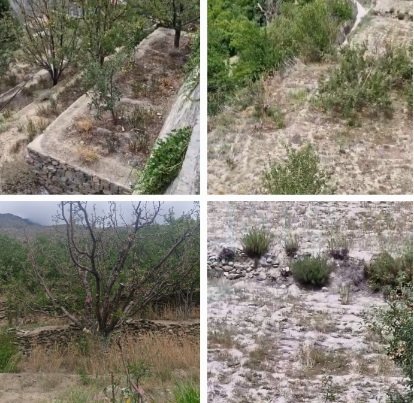
Villagers in Himachal Pradesh's remote Gram Panchayat Pooh are no longer searching for better opportunities—they are hunting for water. Every day they scan the barren mountains, trekking from one spring to another in the hope of finding a trickle. Instead, they encounter dry streambeds strewn with boulders, gravel and hardy sea buckthorn bushes.
A deeper nightmare is unfolding.
The apple orchards that replaced traditional livelihoods such as chilgoza collection, shepherding and cultivation of hardy crops like fafra (buckwheat) are now wilting under what residents describe as the worst drought in living memory. For orchardists, the battle is no longer about saving this year's harvest. It is about saving trees that took 10 to 15 years to reach full bearing.
Far below, the mighty Satluj River thunders through a deep Himalayan gorge. But the villages perched high above remain parched. They can't lift water as it is too sandy and unviable.
The irony is hard to miss.Pooh, one of India's strategically important border settlements, has been declared a Vibrant Village by the Central Government.
Yet its residents have pressed the panic button, warning that climate change is drying up the very springs and glacier-fed streams that sustained life in this cold desert for generations.
The representation, signed by 35 residents of Gram Panchayat Pooh, paints a grim picture. It says the drought has directly and indirectly affected 385 households. Including local residents, Army establishments, GREF personnel, government employees and migrant labourers, nearly 4,000 to 5,000 people depend on the shrinking water resources. However, the local tribal community has been hit the hardest.
The once perennial springs flowing through Pooh, Dubling, Rishi Dogri, Lamche Dogri and adjoining hamlets have fallen silent.
Seasonal streams that carried glacier meltwater down the mountain slopes have turned into lifeless channels of stones and dust.
Residents say the shrinking glaciers and erratic snowfall have broken the natural hydrological cycle that sustained the region.
The memorandum also blames the worsening crisis on damage to the village's only Lift Irrigation Scheme, built under the Pradhan Mantri Krishi Sinchayee Yojana (PMKSY).
According to the villagers, the irrigation infrastructure was damaged during the construction of the Dubling–Rishi Dogri–Lamche Dogri road, disrupting water supply to orchards and agricultural fields. The work is being executed by the CPWD and contract is given to Delhi firm which has further subcontract it to Chandigarh based company Oasis.
The contractor has damaged the scheme dumping debris recklessly in the source of the water scheme. It has damaged the site and breached the water supply.
As an emergency measure, the Panchayat has proposed diverting surplus water from Titang Khad, after meeting the irrigation needs of Dubling, to protect standing apple orchards in Gram Panchayat Pooh until a permanent irrigation system is restored.
In desperation, farmers have begun transporting water through private tankers, both individually and collectively, to save their orchards and feeding the homes.
The exercise has imposed a huge financial burden, yet even the transported water is proving inadequate to keep the trees alive. The company has agreed to set up pump to provide temporary relief, said Panchayat Pradhan Dorje.
"The springs that flowed throughout the year have disappeared. We have never witnessed such a severe water crisis.
The survival of our orchards has become a bigger concern than the crop itself," said Dorje. So is now the case with drinking water problem, he added.
The Panchayat has demanded that the district administration immediately declare Gram Panchayat Pooh a drought-affected area, conduct a joint inspection, restore the damaged irrigation scheme, provide emergency drinking water, compensate affected farmers and extend relief under the District Disaster Management Authority.
The unfolding crisis also raises larger questions for policymakers and planners.
Pooh lies in a fragile cold desert ecosystem with sandy slopes where agriculture depends almost entirely on irrigation from glacier-fed streams.
As snowfall declines and glaciers retreat, experts increasingly warn that water availability may become less reliable.
Against that backdrop, the long-term sustainability of expanding water-intensive horticulture in the sandy region is likely to become an important policy debate, even as apple cultivation remains the principal source of income for local families today.
The representation has now reached the district administration. Villagers, however, say they are still waiting for an urgent response.
They also hope the issue receives attention from the state government, including Revenue Minister and Kinnaur MLA Jagat Singh Negi, as they seek immediate intervention before the drought causes irreversible damage to orchards, livelihoods and one of Himachal Pradesh's most fragile Himalayan ecosystems.
They have also marked representation to Chief Minister Sukhvinder Singh Sukhu and HPSDMA through ADM Pooh seeking immediate attention.
#ClimateChange
#Kinnaur #Pooh
#WaterCrisis
RESPONSES: There were thick cover of Juniper trees at above Tinku nallah before Pooh which have been replaced by apples...the huge Tinku glacier of the nineties through which a tunnel was made in Late March for traffic has now completly vanished.
-Dr VANEET JISHTU, FORMER FIELD BOTANIST HFRI, SHIMLA.