
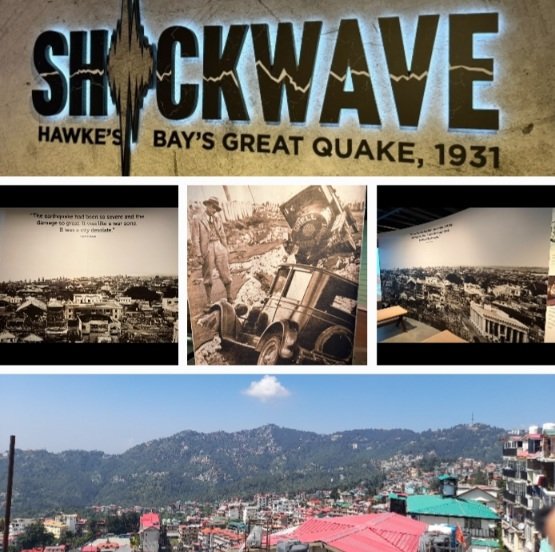
In this travel log, a military veteran and writer draws from a recent visit to New Zealand’s Art Deco Earthquake Museum in Napier. Bridging this rich experience with Shimla’s reality, Major General Atul Kaushik (Retd.), SM, VSM shares urgent, hard-won lessons to warn policymakers and residents of the catastrophic seismic risks looming over the Himalayan capital.
WELLINGTON/SHIMLA:
Standing before the Shockwave exhibit at Napier — reading how a 7.8-magnitude quake flattened Hawke's Bay in ninety seconds on 3 February 1931, killing 256 people and reducing Napier and Hastings to what one survivor called "a war zone" — it's hard not to think of Shimla.
New Zealand rebuilt Napier in Art Deco style and turned its tragedy into a permanent public memory. Himachal Pradesh has had no such reckoning, even though the science says it should.
A Shared Tectonic Inheritance
Napier's earthquake happened because the Pacific Plate subducts beneath the Australian Plate along the Hikurangi Trough — a boundary capable, as the museum panels note, of a magnitude-9 event, with roughly a one-in-four chance of a major rupture in the next fifty years.
Himachal Pradesh sits on a different but comparably restless boundary: the continuing collision of the Indian and Eurasian plates that built the Himalaya itself.
The region's own "1931" already happened, and worse: on 4 April 1905, a magnitude-7.8 earthquake struck the Kangra Valley, flattening towns and villages across the region and remaining one of the deadliest earthquakes in Indian history. Along with 1905, the belt has produced the 1991 Uttarkashi and 1999 Chamoli earthquakes, both causing extensive damage to infrastructure and loss of life.
The Zoning Has Only Gotten Worse
Himachal Pradesh's official hazard classification has moved in one direction — up. Under the earlier seismic code, seven of the state's twelve districts sat in Zone V, the most severe category, with the remaining five in high-hazard Zone IV.
Districts such as Kangra, Mandi, and Hamirpur have 90–98% of their area rated liable to the severest design intensity, MSK IX or greater. The Bureau of Indian Standards has since placed the entire state in Zone V, with disaster authorities warning the state could experience earthquakes up to magnitude 8.0.
A newer probabilistic hazard map goes further still, placing the entire Himalayan arc — Himachal Pradesh, Shimla and Dharamshala named specifically — into a new top category, Zone VI.
Shimla Specifically: Geology Meeting Policy Failure
What makes Shimla's case sharper than most is that hazard is compounded by decades of construction on ground never meant to bear it.
An NGT-appointed expert committee found most buildings unsafe and built on slopes exceeding 70 degrees, requiring heavy contour-cutting that also makes the land landslide-prone. The committee called for identifying and demolishing, relocating, or reconstructing buildings that ignored seismic sensitivity and load-bearing capacity within five to ten years.
Shimla was built by the British for a population of about 30,000 and now holds roughly 2.75 lakh people.
The NGT's Intervention, in Detail
The litigation runs through a single case: Yogendra Mohan Sengupta v. State of Himachal Pradesh, Original Application No. 121 of 2014, before the NGT's Principal Bench in New Delhi. Sengupta had originally sought protection of Shimla's green belts and enforcement of forest-clearance requirements; the Tribunal expanded the matter on its own motion into a full inquiry on the city's construction practices.
16 November 2017 — The First Order
A bench headed by NGT Chairperson Justice Swatanter Kumar, in a 145-page judgment, prohibited new construction of any kind — residential, institutional, or commercial — in the core, green-belt, and forest areas of the Shimla Planning Area, and capped construction elsewhere in the Planning Area at two floors plus a habitable attic. It barred regularisation of existing illegal or unauthorised construction and proposed heavy penalties and environmental compensation for any such regularisation. Public-utility buildings — hospitals, schools, essential-service offices — were exempted.
The Tribunal held that allowing construction in ecologically fragile areas violated the sustainable development and precautionary principles and the public trust doctrine. It warned that unplanned, indiscriminate development across the core, non-core, green, and rural parts of the Planning Area was increasing Shimla's vulnerability to both man-made and natural disasters — earthquakes explicitly among them. The order directed the state to finalise a proper Development Plan within three months, incorporating the Tribunal's precautions.
16 July 2018
The state's review application against the order was dismissed.
February–April 2022
The state government instead published a Draft Shimla Development Plan ("Vision 2041"), notified 16 April 2022, proposing to reopen 17 green belts and the core area to regulated construction — up to two floors with attic and parking in core areas, three storeys elsewhere. Sengupta challenged it in a fresh application, OA No. 297 of 2022.
12 May 2022 and 14 October 2022
The NGT first stayed, then formally set aside the draft plan, calling it illegal and in direct conflict with the 2017 order, and noting the state's own Section 26 liability under the NGT Act for defying binding directions.
11 January 2024 — The Supreme Court Reverses Course
On appeal, the Supreme Court (Justices B.R. Gavai and Aravind Kumar) held that the NGT had exceeded its jurisdiction by dictating the specific content of a state development plan — a quasi-legislative function under the Himachal Pradesh Town & Country Planning Act, 1977. The Court approved the Shimla Development Plan 2041 (as notified 23 June 2023) as "balanced," effectively lifting the 2017 floor cap and the core/green-belt construction ban.
The Legal Legacy
The net effect: the single strongest legal instrument recognising Shimla's seismic and disaster vulnerability — a Tribunal finding on record for over six years — has now been set aside on jurisdictional grounds, not on any finding that the underlying risk assessment was wrong.
The hazard classification has only risen since 2017; the construction restriction responding to it has been removed.
The Missing Layer: Structure-by-Structure Vulnerability Data
Everything above describes aggregate risk — zone classification, slope percentages, population overshoot. What is still absent is structure-level data: which of Shimla's tens of thousands of buildings can actually survive the shaking their zone predicts, and which cannot.
The standard method is two-stage: a Rapid Visual Screening (RVS) of every building — scored in minutes against known collapse indicators (soft storeys, vertical irregularity, pounding gaps, unreinforced masonry, slope-cut foundations, construction era) — followed by detailed structural evaluation of buildings RVS flags high-risk, producing a binding classification of safe, retrofit, or demolish/rebuild.
This is precisely what the 2017 NGT committee gestured toward when it called for identifying buildings that ignored seismic sensitivity and load-bearing capacity — but a call for identification is not a completed, published inventory. The mandated safety audit of lifeline buildings (hospitals, schools, fire stations) has reportedly sat pending for five years.
Without this layer, the Supreme Court's "balanced" development plan, the NGT's original ban, and every future zoning decision are all being made blind to which buildings will actually fail.
Napier's Lesson, and Shimla's Choice
New Zealand's museum does not just document 1931; it teaches Drop-Cover-Hold, insurance checks, and evacuation triggers as routine civic knowledge, and Hawke's Bay rebuilt with earthquake engineering as its organising principle.
Himachal Pradesh has the geological warning, the rising code classification, direct historical proof since 1905, and — for six years — had a binding legal instrument responding to it. That instrument has now been set aside on a technicality of jurisdiction.
What was never built, in all that time, is the one thing that would make any future order enforceable: a public, building-by-building record of who is actually at risk.