
₹34,000 for a Super-Specialist: Sukhu Government Under Fire Over ‘Double Speak’ on Doctors’ Pay. Plumber earns more than a super-specialist in Himachal!
SHIMLA, AUGUST 7: The Sukhvinder Singh Sukhu government is facing mounting criticism over the remuneration being offered to a super-specialist doctor at the Atal Institute of Medical Super Specialities (AIMSS), Chamiana, with the medical fraternity questioning the stark gap between the government's public announcements and what its own appointment orders actually deliver.
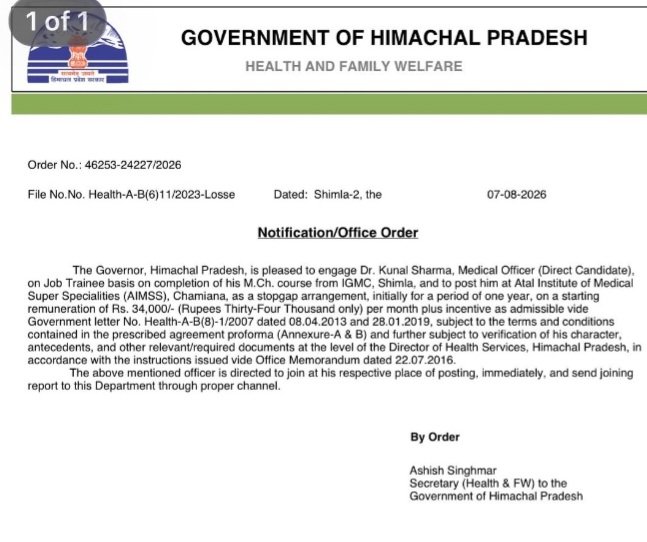
An official appointment order issued by the Health and Family Welfare Department on August 7, 2026, appoints Dr Kunal Sharma, Medical Officer (Direct Candidate), after completion of his M.Ch. course from IGMC Shimla, on a Job Trainee basis at AIMSS Chamiana.
The order, signed by Health Secretary Ashish Singhmar, fixes his remuneration at just ₹34,000 per month, plus admissible incentives.
The order has triggered strong concern among members of the Himachal Pradesh Medical Officers Association (HPMOA), who say the appointment raises serious questions about how the state values highly qualified medical professionals.
12 years of medical education, ₹34,000 a month
A super-specialist reaches this stage after years of rigorous medical education and training—MBBS, postgraduate qualification and a further three years of super-specialisation. In effect, it represents roughly 12 years of continuous study and specialised training.
Yet the government order offers ₹34,000 a month.
Members of HPMOA point out that this translates to approximately ₹1,133 per day, a figure they say is completely out of proportion to the qualification, responsibility and expertise expected from a super-specialist.
The issue becomes even more glaring in the context of the government's recent announcement of a 78 per cent hike in the salary of Job Trainee Medical Officers (Specialists), taking it from ₹26,340 to ₹60,000 per month.
What the government says—and what its order says
The latest appointment order has brought the government's policy on specialist remuneration under scrutiny.
On one hand, the government has publicly projected higher remuneration as a major initiative to attract and retain specialist doctors in Himachal Pradesh.
On the other, an official order issued by its own Health Department places an M.Ch.-qualified doctor at ₹34,000 per month.
This has led to a pointed question from the medical fraternity:
Which figure represents the government's real valuation of specialist doctors—the ₹60,000 announced publicly or the ₹34,000 mentioned in the appointment order?
Paltry pay driving doctors out of Himachal
HPMOA members say the issue goes far beyond one appointment.
They maintain that poor remuneration in government institutions is one of the principal reasons qualified and experienced doctors are leaving Himachal Pradesh for better-paying private hospitals, institutions and opportunities outside the state.
The result, they warn, is a continuing loss of the very human resources that Himachal needs to strengthen its public healthcare system.
Doctors who undergo years of specialised training have increasingly better opportunities outside the state. When government institutions fail to offer competitive salaries and professional incentives, retaining a highly qualified doctor becomes increasingly difficult.
For a hill state that already faces challenges in attracting and retaining specialists, HPMOA members say such remuneration can send precisely the wrong signal.
AIMSS needs specialists, not just infrastructure
The controversy also puts the spotlight on AIMSS Chamiana, which was established as a major centre for advanced healthcare in Himachal.
Members of the medical fraternity argue that a super-speciality hospital cannot become a centre of excellence merely by creating buildings and equipment.
It needs super-specialists—and the government must be prepared to pay them commensurate with their qualifications and responsibilities.
The concern is that if the state continues to offer comparatively low remuneration, its best doctors will naturally gravitate towards institutions offering better professional and financial prospects.
Government now faces uncomfortable questions
The appointment order is a formal government document, not an informal claim. The Health Department will therefore face questions over why an M.Ch.-qualified doctor appointed at a super-speciality institution has been offered ₹34,000 per month, particularly when the government has recently announced a substantially higher remuneration package for specialist Job Trainee Medical Officers.
The government will need to clarify whether the ₹60,000 revised remuneration applies to such super-specialists, and if not, why.
For HPMOA members, the larger issue is clear: if Himachal wants to build world-class public healthcare, it cannot expect world-class specialists to work for salaries that drive them towards better-paid institutions elsewhere.
The ₹34,000 appointment order has therefore opened a much bigger debate—not merely over one doctor's salary, but over the government's ability to retain the medical talent Himachal itself has trained.
#HimachalPradesh #SukhuGovernment #MedicalFraternity #AIMSSChamiana