
Rakhigarhi Excavations Offer Clues to Evolution of Bharatiya Knowledge System: Archaeologist Vasant Shinde
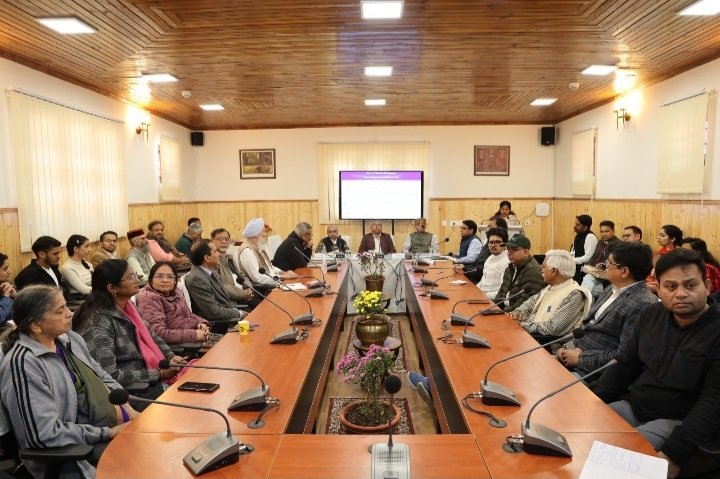
SHIMLA, October 12: Eminent archaeologist and former Vice-Chancellor of Deccan College Post-Graduate and Research Institute, Pune, Prof. Vasant Shinde, delivered a special lecture on the evolution of the Bharatiya Knowledge System, drawing on the archaeological perspective of Rakhigarhi, an important Harappan civilisation site, at the Indian Institute of Advanced Study (IIAS), Rashtrapati Niwas, Shimla, on Monday.
The lecture, titled “Evolution of Bharatiya Knowledge System: Archaeological Perspective with Special Reference to Rakhigarhi”, formed part of the second day of the Institute’s Diamond Jubilee Week celebrations. The session was chaired by IIAS Director Prof. Himanshu Kumar Chaturvedi.
Shinde’s lecture focused on the role of archaeological evidence in understanding ancient societies and the development of knowledge traditions. Rakhigarhi provided the principal reference for examining how excavated remains, settlement patterns, artefacts and material culture can help reconstruct the technological capabilities, social organisation and cultural practices of early communities.
The archaeological perspective also broadens the study of knowledge beyond written texts. Material remains, when examined alongside literary and historical sources, can help researchers understand how ancient communities lived, organised their settlements and developed their cultural practices.
The study of Rakhigarhi is particularly relevant to research on the urban civilisation of the Indian subcontinent. Archaeological investigations at such sites enable scholars to examine the development of ancient settlements and place material evidence within wider historical contexts.
Interdisciplinary approach to India's past
The session underlined the importance of bringing archaeology and history together to develop a more comprehensive understanding of India's civilisational past. Archaeological interpretations remain open to refinement as new evidence emerges and research methods advance.
Prof. Pramod P. Joglekar, Fellow at IIAS, welcomed the gathering and introduced the speaker. Shinde was subsequently felicitated, after which Prof. Chaturvedi delivered the chair’s address.
Art exhibition and book fair continue until October 15
The Diamond Jubilee Week, being observed from October 11 to 15, also features an art exhibition, “Bharatiya Forms, Expressions and Consciousness”, showcasing works by artist Nisha Jaiswal.
Inaugurated by Padma Shri Shovana Narayan on October 11, the exhibition explores Indian epics, traditional artistic forms and cultural consciousness.
The exhibition is open at the Rabindranath Tagore Art Gallery, near the Pool Theatre, from 11 am to 7 pm daily until October 15. Entry is free, with visitors exempted from the regular entry ticket.
A book fair, inaugurated by Prof. Raghuvendra Tanwar and Prof. Reicha Tanwar on October 11, is also running at Rashtrapati Niwas.
It features academic publications and books from national and international publishers and remains open from 11 am to 7 pm until October 15, with free entry.
The programme on October 13 will feature a lecture on “Vande Mataram” by Akhilesh Jha of the Indian Civil Accounts Service, Ministry of Rural Development, Government of India.
The concluding day, October 15, will feature the unveiling of a bust of Dr. Sarvepalli Radhakrishnan, the inauguration of an art gallery dedicated to Kangra Miniatures, a book release and cultural programmes.