

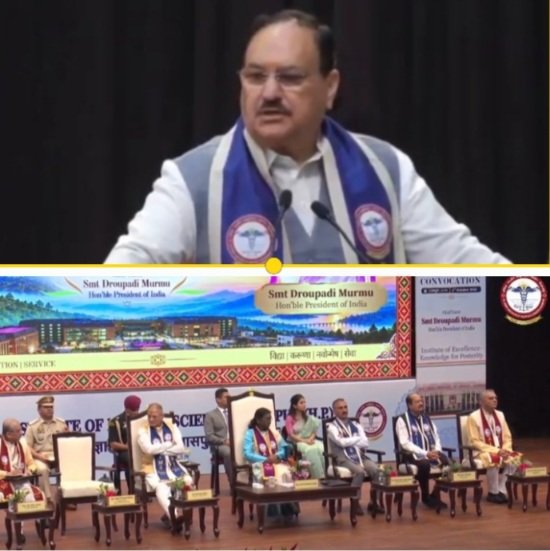
Nadda Sets Two-Year Challenge for AIIMS Bilaspur, Says Institute Must Compete With Established AIIMS
BILASPUR: Union Health and Family Welfare Minister Jagat Prakash Nadda has set an ambitious two-year challenge for the relatively young AIIMS Bilaspur, saying the institute should be capable of competing with established AIIMS institutions within the next two to three years.
Addressing the first convocation of AIIMS Bilaspur here on Tuesday, Nadda said the institute had expanded rapidly despite being established only recently and credited its faculty and administration for pushing beyond the original targets.
“I am happy to say that AIIMS Bilaspur now has 776 beds against the target of 750. We have crossed the target,” Nadda said.
He said the institute currently offers 26 specialties and 15 super-specialties, with facilities for complex surgical procedures, cardiac catheterisation laboratory interventions, neurosurgery, comprehensive cancer care and a fully functional radiotherapy department.
Nadda said these capabilities had been developed within about five years, calling the pace of expansion significant and congratulating the AIIMS faculty and administration.
The minister said the institute had also crossed 12 lakh OPD consultations and one lakh IPD admissions in four years, which, according to him, reflected the pace at which AIIMS Bilaspur was expanding its healthcare services.
However, Nadda also acknowledged the challenge facing a new institution. Established medical institutions take years to build their faculty, systems and reputation, he said, but AIIMS Bilaspur was moving faster than the conventional timeline.
“An institute takes at least ten years to establish itself and it takes time to build a faculty,” Nadda said, expressing confidence that AIIMS Bilaspur would be able to compete with any other AIIMS within the next two to three years.
His remarks effectively put the young institute on notice: rapid infrastructure expansion will now have to be matched by academic excellence, specialist services, research and patient care.
Turning to the graduating students, Nadda said professional medical education should not be viewed as an entitlement.
“Primary education can be a birthright, secondary education can be a birthright, school education can be a birthright, but professional education is not a birthright. It is a privilege,” he said.
Nadda said the government was investing heavily in expanding medical education, referring to the Centre's decision to support the creation of additional MBBS and postgraduate seats by 2029.
He told the graduating doctors that such public investment imposed a corresponding responsibility on them to serve society.
“You have been fortunate to receive education at an All India Institute of Medical Sciences,” Nadda said, urging the graduates to use the opportunity with “high dedication”.
He specifically highlighted the advantage of studying at AIIMS Bilaspur amid Himachal Pradesh’s natural environment and urged the graduates to protect and strengthen the reputation of the AIIMS brand wherever they serve.
Nadda said he expected the young doctors to provide high-quality healthcare and work for humanity, while carrying forward the direction and values articulated by President Droupadi Murmu at the historic first convocation.
Chief Minister Sukhvinder Singh Sukhu said theb.Medical colleges in Himachal Pradesh are being transformed with advanced facilities such as 3 Tesla MRI, PET scans, high-end X-rays, ultrasound and robotic surgery.
Arrangements for nearly 500 robotic surgeons have been completed, while expanded diagnostic, cancer and super-specialty services are bringing advanced treatment closer to common and poor families.
"The state had only 277 PG seats earlier; we are now working to add 320 more. I urge Union Health Minister J.P. Nadda Ji to support Himachal Pradesh’s efforts to expand medical education, strengthen healthcare infrastructure and ensure better treatment for the people of the state.”
The first convocation thus became more than a graduation ceremony for AIIMS Bilaspur. It also marked a performance benchmark for an institute that has crossed its initial infrastructure and patient-care targets but is now being expected to translate that rapid growth into institutional excellence.
#AIIMSBilaspur #JPNadda #HimachalPradesh #Healthcare