
FSSAI Cracks Down on Contaminating Masala Makers Across the Nation
SHIMLA / NEW DELHI — A regulatory crackdown by the Food Safety and Standards Authority of India (FSSAI) has flagged toxic pesticide levels in packaged chilli powder, triggering prosecution against M/s Vasant Masala Private Limited and sparking fresh food-safety concerns across Himachal Pradesh, Uttarakhand, and the Himalayan belt.
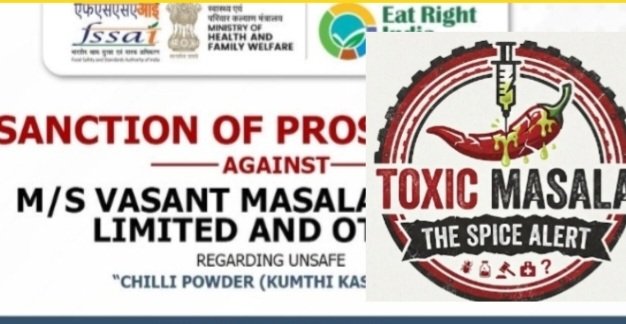
According to an official FSSAI notice accessed by HimbuMail, a regulatory sample of "Chilli Powder (Kumthi Kashmiri)" lifted from M/s Vasant Masala Private Limited failed safety standards after laboratory testing detected Difenoconazole—a chemical fungicide—exceeding the maximum permitted limit under the Food Safety and Standards (Contaminants, Toxins and Residues) Regulations, 2011.
When the food business operator appealed the initial test, the sample was sent to a Referral Food Laboratory.
The referral lab confirmed the product as unsafe, prompting FSSAI to sanction prosecution against M/s Vasant Masala Private Limited and others under the Food Safety and Standards Act, 2006.
The findings carry acute urgency for households across Himachal Pradesh, Uttarakhand, Jammu & Kashmir, Ladakh, Sikkim, and the Northeast.
Because mountain states rely heavily on packaged spices transported from outside the hills—and consume chilli and masala daily to combat harsh winters—contaminated batches pose an immediate, recurring health risk in local kitchens and roadside eateries alike.
What makes the crisis even more alarming in the hills is the near-total absence of active consumer rights groups, leaving buyers vulnerable in an often lawless market where few have the resources or backing to drag powerful mirch-masala manufacturers before consumer courts.
Without organized local watchdogs or sustained legal pushback, accountability remains dangerously weak—making strict regulatory vigilance and public awareness vital.
While the FSSAI notice confirms legal prosecution, it does not disclose specific batch numbers or distribution routes, leaving consumers and state food-safety wings in the hills racing to identify whether tainted packets have already reached local markets.
Meanwhile, state food safety and health regulatory authorities in Shimla, Dehradun, Srinagar, and Ladakh remain conspicuously inactive, rarely lifting samples or placing test findings in the public domain even during peak festive rushes like Diwali.
As quick-commerce and home-delivery giants such as Blinkit and Swiggy and others—alongside mushrooming shopping malls and departmental stores—sweep across hill towns including Shimla, Dharamshala, Kullu, Mandi, Dehradun, Nainital, and Srinagar, food safety officers have largely failed to inspect dark stores or retail shelves and their warehouses.
Consumers say this glaring inaction raises serious questions about how regulatory officials justify their jobs and whether lax enforcement amounts to virtual connivance with major retail and delivery players.
Until batch-level recalls and heightened border sampling are enforced, buyers are urged to scrutinize FSSAI license numbers, avoid loose or unlabelled spice packs, and report suspect products to state food-safety authorities.
#FSSAI #FoodSafetyIndia #PesticideAlert #HimachalPradesh #Uttarakhand