
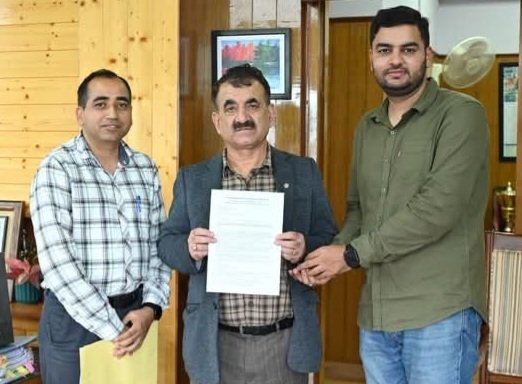
HPU Microbial Research Takes Himalayan Climate Solution to Germany
SHIMLA: Himalayan microbes could offer a low-carbon tool to tackle pollution in a warming world. Himachal Pradesh University (HPU) researcher Aditya Sharma, Senior Research Fellow in the Department of Biotechnology, will present his work on Climate-Smart Bioremediation at the international conference CBC2026 – Connecting Biodiversity, Climate, and Human Behaviour in Leipzig, Germany, from September 21 to 24.
Sharma has received an International Travel Support grant from the Anusandhan National Research Foundation (ANRF) to present the research at the global forum organised by the Helmholtz Centre for Environmental Research (UFZ) and Leipzig University.
Turning microbes into pollution fighters
Bioremediation uses naturally occurring microorganisms—particularly bacteria and fungi—to break down, transform or neutralise pollutants in soil and water.
Sharma's research adds a climate dimension: instead of relying entirely on energy-intensive excavation, chemical treatment or other conventional remediation methods, scientists can explore biological systems that potentially require less energy and generate less secondary pollution.
The concept is particularly relevant as climate change is simultaneously increasing environmental stress and making conventional, resource-intensive solutions harder to sustain.
Why the Himalayas are important
The Himalayan environment is home to microbial communities adapted to cold temperatures, high UV exposure, limited nutrients and extreme environmental fluctuations.
These adaptations make Himalayan microbes scientifically valuable. Researchers can identify microorganisms with useful metabolic abilities and investigate whether they can degrade pollutants or function effectively under changing environmental conditions.
The potential applications range from contaminated soil and wastewater treatment to restoration of degraded ecosystems, particularly in environmentally fragile mountain regions.
But the research is not about releasing microbes indiscriminately into nature. Any practical application would require laboratory validation, toxicity testing, field trials and ecological-safety assessment.
A climate-change solution, not a silver bullet
Climate change is altering temperature, rainfall, soil moisture and ecosystems while pollution continues to put additional pressure on natural systems.
Climate-smart bioremediation seeks to address both challenges by making environmental cleanup more biological, locally adaptable and potentially less carbon-intensive.
Microbes already drive critical natural processes such as decomposition, nutrient cycling and carbon transformation. Harnessing these capabilities could strengthen ecosystem restoration while reducing dependence on high-energy remediation technologies.
The approach cannot solve climate change on its own, but it could become an important tool in the larger transition towards low-carbon pollution control and nature-based environmental management.
Himalayan biodiversity under the microscope
The research also puts the spotlight on the largely unexplored microbial biodiversity of the Himalayas.
While the region is celebrated for its forests, wildlife and plant diversity, its microscopic life forms remain comparatively less studied. Their ability to survive extreme conditions could hold valuable clues for developing environmental technologies suited to a changing climate.
HPU Vice-Chancellor Prof. Mahavir Singh congratulated Sharma and his supervisor Dr. Ravi Kant Bhatia, Assistant Professor, Department of Biotechnology, and stressed the need to responsibly explore Himalayan biological resources for sustainable development.
Sharma's presentation at CBC2026 will therefore take a distinctly Himalayan research question to a global platform: can nature's own microorganisms help clean polluted environments while keeping the climate cost of remediation down?
That is the promise—and the scientific challenge—behind climate-smart bioremediation.
#HPU #HimalayanResearch #Bioremediation #ClimateChange