
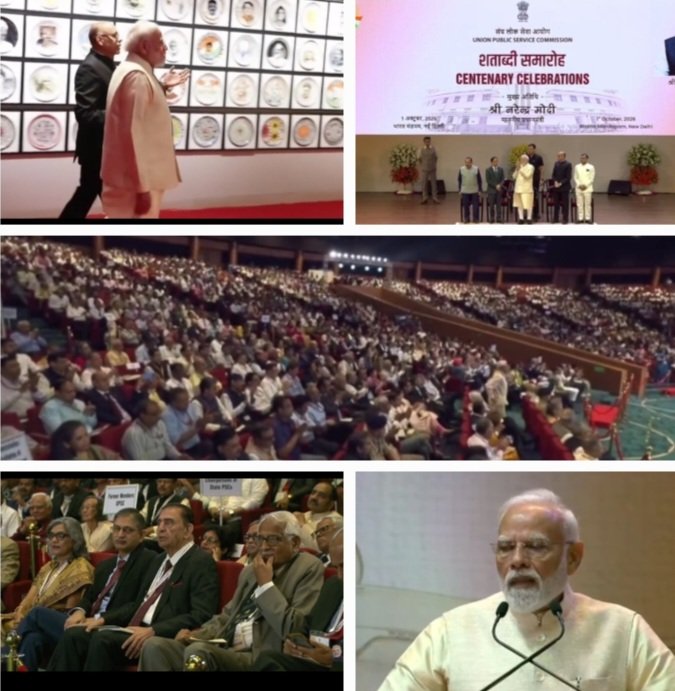
UPSC at 100: Nation First, Citizen First — The Test of Trust Begins With Fair Selection
NEW DELHI/SHIMLA: From Sardar Vallabhbhai Patel’s “steel frame of India” to an era of artificial intelligence, the Union Public Service Commission (UPSC) has travelled a century—but its fundamental test remains unchanged: finding the right people for the right public responsibilities while protecting merit, fairness and public trust.
As the UPSC completes 100 years, Prime Minister Narendra Modi has put “Nation First” and “Citizen First” at the centre of the next phase of civil-service recruitment, arguing that the officers selected today will be responsible for governing an India that will be markedly different by 2047.
The transformation is visible in the numbers.
When the first Public Service Commission was established on October 1, 1926, it was an advisory body whose members were appointed under the British system. It subsequently evolved into an independent constitutional institution under Articles 315 to 323 of the Constitution.
The scale of the examination system has expanded dramatically. Applications across UPSC examinations and recruitment by selection rose from 42,727 in 1950-51 to 45.10 lakh in 2022-23, a more than hundred-fold increase.
Examination centres have expanded from just eight in 1950 to 86 in 2026.
The social composition of the civil-service candidate pool has changed just as sharply.
In the Civil Services Examination of 1952, only 3 of the 83 recommended candidates were women. In CSE 2025, women accounted for 299 of 958 recommended candidates—31.2 per cent. The latest cohort also saw women secure 11 of the top 25 ranks.
The change is not confined to gender. UPSC data shows that the number of SC candidates recommended through CSE rose from 9 in 1955 to 158 in 2025, while ST recommendations increased from 2 in 1956-57 to 73 in 2025.
The Commission says the figures reflect a much wider reach of public-service recruitment across social and geographical backgrounds.
The journey of women within the institution itself has also been gradual. Kiran Bedi became the first woman selected by the Commission for the Indian Police Service in 1972, when she was the only woman among 80 vacancies.
Two decades later, Rose Millian Bathew Kharbuli became the first woman Chairperson of UPSC in 1992. Rajni Razdan became the second woman to head the Commission in 2014.
The institution's present composition also reflects that evolution. UPSC currently has three women among its eight members, according to its centenary backgrounder.
But the biggest transformation may now be technological.
The UPSC that once relied on paper-based examinations has moved through OMR, computer-based recruitment tests, online applications and digital candidate services to AI-assisted facial authentication and cybersecurity systems.
In the 2026 Civil Services Preliminary Examination, AI-based facial authentication was implemented at scale for around 5.5 lakh candidates, with authentication taking approximately six to eight seconds per candidate.
That transition creates a new responsibility. Technology can make recruitment faster and more secure, but it cannot itself guarantee fairness.
The credibility of the system will still depend on how transparently technology is deployed, how candidate data is protected, how errors are addressed and whether every aspirant has a meaningful opportunity to challenge an administrative or technical mistake.
This is where the Prime Minister’s “Nation First, Citizen First” formulation acquires significance.
The future civil servant, Modi has argued, cannot be selected only on the basis of what he or she knows. Recruitment must also examine motivation, judgement, problem-solving ability, innovation, sensitivity and the capacity to work in an increasingly complex environment shaped by AI, climate change, technology and rising citizen expectations.
UPSC Chairman Dr Ajay Kumar has similarly identified Trust, Transparency and Technology as the three guiding principles for the Commission's next phase. He has stressed the need to assess reasoning, spontaneous thinking and judgement in ambiguous situations rather than the ability to reproduce coached answers.
For candidates, however, trust is ultimately built through the mechanics of an examination.
A secure question paper, a predictable examination calendar, transparent evaluation, timely results, accessible grievance mechanisms and an opportunity to challenge errors matter as much to an aspirant as the constitutional status of the Commission.
The same standards need to influence State Public Service Commissions. The UPSC centenary should become an opportunity for state commissions to systematically adopt proven practices in examination security, digital applications, candidate authentication, answer-key transparency, accessibility, grievance redressal and time-bound recruitment.
Their institutional independence is equally important. Public-service commissions must be seen to operate through transparent rules and objective procedures, insulated from perceptions of political influence, preferential treatment or bias.
Public confidence cannot survive if candidates believe that influence rather than merit can affect recruitment.
UPSC's own evolution demonstrates why institutional reform cannot stop.
Its journey has moved from a colonial recruitment structure to a constitutional institution, from eight examination centres to 86, from three women recommended in 1952 to 299 in the 2025 Civil Services Examination, and from paper-based processes to AI-enabled examination security.
The challenge of the next century is therefore not simply to preserve the “steel frame” but to make that frame fit for an India of artificial intelligence, mass digital participation and unprecedented youth aspirations.
The question before UPSC at 100 is no longer whether the institution can survive another century.
It is whether it can remain trusted, independent, transparent and merit-driven while continuously changing with the nation it serves.Yes.
There is, however, another difficult question that cannot be left outside the centenary debate: whether the recruitment process can better assess integrity, ethical judgement and character alongside knowledge and administrative ability.
The issue has acquired greater public attention because officers from different states and services have, from time to time, been arrested or investigated in alleged corruption cases, including cases involving agencies such as the CBI, ED and state anti-corruption bodies.
Such cases concern individual officers and should not be generalised to the civil services as a whole, but they inevitably raise questions about how effectively integrity and ethical conduct can be assessed, monitored and reinforced throughout a public servant's career.
For an institution entrusted with identifying the country's future administrators, selecting candidates who can withstand pressure, resist inducements and uphold public interest is as important as testing their knowledge.
The UPSC cannot, of course, guarantee the conduct of an officer decades after selection. Integrity is ultimately tested in office, where power, discretion, public money and political and administrative pressures intersect.
But the centenary provides an opportunity to examine whether recruitment, training, probation and subsequent service systems can do more to identify and strengthen ethical decision-making.
This is particularly relevant in the AI era, when technology can make examinations more secure and efficient but cannot substitute for human values.
Technology can verify identity; it cannot certify integrity. An examination can test knowledge; it cannot fully predict character.
That makes the Prime Minister's “Nation First” and “Citizen First” formulation particularly significant. If the purpose of recruitment is to build a public administration capable of delivering good governance, then competence, impartiality, empathy and integrity must remain inseparable from merit.
For UPSC as it enters its second century, the challenge is therefore not merely to find the brightest candidates. It is to strengthen a system that identifies people capable of exercising public power with competence, honesty, restraint and accountability.
That same benchmark should extend to State Public Service Commissions, whose credibility will depend increasingly on their ability to demonstrate that recruitment is based on merit and transparent procedures rather than influence, preference or bias.
And for India's young aspirants, the ultimate measure remains straightforward: Nation First, Citizen First—and merit first in the selection room.
#UPSC #UPSC100Years #CivilServices #Youth #UPSC