
Tree improvement must focus on climate resilience, local species in Himachal and Uttarakhand, Jammu Kashmir and Ladakh For vision 2047..
SHIMLA/DEHRADUN/LEH, AUGUST 21: Research experts from Himachal Pradesh and Uttarakhand have called for a stronger focus on climate-resilient tree varieties, indigenous species and better-quality planting material to improve forest productivity while protecting the fragile Himalayan ecosystem.
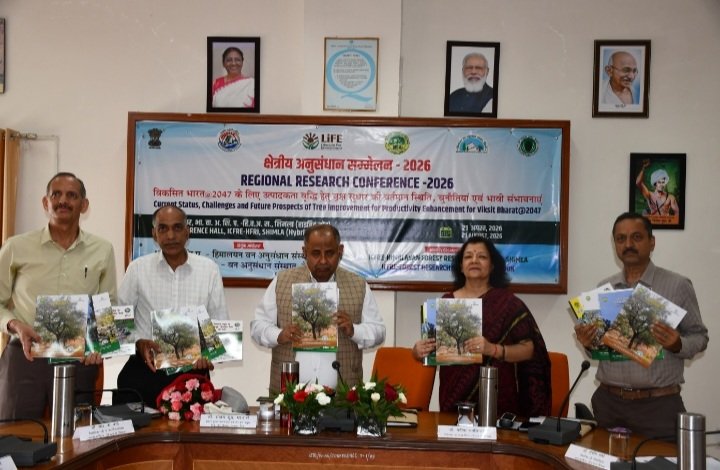
The emphasis came during the Regional Research Conference (RRC)-2026 on “Current Status, Challenges and Future Prospects of Tree Improvement for Productivity Enhancement for Viksit Bharat@2047”, organised by the ICFRE-Himalayan Forest Research Institute (HFRI), Shimla, in collaboration with the ICFRE-Forest Research Institute (FRI), Dehradun.
The main outcome of the discussions was that increasing the number of trees alone will not be enough for the Himalayas.
Trees suited to local soil, altitude and changing weather conditions need to be identified, scientifically improved and propagated through quality planting material.
Experts also stressed that forest research must translate into practical solutions for forests, farmers and local communities.
ICFRE Director General Kanchan Devi said tree improvement programmes should develop forests that can withstand climate change and meet future needs.
She called for studies to understand how different tree varieties perform under different environmental conditions, particularly in the Himalayan region.
She also stressed long-term tree breeding programmes, climate-resilient technologies and the use of Artificial Intelligence (AI) in forestry research.
In simple terms, tree improvement means selecting and developing trees with better qualities such as faster growth, stronger resistance to pests and diseases, better survival and greater ability to withstand changing climatic conditions.
Experts said this work needs to be based on local genetic resources rather than relying excessively on species or planting material that may not suit Himalayan conditions.
PCCF and HoFF Himachal Pradesh Dr Sanjay Sood stressed the importance of protecting both biodiversity and genetic diversity. He advocated greater plantation of traditional and indigenous species that are naturally adapted to local conditions.
The approach, he said, should simultaneously strengthen ecological security and support the livelihoods of people dependent on forests.
The conference also highlighted the need to improve the genetic resources of Himalayan trees.
Genetic resources refer to the naturally occurring variation within tree species that can help scientists identify plants better suited to drought, heat, pests, diseases and other environmental stresses.
Preserving this diversity is particularly important as climate change alters growing conditions across the mountains.
HFRI Director Dr Manisha Thapliyal said the Himalayan ecosystem is facing multiple environmental pressures and requires more practical strategies to increase green cover and improve climate resilience.
She stressed closer coordination among research institutions, universities, forest departments and other organisations so that emerging forestry problems can be identified early and solutions taken to the field.
FRI Dehradun Director Dr Richa Mishra called for modern technologies and long-term, outcome-oriented research.
She said research should not remain confined to laboratories and institutions but should produce solutions that can be effectively used in forests and by communities.
The two technical sessions provided a wider roadmap for the Himalayan states. The first session focused on tree improvement, genetic resources and quality planting material, including better planting material for Western Himalayan forests, biotechnology-based conservation and management of forest genetic resources, and future breeding strategies.
The second session focused directly on climate adaptation, agriculture and sustainable livelihoods.
Experts discussed improving economically important medicinal trees, developing better multipurpose trees, clonal forestry—raising large numbers of genetically similar plants from selected superior trees—and using Himalayan genetic diversity to develop climate-resilient varieties.
For Himachal Pradesh and Uttarakhand, experts also discussed the scope of agroforestry, under which trees are grown along with crops or other farm activities.
Such systems can help rehabilitate degraded land, diversify farm income and improve soil and ecological conditions. Issues related to forestry research in Jammu, Kashmir and Ladakh were also discussed.
The conference also underlined the need to strengthen the link between scientific research and field-level forestry.
Better coordination between forest departments and research institutions could help ensure that improved planting material and new technologies reach plantations, degraded forests and community-based forestry programmes.
Four publications were released during the conference, covering seed production management for Acacia catechu, Quercus leucotrichophora and Betula utilis, besides a publication on the cultivation of important medicinal plants of Himachal Pradesh.
The conference concluded that the future of Himalayan forestry will depend not merely on expanding tree cover but on planting the right trees in the right locations, preserving genetic diversity and developing trees capable of surviving a warmer and more unpredictable climate.
The outcome assumes added importance for Himachal Pradesh and Uttarakhand, where ecological fragility, changing weather patterns and dependence on natural resources make climate-resilient forestry increasingly critical.
#HimachalPradesh #Uttarakhand #HimalayanForests #ClimateResilience