

HFRI Advocates Greening of High-Altitude Cold Deserts to Combat Desertification
Tabo: Scientists are advocating increased vegetation cover in the high-altitude cold deserts of Himachal Pradesh, where vast stretches of barren terrain have traditionally remained devoid of grass, to combat desertification, improve local livelihoods and make the landscape more hospitable.
However, greening these naturally sparse mountain ecosystems also raises questions about how far vegetation expansion should go without altering the region’s natural character and fragile ecological balance.
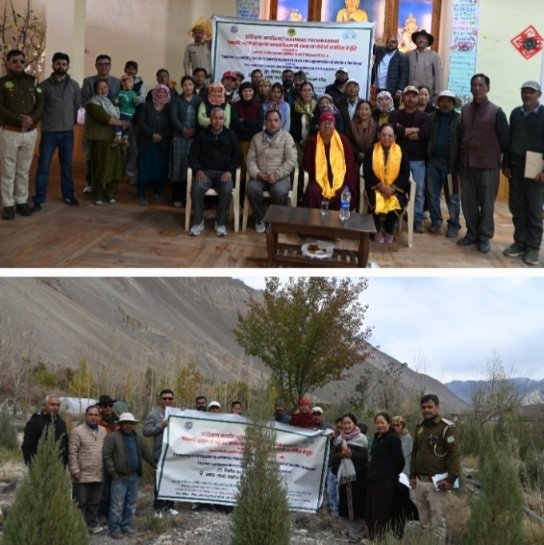
The Himalayan Forest Research Institute (HFRI), Shimla, organised a one-day training programme in Tabo on October 24, bringing together 37 farmers from villages under Tabo gram panchayats to discuss vegetation expansion, land degradation and forestry-based livelihood opportunities.
Dr Ranjeet Kumar, Scientist-F and training coordinator at HFRI, explained the objectives of the institute’s ongoing research project to increase green cover in arid and dry regions through community participation. He discussed the role of Salix, poplar and Chharma in plantation activities, natural resource management and community benefits.
Dr Pawan Kumar, senior scientist at HFRI, highlighted the role of insects in pollinating trees, plants, vegetables and fruit crops in cold-desert ecosystems. He also shared the institute’s research on insect species found in the region.
Juniper, locally known as Shukpa, was another focus of the programme. Dr Sandeep Sharma, retired HFRI scientist, explained its ecological, social and religious significance in cold-desert landscapes. He discussed research on breaking seed dormancy to improve regeneration and noted that natural regeneration of the species was limited. He encouraged farmers to plant juniper to support local communities and conserve the fragile environment.
Senior technical officer Dushyant Kumar explained nursery techniques for cold-desert species and their potential to meet local needs. He stressed that the region’s distinctive ecology required specialised approaches and sustained efforts to expand vegetation cover.
The programme also included a visit to demonstration plantation plots at HFRI’s Regional Research Centre in Tabo, where scientists showcased the growth of Salix, poplar, juniper, Elaeagnus and Rosa webbiana.
The effort to green high-altitude cold deserts brings into focus the need to distinguish ecological restoration from the indiscriminate greening of naturally barren terrain.
While suitable native vegetation can help conserve soil and support local livelihoods, plantation choices must account for the region’s natural ecology so that efforts to increase green cover do not undermine the mountain landscape they seek to protect.
The programme concluded with discussions between scientists and farmers on ecological challenges in cold deserts. Participants shared their feedback and appreciated the training.
#HFRI #HimachalPradesh #ColdDesert #Environment