What Price the ₹5,000 Crore Apple Industry?
SHIMLA: The mountains of Himachal Pradesh are changing colour.
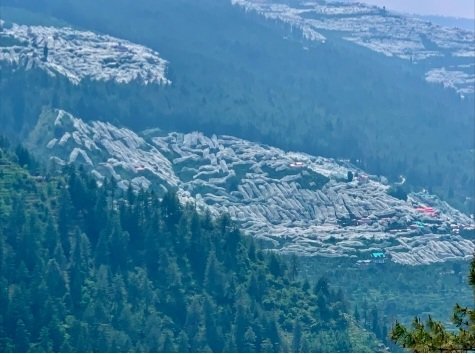
What were once dark green slopes clothed with deodar, fir, kail and ban oak are increasingly turning white under endless stretches of synthetic anti-hail nets. Entire hillsides across Himachal Pradesh — from Kotkhai and Rohru to Jubbal, Chopal and Kinnaur — now appear wrapped in plastic mesh visible from kilometres away.
The transformation is dramatic.
For some, it represents scientific progress and climate adaptation. For others, it is the most visible symbol of the Himalayan ecological crisis — mountains slowly transforming from living forest ecosystems into industrial horticulture landscapes.
At the centre of this transformation stands Himachal’s nearly ₹5,000 crore apple economy, the backbone of mountain livelihoods supporting nearly 2.5 lakh families and sustaining entire regional markets, transport networks and rural economies.
But the uncomfortable question is growing louder in the Himalayas:
What ecological price is being paid for this prosperity?
From Forest Mountains to Orchard Mountains
Apple cultivation changed the destiny of Himachal Pradesh.
Roads reached remote villages. Education levels rose. Rural incomes improved. Thousands of mountain families entered the cash economy. The apple revolution turned upper Shimla into one of India’s most prosperous rural belts.
Yet beneath this economic success lies another story — one written in disappearing forests, fragmented biodiversity and increasingly engineered mountain landscapes.
Across large parts of upper Shimla, mixed Himalayan forests gradually gave way to monoculture apple plantations. Dense ecosystems once dominated by deodar cedar, spruce, fir and ban oak were terraced into commercial orchards.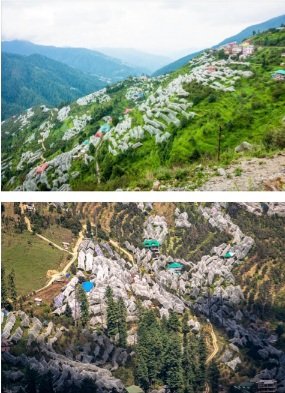
Environmentalists and forest officials have repeatedly alleged that parts of this expansion took place through encroachments onto forest land, often under political protection and administrative silence.
The controversy eventually reached the courts.
The Himachal Pradesh High Court ordered the removal of orchards raised on encroached forest land and directed authorities to restore native forest species in several areas.
Court-monitored reports revealed thousands of encroachment cases linked to commercial horticulture.
In villages like Chaithla in Kotkhai, hundreds of fruit-bearing apple trees were reportedly felled following judicial directions, triggering outrage among orchardists.
But the issue quickly exposed the great Himalayan contradiction.
Ecology Versus Economy — Or Both?
For environmental groups, the issue was straightforward: forests had been illegally cleared for commercial profit.
For orchardists, the reality was far more complicated.
Many farmers argue that orchards planted decades ago now sustain entire generations.
In numerous villages, land boundaries and forest demarcations remained historically unclear, with cultivation expanding gradually over time without formal ownership documentation.
When eviction and felling drives began, protests erupted across Himachal Pradesh.
Ironically, both sides invoked environmental protection.
One side argued forests were destroyed for commercial monoculture.
The other warned that indiscriminate removal of mature orchards could destabilise fragile mountain slopes, trigger landslides and accelerate soil erosion in already climate-stressed regions.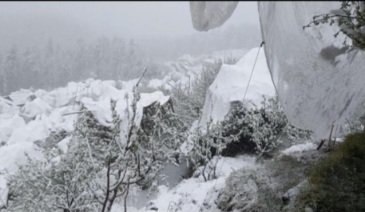
The Supreme Court of India later stayed portions of the High Court order, particularly warning against large-scale felling during the monsoon season.
This is the paradox modern Himachal now faces:
The same apple orchards accused of replacing forests are also seen by many as stabilising fragile slopes and sustaining mountain communities.
The White Nets and the Industrialisation of the Himalayas
The anti-hail nets now spreading across Himachal’s mountains are not merely agricultural tools.
They symbolise a much deeper transformation.
Traditional Himalayan landscapes once functioned as interconnected ecological systems — dense forests, perennial springs, mixed farming, seasonal grazing routes, bird habitats and biodiversity corridors existing together.
Today, many mountain regions increasingly resemble industrial production zones designed for market efficiency.
The transformation includes:
-
terraced monoculture orchards,
-
synthetic anti-hail netting,
-
drip irrigation systems,
-
chemical-intensive spraying,
-
road blasting and hill cutting,
-
cold storage chains,
-
imported rootstocks and high-density plantations,
-
and massive packaging infrastructure.
The visual impact alone is extraordinary. Entire valleys now appear draped in white mesh.
Critics argue these nets are altering not just the appearance of the Himalayas but also local ecology itself — affecting bird movement, pollinator patterns, sunlight penetration, microclimates and the cultural identity of mountain landscapes.
The Himalayas are slowly being converted into controlled agricultural infrastructure.
The Chemical Mountains
Another rarely discussed dimension is chemical dependence.
Modern commercial apple cultivation increasingly relies on repeated spraying of fungicides, pesticides, herbicides and growth regulators to produce market-perfect fruit.
The pressures of global competition and changing climate conditions have intensified chemical usage across many orchards.
Environmentalists warn that long-term exposure may affect:
-
pollinators like bees,
-
soil microorganisms,
-
mountain springs and groundwater,
-
biodiversity,
-
and even human health in horticulture regions.
Ironically, as commercial horticulture expands, traditional mixed mountain farming systems are steadily disappearing.
Climate Change Has Changed the Rules
Yet blaming orchardists alone ignores a larger truth.
Climate change has fundamentally altered Himalayan agriculture.
Warmer winters, declining chilling hours, erratic snowfall, sudden hailstorms, frost damage and prolonged dry spells are making traditional apple cultivation increasingly uncertain.
Growers are investing in anti-hail nets, imported varieties and high-density plantations not merely for profit, but for survival.
The white nets over the Himalayas are therefore both:
-
symbols of ecological pressure,
-
and symbols of climatic desperation.
Farmers who once depended on predictable snowfall and stable seasons now face weather extremes that can wipe out an entire year’s income within minutes.
What Future for the Himalayas?
The debate is no longer whether apple cultivation should continue.
The real question is whether the Himalayan ecosystem can survive industrial-scale horticulture without losing its ecological soul.
Can Himachal Pradesh balance prosperity with regeneration?
Can forests coexist with orchards?
Can the ₹5,000 crore apple economy transition toward:
-
mixed agroforestry,
-
reduced chemical dependence,
-
ecological horticulture,
-
scientifically regulated land use,
-
and restoration of native Himalayan species?
Or will the mountains gradually become a continuous commercial production surface wrapped in plastic mesh?
The answer will determine not only the future of Himachal’s apple economy, but the ecological future of the Himalayas themselves.
About the Writer
Maj Gen Atul Kaushik is a decorated Army veteran awarded the Sena Medal (SM) and Vishisht Seva Medal (VSM) for distinguished service. A strong voice for Himalayan ecology and sustainable mountain development, he now heads the NGO Pahari Samaj Paryavaran Kwach. He has also served as Chairperson of the Himachal Pradesh Private Educational Institutions Regulatory Commission Views expressed as above are his).
#HimachalPradesh #AppleEconomy #Himalayas #ClimateChange
RESPONSES:
1.Without even reading the reports, one can sense by merely looking at the spread of anti-hail nets across orchards that this trend may, sooner or later, trigger devastating impacts on local micro and macro climatic systems. These artificial coverings are far from being nature-friendly interventions. Ironically, as more farmers adopt them in desperation to save crops from erratic weather, the larger ecological imbalance may only deepen.
At the same time, the expanding web of high-tension electricity towers, massive RCC constructions and tinned roofing across the Himalayan landscape is steadily altering the region’s natural weather behaviour. The unchecked concretisation and metallic heat-trapping surfaces are contributing to rising temperatures, disrupted wind patterns and unusually intense rainfall events. The Himalayas are fragile by nature, and excessive human interference in the name of development and protection may ultimately push the mountain ecology towards irreversible climatic distress.
Dr VIJAY SINGH THAKUR, FORMER VICE-CHANCELLOR, Dr YS PARMAR UNIVERSITY OF HORTICULTURE AND FORESTRY, NAUNI
2. Another pertinent point, can farmers especially marginal ones (90 to 95% ) afford to sustain their orchards in view of diminishing returns resulting from lower yield and increasing input costs?
I fear that we may reach the stage from where apple cultivation took off.
-MANOJ KUMAR, HYDROPOWER EXPERT, SHIMLA