CHOKED IN CHAIL: How Oversized Luxury Buses Are Turning Himachal’s Lifelines into Parking Lots
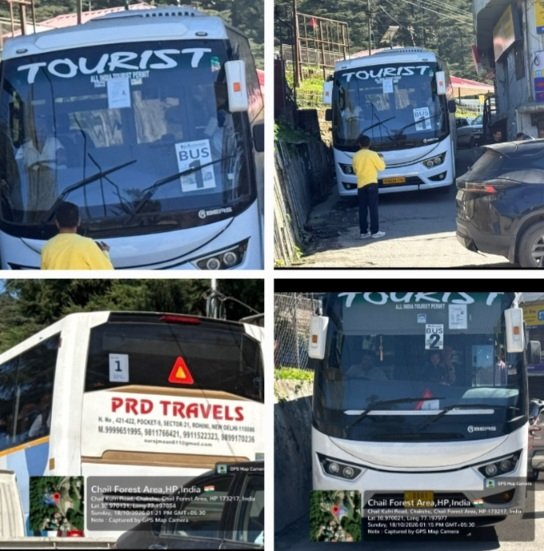
CHAIL/SHIMLA: At exactly 1:15 PM on October 18, I stood at coordinates 30.969985° N, 77.197983° E along the Chail–Kufri road and watched a vital mountain lifeline grind to a complete halt.
Before me, a massive private luxury coach—popularly referred to in the hills as a "Volvo bus"—was inching its way around a sharp, unforgiving bend. Its sheer length and wide turning arc swallowed nearly the entire carriageway. In its wake, and squeezed tightly against the hillside, local cars, motorcycles, and small commercial vehicles sat pinned in place, waiting for a multi-ton steel behemoth to negotiate a corridor that was never engineered to hold it.
Walking through the congested market passages of Chail that afternoon, I documented multiple oversized tourist coaches—bearing registration plates including CH02AA6160, DD01U9467, and DD01T9851—squeezing through bottlenecks with barely inches to spare. Where two local vehicles could normally pass with care, a single luxury coach left opposing traffic nowhere to go.
I did not record these registration numbers to accuse individual drivers of traffic offences. Rather, as Chief Executive Officer of the Pahari Samaj Paryavarani Kawach Foundation (PSPK), I documented them for official verification to ask the state administration a fundamental question: who decided that the narrow Kandaghat–Sadhupul–Chail–Kufri–Shimla road network is physically suitable for vehicles of this scale?
When a Holiday Becomes a Local Emergency
Himachal Pradesh welcomes visitors. Our hotels, restaurants, transport operators, and thousands of families depend on tourism for their livelihoods. But standing on the roadside in Chail, watching frustration build on the faces of stranded commuters, it became painfully clear that we are allowing tourism to operate at the cost of local lives and public safety.
For a holidaymaker inside an air-conditioned coach, a forty-minute gridlock is a minor inconvenience. For the mountain communities living along these routes, that same road is their only lifeline.
When large tourist coaches enter narrow hill stretches during morning office hours or evening commuting periods, the cascading congestion hits residents hardest.
Schoolchildren are delayed reaching their classrooms. Teachers, government employees, hospital staff, and daily-wage workers struggle to report for duty.
Farmers and shopkeepers are cut off from predictable access. Most dangerously, a patient travelling to a hospital or an emergency ambulance cannot afford to be stranded behind an oversized coach struggling to manoeuvre on a steep gradient. A tourist’s convenience cannot take precedence over a citizen’s access to medical care.
A Permit Is Not an Engineering Certificate
Many of the coaches I observed prominently display the words "All India Tourist Permit" across their windshields. However, possessing a valid tourist permit does not automatically establish that every narrow mountain road in the country is physically suited for that vehicle.
A coach can be legally registered on paper while remaining completely unsuitable for a constricted Himalayan carriageway.
These luxury buses require greater turning space, wider swept paths on sharp bends, and significant passing clearance. When one becomes immobilised at a bottleneck, the entire traffic stream is paralysed.
Nor can the solution be the indiscriminate widening of every mountain road.
Having spent my career reading terrain, and now working in environmental protection, I know the cost of hacking into fragile Himalayan slopes. Widening requires slope cutting, vegetation removal, heavy retaining structures, and the disturbance of natural drainage systems.
Himachal must not destroy its mountain slopes simply to accommodate progressively larger tourist vehicles.
A Blueprint for Sane Mobility
The objective is not to discourage tourism, but to plan it responsibly. Large tourist coaches should operate on suitable arterial highways and terminate at designated transport hubs outside congested settlements.
From those hubs, smaller, appropriately sized vehicles can provide onward connections to destinations served by narrow hill roads. Such a model would reduce traffic conflicts, protect sensitive settlements, and directly support local transport operators.
Following our field assessment in Chail, the Pahari Samaj Paryavarani Kawach Foundation has called upon the Government of Himachal Pradesh to initiate immediate corrective measures. As a first precaution, authorities must introduce restricted entry windows for large tourist buses during peak local commuting hours—specifically between 8:00 AM and 10:30 AM, and again from 4:30 PM to 7:00 PM—to protect school, office, and essential-service movement.
Simultaneously, the state must conduct a joint road-safety audit involving the Public Works Department, the Transport Department, the Traffic Police, and district administrations to assess turning radii and carriageway widths along the Kandaghat–Sadhupul–Chail–Kufri–Shimla corridor. Authorities need to verify route permissions for the coaches documented in our field photographs, notify enforceable size restrictions for narrow market stretches, and establish designated parking and passenger-transfer hubs outside sensitive hill towns. Finally, the administration must commit to public disclosure of its safety assessments and issue a time-bound action-taken report on public complaints regarding tourist-coach congestion.
As I drove back from Chail, watching the evening traffic build up once again behind slow-moving coaches, the choice facing our state felt stark. Himachal Pradesh cannot continue treating fragile mountain roads as though they were highways across the plains. The mountains have physical limits, and good governance begins by recognising them.
(Major General Atul Kaushik, SM, VSM (Retd.) is the CEO of the Pahari Samaj Paryavarani Kawach Foundation (PSPK). He can be reached at