
Himalayan Council on Paper, Mountain States on Their Own: Centre’s Climate Inaction Threatens North India’s Water Security
Eight years after its constitution, Himalayan States Regional Council faces questions over inactivity; ecological services go uncompensated as Centre withdraws Revenue Deficit Grants, deepening financial crisis in mountain states
SHIMLA/DEHRADUN/SRINAGAR/ITANAGAR:
The appointment of a new chairperson to the Himalayan States Regional Council (HSRC) has once again brought into focus an uncomfortable question: does the Union government have a serious, functioning strategy to protect the Indian Himalayas, or is the council gradually becoming another institutional announcement with eyes on elections without meaningful action on the ground?
A fresh Office Memorandum issued by NITI Aayog on November 12, 2026, appoints its Vice-Chairperson Ashok Kumar Lahiri as Chairperson of the Himalayan States Regional Council, which by and large remains as good as defunct!
The council was originally constituted on November 9, 2018, to facilitate coordinated and integrated development of the Indian Himalayan states through inter-sectoral and inter-state coordination, policy dialogue and collaborative action.
The mandate is substantial, but its performance is now under serious scrutiny from civil society organisations and mountain-development advocates.
The Integrated Mountain Initiative (IMI), a network working on sustainable mountain development, had earlier raised concerns over the council's inactivity, pointing out that neither the council nor its working groups had met since 2019.
The latest appointment memorandum, however, does not announce a meeting schedule, a time-bound action plan or any fresh implementation mechanism.
The council was conceived as a national coordination platform to address mountain-specific challenges, including water security, spring revival, sustainable tourism, mountain livelihoods, biodiversity, shifting cultivation, entrepreneurship and scientific data for informed policymaking.
Its mandate also envisaged monitoring the implementation of recommendations by Central ministries and Himalayan state governments. Yet, eight years after its creation, the absence of visible institutional engagement raises fundamental questions about the Centre's commitment to the ecological security of the Himalayas.
The timing of the appointment has also attracted attention. Members of civil society view the renewed institutional activity in the context of the approaching Assembly elections in Uttarakhand and Himachal Pradesh in 2027.
They recall that the council was constituted in November 2018, around the period when Himalayan states were witnessing electoral activity. The concern is that mountain development should not become an election-linked administrative exercise but a continuous national priority.
The stakes extend far beyond the geographical boundaries of the Himalayan states. The Himalayas are the source of major river systems sustaining the Indo-Gangetic plains, the Punjab agricultural belt and millions of people across northern India.
Their glaciers, snowfields, forests, springs and river basins form a critical natural water-security system. Ecological degradation in these mountains will therefore not remain confined to Himachal Pradesh, Uttarakhand, Jammu and Kashmir, Ladakh, Sikkim and the northeastern states. Its consequences will extend to the downstream agricultural economy, industries and major urban centres.
The Centre cannot afford to treat Himalayan protection as a peripheral environmental concern.
The proposed Renukaji Dam in Himachal Pradesh illustrates the direct relationship between mountain watersheds and the water security of the plains.
The project on the Giri river in Sirmaur is intended to supply water to Delhi and augment supplies for other beneficiary states. The national capital's future water security is thus linked to the health and management of Himalayan river basins.
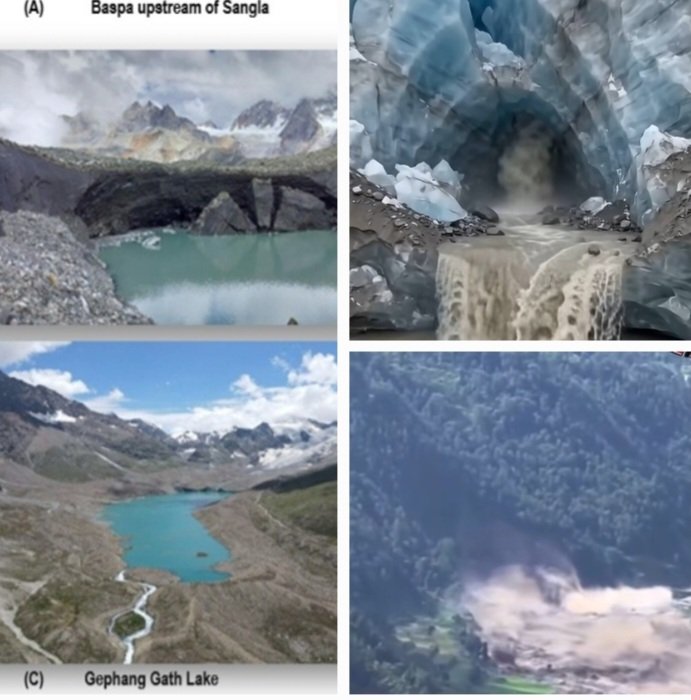
The climate crisis is already changing the risk profile of the entire Himalayan region. Cloudbursts, flash floods, landslides, glacial lake outburst floods, prolonged dry spells and erratic precipitation are putting settlements, roads, hydropower projects, drinking-water systems and livelihoods under mounting pressure.
The emerging pattern is not one of isolated natural disasters but of repeated shocks to an already fragile mountain economy.
Himachal Pradesh provides one of the starkest illustrations of the cost of this vulnerability. The 2023 monsoon disaster alone caused direct losses estimated at approximately Rs 10,000 crore, with the wider economic impact taking the figure beyond Rs 12,000 crore.
Subsequent disasters have added to the financial and infrastructural burden. Between 2023 and 2025, the state recorded 86 cloudbursts, 234 landslides and 121 flash floods, according to figures cited by Chief Minister Sukhvinder Singh Sukhu in May 2026.
The damage is not restricted to roads and bridges. Drinking-water schemes, power infrastructure, agricultural land, orchards, public buildings and tourism-dependent businesses have repeatedly suffered destruction.
Every major disaster forces the state to divert scarce resources towards emergency restoration and reconstruction, while planned development expenditure and public investment come under pressure.
For a small hill state already struggling with fiscal constraints, recurring climate-related destruction is becoming a serious economic liability.
Uttarakhand's experience, including the devastating 2013 Kedarnath disaster and subsequent episodes of flooding and land subsidence, offers another warning.
The 2023 glacial lake outburst flood in Sikkim exposed the vulnerability of infrastructure in high-altitude river valleys.
Arunachal Pradesh and other northeastern states face similar risks from extreme rainfall, unstable slopes and infrastructure development in difficult terrain.
These disasters demand a common Himalayan disaster-management strategy rather than fragmented state-level responses.
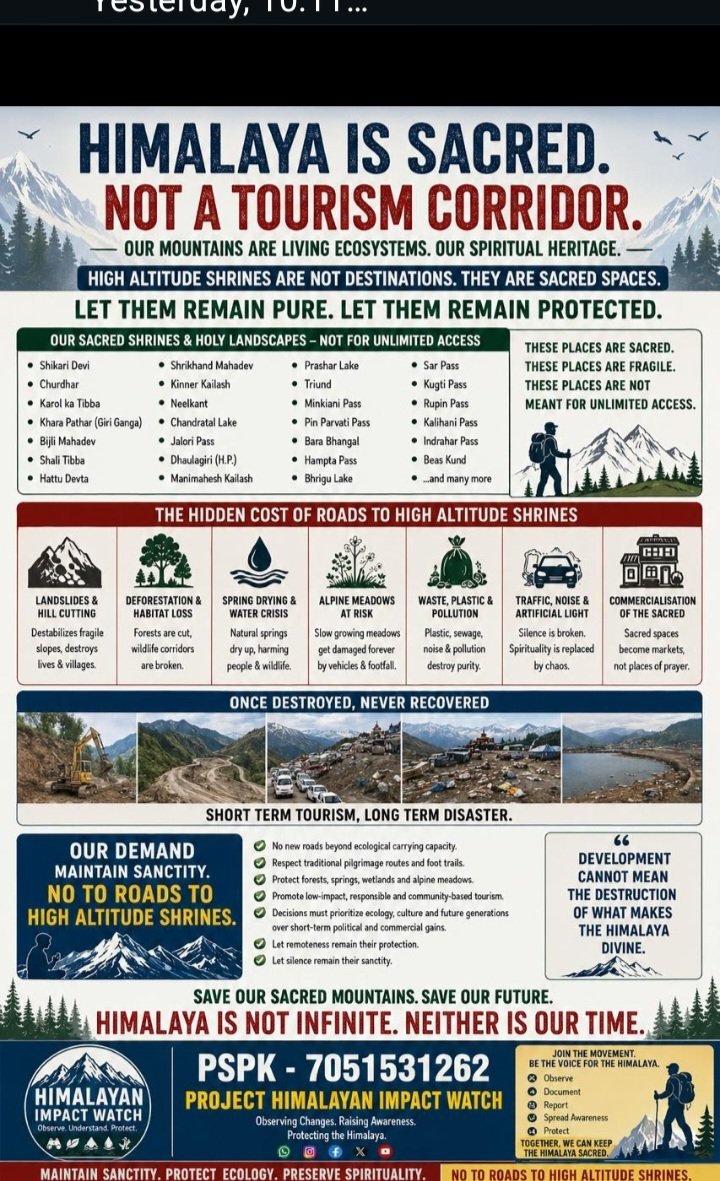
The growing pressure of unregulated tourism is adding another layer to the crisis. From Shimla, Manali, Kullu, Dharamshala, Palampur and Narkanda to Leh, Ladakh, Dehradun and the Char Dham pilgrimage circuit, popular destinations are struggling with traffic congestion, waste disposal, sewage management, water shortages and pressure on fragile landscapes.
The Atal Tunnel and its surrounding tourist belt have brought new accessibility and economic opportunities, but also raise questions about carrying capacity, traffic regulation, waste management and the ability of local administrations to cope with sudden visitor surges. Over a lakh vehicles cross Atal Tunnel every year.
The garbage crisis is becoming particularly visible in destinations that attract large seasonal tourist flows. Plastic waste, untreated sewage, construction debris and indiscriminate disposal of garbage are putting additional pressure on mountain rivers, forests and local water sources.
The issue is not tourism itself but the absence of scientifically determined carrying capacities, enforceable building norms, adequate waste infrastructure and a tourism policy that places ecological limits alongside economic considerations.
The Integrated Mountain Initiative and several other civil society organisations have repeatedly argued that mountain-specific challenges require a dedicated institutional response at the national level.
The demand for a separate Ministry for Himalayan Affairs has emerged from the recognition that conventional development policies designed for the plains cannot adequately address the geographical, ecological, economic and strategic vulnerabilities of mountain states.
The financial treatment of Himalayan states exposes another contradiction in the Centre's approach.
Instead of adequately compensating states such as Himachal Pradesh for preserving forests, watersheds, rivers, biodiversity and other ecological assets that sustain millions of people downstream, the Centre has discontinued Revenue Deficit Grants from 2026-27, following the recommendations of the 16th Finance Commission.
The decision has dealt a serious financial blow to Himachal Pradesh, a predominantly mountainous state with limited avenues for generating sustainable revenue.
The scale of the setback is evident from the state's budget estimates. Himachal Pradesh was expected to receive approximately Rs 3,257 crore as Revenue Deficit Grant in 2025-26.
The provision has disappeared from the 2026-27 financial framework. The 15th Finance Commission had recommended Rs 37,199 crore in revenue deficit grants to the state over five years.
The 16th Finance Commission discontinued this category of assistance for states, arguing that such grants could weaken incentives for fiscal discipline.
However, the consequences for fiscally constrained mountain states deserve a separate assessment because their geographical disadvantages and ecological responsibilities are fundamentally different from those of larger, more industrialised states.
The state's expenditure structure leaves little room for manoeuvre. According to the 2026-27 Budget, every Rs 100 spent by the government includes Rs 27 on salaries, Rs 21 on pensions, Rs 13 on interest payments and Rs 9 on repayment of loans.
Another Rs 10 goes towards grants to autonomous institutions, leaving just Rs 20 for capital works and other activities. In effect, around 80 per cent of this expenditure is committed to these obligations, severely restricting the state's ability to create new infrastructure, invest in climate resilience and undertake development works.
The fiscal squeeze is particularly damaging because Himachal Pradesh does not possess the industrial base, large commercial markets or diversified revenue streams available to bigger states. Its economy depends substantially on horticulture, tourism, hydropower and government transfers.
These sectors are themselves vulnerable to climate disasters, market fluctuations and ecological degradation. Repeated destruction of roads, bridges, power infrastructure and public utilities further increases the burden on an already stretched exchequer.
Concerns over inefficient expenditure, project leakages and corruption add to the demand for stronger financial accountability and better utilisation of public money.
The larger injustice is that the state bears the opportunity cost of conserving its natural resources while the benefits flow far beyond its borders. Forest restrictions, environmental safeguards and limitations on land use constrain economic activity, while its rivers and watersheds sustain downstream populations, agriculture, industries and urban centres.
Yet there is no sufficiently robust, predictable and dedicated national mechanism to compensate Himalayan states for these ecological services.
The Centre cannot simultaneously expect mountain states to protect the country's water towers, preserve forests, maintain fragile watersheds and absorb the costs of climate-related disasters while withdrawing financial support without creating an adequate alternative.
A dedicated Green Ecosystem Services Compensation Fund, calculated on forest cover, watershed protection, biodiversity conservation, glacier and river-basin management and disaster vulnerability, is urgently needed. Himalayan states must receive additional, predictable financial assistance for performing an ecological responsibility that is national in character.
The strategic dimension of Himalayan protection is equally important and cannot be separated from India's national security interests.
China is advancing major infrastructure projects across the Tibetan plateau, including the world's largest hydropower project on the Yarlung Tsangpo, which enters India as the Brahmaputra.
The scale of the proposed project, its location in a seismically active region and its potential implications for downstream river systems have raised concerns among scientists and strategic observers.
The implications are particularly serious for Arunachal Pradesh and the Brahmaputra basin.
Any major earthquake, landslide, sudden release of water or disruption of river flows could have consequences extending across international boundaries.
The Himalayan region is seismically vulnerable, and infrastructure planning cannot afford to ignore geological risks in pursuit of ambitious construction targets.
The devastating flood disaster around Nepal's Rasuwa district and the Gyirong border region with Tibet has further underlined the need for cross-border cooperation.
India, Nepal and China need stronger mechanisms for sharing real-time rainfall information, river-flow data, glacial lake monitoring, weather forecasts and disaster warnings.
The absence of timely information can turn an extreme weather event into a humanitarian catastrophe, particularly in remote mountain valleys where communication and road connectivity are easily disrupted.
The Centre must therefore move beyond isolated infrastructure announcements and establish a comprehensive Himalayan framework combining ecological protection, disaster preparedness, scientific research, strategic planning and regional cooperation.
India also needs institutional arrangements for sustained engagement with Nepal and China on transboundary rivers, seismic risks, glacial monitoring and early-warning systems.
The political economy of Himalayan development also deserves urgent attention. States such as Himachal Pradesh have limited legislative representation in Parliament despite carrying a disproportionate burden of protecting forests, watersheds, glaciers and other ecological assets that benefit the entire country.
Himachal Pradesh has four Lok Sabha and three Rajya Sabha members. The Himalayan states collectively have far less parliamentary influence than the large states of the plains.
Civil society representatives argue that this political imbalance has contributed to their concerns receiving inadequate national attention.
The Centre must recognise that protecting mountain ecosystems is a national economic and security investment, not a concession to smaller states.
Himalayan states need enhanced financial assistance, disaster-resilient infrastructure funding, climate adaptation resources and compensation for the ecological services they provide to the rest of the country.
Conventional funding formulas and development benchmarks cannot adequately account for the costs of maintaining fragile mountain ecosystems.
The Modi government's initiatives such as Vibrant Villages and Parvatmala, along with improved connectivity in strategically sensitive border regions, are important steps.
However, connectivity cannot become synonymous with indiscriminate construction. Roads, tunnels, dams, hydropower projects and tourism infrastructure must be assessed against geological stability, environmental carrying capacity and long-term disaster risks.
Development that repeatedly gets washed away by floods or buried under landslides cannot be described as sustainable development.
The Himalayan States Regional Council offers an institutional platform to bring together the Centre, state governments, scientific institutions and civil society. Its original mandate provides for inter-ministerial coordination and collaboration with organisations such as the International Centre for Integrated Mountain Development (ICIMOD) in Kathmandu.
What is missing is visible institutional ownership, regular meetings, measurable targets, dedicated funding and accountability for implementation.
The new chairperson must now convene the council without delay, publish a time-bound action plan and bring all Himalayan chief secretaries and concerned Central ministries to the table. Its proceedings, recommendations and implementation status should be placed in the public domain.
The government must also clarify why a council created in 2018 with such an expansive mandate has remained largely inactive, despite repeated warnings from mountain organisations and civil society.
The larger question confronting New Delhi is whether it understands the value of the Himalayas beyond their political geography.
These mountains are not merely a collection of border states, tourist destinations or hydropower sites. They are the ecological foundation of North India's water security, agricultural productivity, biodiversity and strategic stability.
If the Himalayas continue to erode under the combined pressure of climate change, unregulated tourism and development that ignores ecological limits, the consequences will not stop at the mountain boundaries.
The Indo-Gangetic plains, the Punjab agricultural belt and major cities dependent on Himalayan river systems will eventually pay the price.
The Centre cannot afford another institutional ritual followed by years of silence. The Himalayan States Regional Council must become a functioning national institution before the next major disaster exposes the cost of continued policy neglect.
Protecting the Himalayas is not simply about saving mountain states; it is about protecting the water, food, economic and strategic security of the entire country.
#HimalayanCrisis #ClimateChange #HimalayanStates #WaterSecurity #EcologicalSecurity