


Time to Say Goodbye to Gold Jewellery? Diwali Bazaars Lose Their Buzz as Middle Class Battles Inflation, Job Insecurity and Record Gold Prices
SHIMLA/CHANDIGARH/DEHRADUN:
A subdued Dhanteras and a Diwali season without the customary shopping frenzy have exposed the growing financial distress of India's middle class.
While ordinary families repaired old possessions instead of buying new ones, the political class in power appeared to enjoy the privileges of office, new cars, flats, travel, gifts and festivities.
From quiet bazaars and a lean Himachal apple season to global layoffs and expensive gold, the widening divide raises uncomfortable questions about who is actually enjoying the fruits of economic growth.
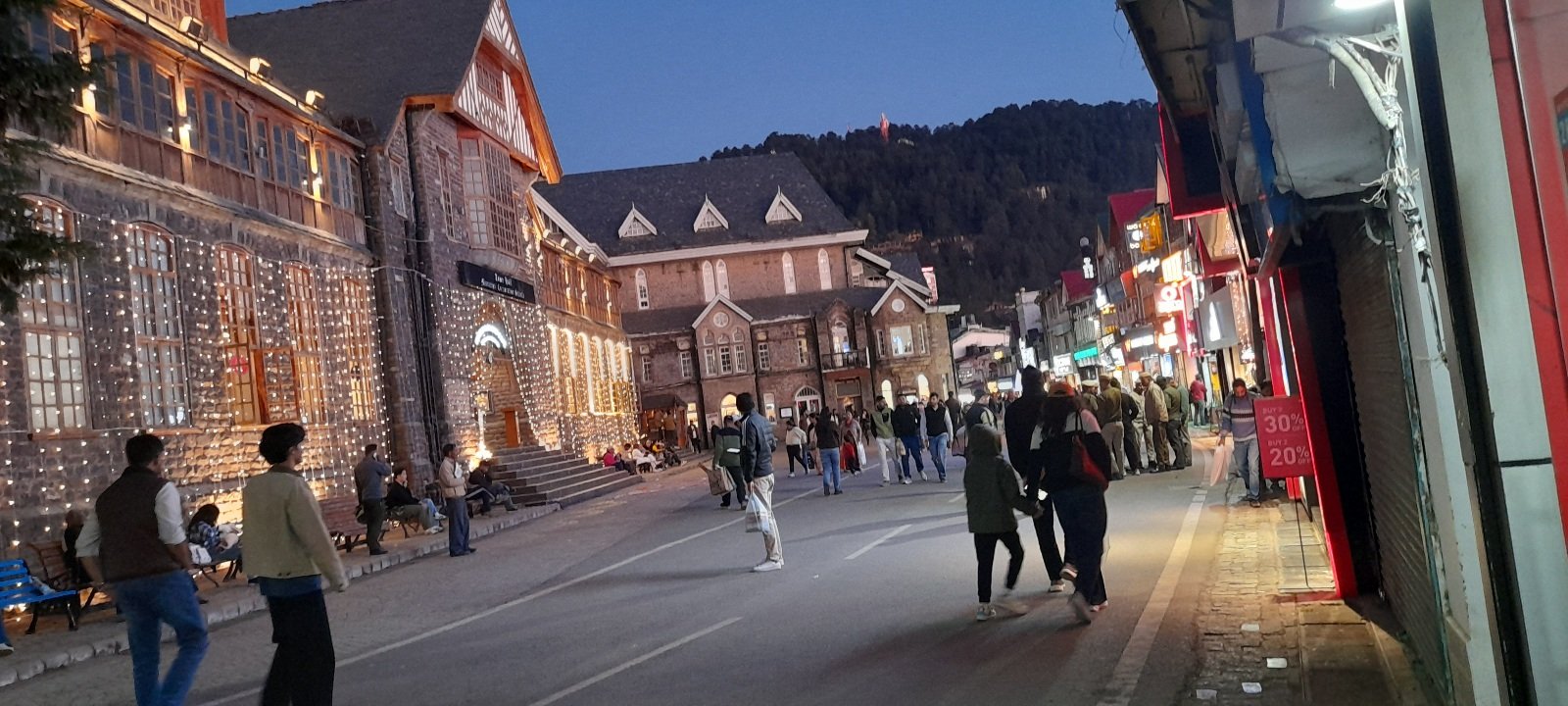
The festive season that once brought India's markets alive with crowds, shopping bags and last-minute purchases appeared markedly subdued this Diwali.
The familiar rush in bazaars, shopping streets and retail markets was missing in several cities. Families appeared more cautious, discretionary purchases were postponed and household budgets were increasingly directed towards essentials.
Dhanteras 2026, traditionally one of the biggest occasions for purchasing gold and silver, also passed without the customary buying enthusiasm in many markets.
The extraordinary rise in gold prices has made even modest purchases expensive, while uncertainty over employment, household incomes and the wider economy has further weakened consumer confidence.
An emerging feature of this year's festive economy was the preference for repairing old household goods rather than purchasing new ones.
From appliances and furniture to vehicles and personal belongings, extending the life of existing products became a more affordable alternative to replacement. Families were increasingly calculating whether a purchase was necessary rather than treating Diwali as an occasion to spend.
The contrast was particularly striking when viewed against the lifestyle of the political establishment. While ordinary households tightened their purse strings, those occupying positions of power and privilege appeared considerably less constrained by the economic anxieties confronting the public.
Gifts, new cars, flats, travel and elaborate festivities continued to be symbols of a privileged world largely insulated from the pressures of everyday living.
This contrast raises an uncomfortable question about who is actually enjoying the fruits of economic growth. When unemployed youth struggle to find work, salaried families postpone purchases and small traders wait for customers, the visible privileges of those in power sharpen public perceptions of economic inequality.
The real test of prosperity is not how lavishly the powerful celebrate festivals, but whether ordinary citizens can afford to participate in the same celebrations.
Job insecurity and global disruptions deepen household anxiety
The employment situation has added another layer of uncertainty to festive consumption. The global technology industry has witnessed an extensive wave of workforce reductions as companies restructure, control costs and redirect investment towards artificial intelligence.
According to Layoffs.fyi data reported in 2026, more than 1.28 lakh technology jobs had been eliminated globally by September 10 across 299 companies. Companies including Oracle, Amazon, Dell and Uber were among those associated with workforce restructuring.
Artificial intelligence has become an important factor in the changing employment landscape, although not every layoff can be attributed to AI. Cost-cutting, business restructuring, changing demand and geopolitical uncertainty are also responsible.
The conflict in West Asia has added to economic uncertainty through energy prices, supply chains and business costs. The resulting pressure on businesses and households has made employers more cautious and consumers more reluctant to commit to major purchases.
For young people entering the job market, the combination of recruitment uncertainty, layoffs and changing skill requirements creates additional anxiety.
India's youth unemployment remains substantially higher than its overall unemployment rate, with urban graduates particularly exposed to the mismatch between qualifications and available opportunities.
For unemployed graduates and families dependent on a single salary, buying a new television, refrigerator, vehicle or expensive jewellery is increasingly difficult to justify. Repairing existing goods, postponing upgrades and retaining cash have become rational household responses.
Himachal's double setback: lean apple and tourist seasons
The festive slowdown has particular significance for Himachal Pradesh, where the rural economy depends heavily on apple cultivation and tourism.
The 2026 apple season was substantially weaker than the previous year. By September 9, only 79.66 lakh apple boxes had been marketed against 1.46 crore during the corresponding period in 2025, according to Horticulture Department figures reported in the media.
The Sanyukt Kisan Manch estimated that total production might not exceed 1.25 crore boxes.
The reduction has consequences far beyond orchard owners. Apple growers, commission agents, transporters, labourers, packaging businesses and rural traders all depend on the circulation of money during the harvest season.
Even where growers obtained better prices per box, higher rates could not necessarily compensate for the loss of production. The reduced income circulation affects purchases ranging from household appliances and clothing to vehicles, construction material and jewellery.
Tourism, another important economic driver, also presented a mixed picture. Shimla experienced strong post-monsoon weekends in October, with occupancy approaching 100% at some hotels, but September reports indicated occupancy of around 20% during a weak weekend.
Foreign tourist arrivals in Himachal also remained substantially below pre-pandemic levels.
A few successful tourism weekends cannot necessarily compensate for the wider uncertainty confronting small hotels, taxi operators, restaurant owners, guides and workers dependent on seasonal incomes.
For Himachal, the combination of a lean apple season and uneven tourist activity has weakened two important sources of household spending just as the festive season arrived.
Gold jewellery: the expensive illusion of an investment
Against this economic backdrop, the extraordinary appreciation in gold prices has fundamentally changed the economics of jewellery buying.
The Dhanteras figures supplied for this story show that 10 grams of 24-carat gold, which cost ₹30,049 in 2016, reached ₹1,41,032 in 2026. That represents an appreciation of approximately 369%, or nearly 4.7 times the earlier price.
| Dhanteras | Gold price, 24K, 10g |
| 2016 | ₹30,049 |
| 2017 | ₹29,671 |
| 2018 | ₹31,739 |
| 2019 | ₹38,630 |
| 2020 | ₹50,738 |
| 2021 | ₹47,652 |
| 2022 | ₹49,818 |
| 2023 | ₹60,029 |
| 2024 | ₹78,493 |
| 2025 | ₹1,29,828 |
| 2026 | ₹1,41,032 |
But the customer purchasing an ornament does not simply pay the bullion price. Making charges, wastage, design premiums, stones and GST increase the final bill. At resale, the customer may not recover these additional costs.
The jewellery industry must answer a basic question: why should consumers pay substantial premiums for an article whose resale value is calculated primarily on its recoverable gold content?
The World Gold Council's 2026 India demand figures reveal the changing market. Jewellery consumption has declined in volume even as its monetary value has increased. Consumers are spending more money but acquiring less gold.
CRISIL Ratings has also projected a contraction in organised jewellery retail volumes, despite strong revenue growth driven by higher gold prices. This is an important distinction: rising jewellery turnover does not necessarily mean more families are buying gold.
The prospect of gold reaching ₹2 lakh per 10 grams by next Dhanteras cannot be ruled out, but it is not a dependable forecast. From ₹1,41,032, another 41.8% appreciation would be required to reach that level within a year.
The jeweller's margin and purity deserve public scrutiny
The jewellery business combines bullion prices, craftsmanship, retail margins, making charges and design premiums. Consumers often struggle to understand the complete cost structure before making a purchase.
A 22-carat ornament contains approximately 91.6% gold. It cannot legitimately be represented as 24-carat gold. Yet buyers often find it difficult to distinguish the benchmark bullion rate from the actual rate applied to the ornament.
The problem becomes more apparent when jewellery is resold.
The customer may receive deductions for stones, soldering, impurities and other materials, while making charges and taxes are generally not recovered. The jeweller's exchange policy can therefore make a substantial difference to the eventual value received.
Hallmarking has improved consumer protection, but the BIS system needs rigorous enforcement. Every buyer should verify the HUID, insist on seeing the ornament weighed and obtain an itemised invoice distinguishing net gold weight from stones and other materials.
The Legal Metrology authorities should undertake surprise inspections of jewellery shops in Shimla, Dharamshala, Mandi, Solan, Rohru, Rampur and other emerging markets. Consumers should be able to see the weighing instrument, its verification status and the actual weight recorded.
BIS guidelines require registered jewellers to make a weighing balance with 0.01-gram accuracy available for customer verification. This should be a basic consumer right, not a favour extended by the shopkeeper.
The shadow economy of gold cannot be ignored
India's gold trade also has an illicit supply-chain problem.
The Directorate of Revenue Intelligence reported 221 gold seizures involving 1,073 kg of gold worth approximately ₹785 crore in 2024-25. Wider Customs enforcement statistics recorded 3,005 gold-smuggling cases, 2,600 kg seized and 533 arrests during the same financial year.
The DRI has documented organised smuggling networks using airports, land borders, concealed consignments and intermediaries.
The question is how illegally imported gold moves through the bullion market and whether its eventual entry into jewellery manufacturing can be adequately traced.
There is no justification for assuming that ordinary jewellers are dealing in smuggled gold. But the government must ensure that legitimate supply chains are properly documented and that illegal bullion does not undermine the organised market.
Time for a consumer revolt against blind jewellery buying
The middle class needs to reconsider the traditional practice of treating jewellery as an investment.
A gold ornament is a consumption purchase, not the equivalent of owning pure bullion. Its purchase price includes several components that may never be recovered. Its resale value depends on actual gold content, purity, deductions and the buyer's valuation policy.
Consumers should insist on BIS hallmarking and HUID verification, demand an itemised invoice, watch the ornament being weighed on a verified electronic balance and obtain the written buyback policy before purchasing. Independent purity testing should be sought whenever doubts arise.
Those buying gold purely for investment can examine regulated alternatives such as gold ETFs, subject to market risks and costs. Those who want physical gold can consider certified bullion with transparent purity and pricing.
Jewellery should be bought for personal use, craftsmanship and sentimental value, not under the illusion that every rupee spent will be recovered when it is sold.
The subdued shopping experience, pressure on household incomes, employment uncertainty and reduced purchasing power of apple-growing families together point towards a change in consumer behaviour.
The traditional festive philosophy of buying something new, irrespective of financial implications, is increasingly giving way to cautious spending.
The jewellery industry may report higher revenues, but that does not necessarily mean Indian families are becoming more prosperous.
When the same household spends more money to acquire less gold, repairs old possessions instead of replacing them and postpones purchases because jobs and incomes are uncertain, the warning signs deserve attention.
The real Dhanteras prosperity should be measured not by how much gold a family brings home, but by how much financial security it retains. It is time to say goodbye to unquestioning jewellery buying. A family's financial security is worth more than a showroom ornament, however expensive or fashionable it may be.
#GoldPrices #Dhanteras2026 #ConsumerRights #HimachalPradesh