
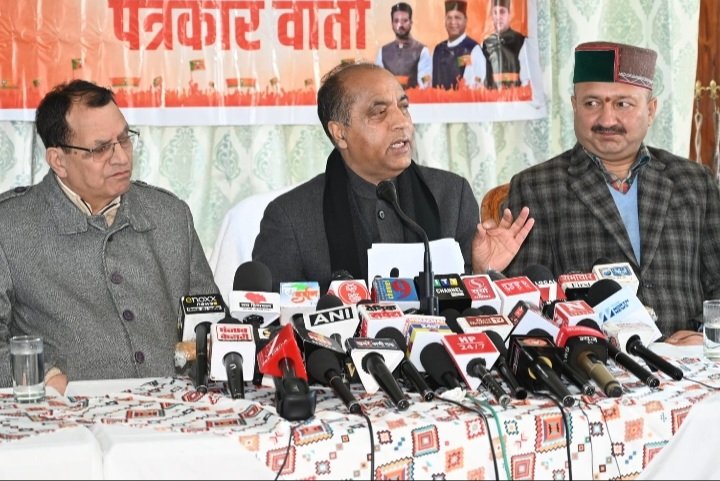
Thakur Rebuts CM Sukhu, Says Data Exposes Congress’ “Centre Is Ignoring Himachal” Narrative. But he doesn't touch Himachal’s Core Issues.
Shimla:
Leader of Opposition Jairam Thakur on Thursday launched a sharp counterattack on Chief Minister Sukhvinder Singh Sukhu, rejecting his repeated claims that the Centre was neglecting Himachal Pradesh.
Thakur said a factual comparison of Union Budgets clearly shows that India has moved from a subsidy-driven model under the Congress to an investment-led development model, with Himachal Pradesh emerging as a major beneficiary.
Addressing a press conference, Thakur said that while the 2013–14 Budget focused largely on subsidies, the 2026–27 Budget is centred on capital investment, infrastructure creation and Atmanirbhar Bharat.
He said total capital expenditure (CAPEX) has jumped from about ₹1.98 lakh crore in 2013–14 to ₹12.2 lakh crore in 2026–27—an increase of over 516 per cent.
“If this does not qualify as development, then what does?” he asked, taking a swipe at the Congress.
Thakur said the shift is visible across sectors. The defence budget has risen from ₹2.03 lakh crore to ₹7.85 lakh crore. The agriculture budget has grown from ₹27,000 crore to ₹1.32 lakh crore, while education spending has more than doubled to ₹1.39 lakh crore. Railway CAPEX has surged from ₹63,000 crore to ₹2.93 lakh crore, and the health budget has increased from ₹37,000 crore to nearly ₹92,000 crore. Investment in roads and national highways has risen nearly eightfold to over ₹2.7 lakh crore.
Responding directly to CM Sukhu’s allegations of “step-motherly treatment” by the Centre, Thakur said the figures tell a different story.
For 2026–27, Himachal Pradesh is set to receive ₹13,949 crore through tax devolution and ₹10,243 crore as grants-in-aid.
In addition, between 2020–21 and 2025–26, the state has been provided ₹8,309 crore as interest-free loans under the Special Assistance to States for Capital Expenditure scheme.
“This is not discrimination, this is record central support,” he asserted.
Highlighting improvements in social indicators, Thakur said women’s labour force participation has risen from 23 per cent to over 41 per cent, exports have grown from $310 billion to $825 billion, and multidimensional poverty has fallen sharply.
Renewable energy capacity has increased from 76 GW to 254 GW, reflecting the Centre’s focus on sustainable growth.
On healthcare, Thakur said schemes like Ayushman Bharat have provided health cover to over 42 crore people.
He noted that while there were only seven AIIMS during the Congress-led UPA regime, the number has now risen to 23 AIIMS that are sanctioned or operational—a 229 per cent increase. Himachal Pradesh, he said, has benefitted directly with AIIMS Bilaspur.
Thakur also listed infrastructure projects in the state, including the launch of air services at four airports/heliports under the UDAN scheme, 22 new flight routes, site clearance for the Mandi greenfield airport, and the completion of over 2,600 km of national highways.
Projects under the Bharatmala programme worth nearly ₹10,000 crore and the Atal Tunnel, he said, underline the Centre’s commitment to hill states.
Tourism and healthcare infrastructure have also received a boost, Thakur said, citing approvals under the Swadesh Darshan scheme, the ESIC hospital at Kala Amb, expansion of AIIMS Bilaspur, drone-based health services, and new medical colleges in Chamba, Hamirpur and Nahan.
Leader of Opposition said nearly 200 centrally sponsored schemes with a 90:10 funding pattern are benefitting Himachal Pradesh, especially in rural employment, water supply, housing and village development.
“The Union Budget is clearly focused on growth, investment and public welfare,” Thakur said, adding that the Congress was indulging in “political rhetoric and confusion” instead of acknowledging the facts.
Jai Ram Thakur, despite repeatedly projecting himself as Himachal Pradesh’s strongest voice at the Centre, failed to raise some of the state’s most legitimate and pressing demands, including a green cess to compensate for environmental degradation, a dedicated climate change mitigation package for the fragile hill state, and a differentiated GST compensation framework.
Given Himachal’s lean consumer markets and weak consumption base, applying uniform GST norms has put the state at a structural disadvantage, a concern Thakur needs to be pursued with the Centre.
Critics say his silence on these issues exposed the gap between political rhetoric and real advocacy for Himachal’s long-term ecological and fiscal interests.