
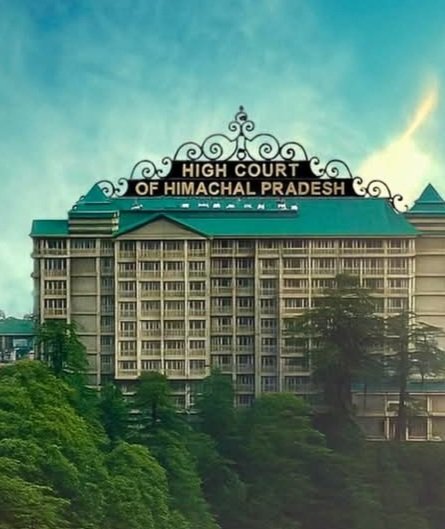
False Affidavit Costs Panchayat Head Dear: HC Upholds 6-Year Ban, Says “Honesty Non-Negotiable in Elections”
Shimla, April 18: In a significant ruling reinforcing electoral integrity, the Himachal Pradesh High Court has upheld a six-year disqualification of a former Gram Panchayat Pradhan from Mandi district, making it clear that hiding criminal antecedents is a serious breach that cannot be taken lightly.
A Division Bench of Justice Vivek Singh Thakur and Justice Ranjan Sharma dismissed the petition filed by Basant Lal, who had challenged his disqualification under the Panchayati Raj Act after being found guilty of concealing a pending criminal case while filing his nomination.
The court noted that Lal, elected as Pradhan of Gram Panchayat Pangna in 2020, had deliberately failed to disclose a criminal case pending against him at the time of filing his nomination. This concealment led to his election being declared void earlier, a decision that had already survived multiple legal challenges up to the Supreme Court.
Rejecting the argument that a six-year ban was “harsh and disproportionate,” the High Court held that the law leaves no room for leniency in such cases.
It emphasized that the disqualification is not due to the nature of the criminal case, but because of the false declaration itself, which strikes at the root of free and fair elections.
The Bench underlined that candidates seeking public office must act with complete honesty, adding that voters have a right to make an informed choice. Any suppression of material facts, it said, directly undermines democratic transparency.
Importantly, the court also refused to strike down the legal provision imposing a six-year ban, reasoning that anything less would render the punishment ineffective. Since Panchayat elections are held every five years, a shorter disqualification would allow erring candidates to return in the very next cycle, defeating the purpose of the law.
Drawing from history, the judgment even cited ancient Chola-era governance systems, where strict disqualifications ensured accountability in local self-governance—suggesting that electoral ethics have long demanded high standards.
In a strong closing note, the court observed that corrupt practices in elections deserve even harsher consequences, making it clear that integrity in public life is not optional but mandatory. The petition was accordingly dismissed.
If you lie in your nomination, the system will catch up—and the penalty will stick.