

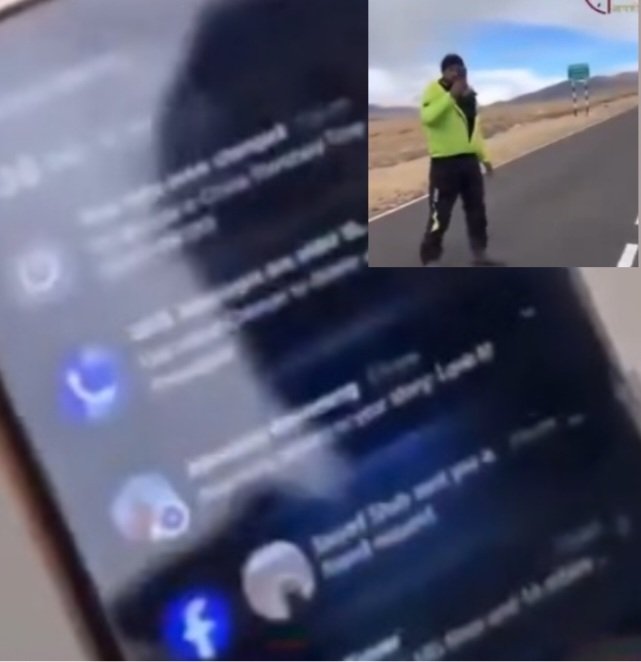
CST on Indian Phones in Ladakh Raises Intelligence Questions: Who Is Telling the Handset What Time It Is?
LEH/NEW DELHI: Reports of mobile phones used by Indian tourists in parts of Ladakh suddenly switching from India Standard Time (IST) to China Standard Time (CST) have raised questions that go beyond a smartphone glitch.
In a sensitive border region, Indian intelligence and technical agencies may need to determine whether the switch is being triggered by a foreign cellular signal, location-based software, a handset's internal database—or a combination of these factors.
India's time zone has not changed. Ladakh continues to follow IST, or UTC/GMT+5:30. China Standard Time is UTC/GMT+8, making it 2 hours and 30 minutes ahead of IST.
The appearance of CST on a private handset therefore does not mean that Indian territory has adopted China's time zone.
The real mystery is what makes the handset display CST. Modern smartphones can determine time zones automatically through cellular-network information and, depending on the device, location-based services.
A phone near the Line of Actual Control could therefore potentially receive information that causes its automatic time-zone system to select CST.
Ladakh's geography makes the issue particularly sensitive. The Union Territory broadly lies between about 32° and 36° north latitude and 75° and 80° east longitude, with Leh around 34°N, 77°E.
But geographical longitude does not determine India's legal time zone. India follows one national time zone, IST, across its territory.
The first question for intelligence agencies is therefore the network. If CST appears repeatedly at specific locations on the Indian side of the LAC, investigators need to establish the exact coordinates, network operator, roaming status, Mobile Country Code (MCC), Mobile Network Code (MNC) and signal strength at the time of the switch.
The second question is the handset itself. Where was the affected phone manufactured?
Which company supplied its hardware, firmware and operating system? Which location and time-zone databases does it use?
What applications and system services are pre-installed? These questions become relevant because many smartphones sold in India are manufactured in China or contain components and software originating from Chinese companies.
Experts say this aspect deserves examination, but it should not automatically be equated with surveillance.
A Chinese-manufactured handset displaying CST does not, by itself, establish that the device contains surveillance software.
However, if a phone is automatically identifying a Chinese time zone while operating on the Indian side of a strategically sensitive border, its software, firmware, location services and network behaviour warrant forensic examination.
The concern goes beyond the clock. Intelligence agencies could examine whether the same handset is collecting location information, identifying nearby cellular networks or transmitting data when the CST switch occurs.
Such an investigation could determine whether the phenomenon is simply a time-zone database or network-detection error—or whether there is a broader telecommunications-security issue.
The distinction is critical. A Chinese network signal reaching an Indian location would raise questions about the geographical reach of foreign telecommunications infrastructure.
A location-database error would point towards a software problem. If the trigger originates from handset firmware, that would require a different level of technical scrutiny.
The phone could therefore become a sensor for the border. Multiple devices from different manufacturers and Indian mobile operators could be tested at identical locations.
Their GPS coordinates, network identifiers, roaming status, signal strength, time-zone settings and system logs could be compared to establish precisely what happens when CST appears.
The mystery should be solved through technical evidence, not political speculation. CST appearing on an Indian phone is not evidence of Chinese sovereignty or territorial control.
But if repeated testing establishes that Chinese network or device-level technology is causing the switch on the Indian side of the LAC, the finding could have wider implications for India's telecommunications and border-security architecture.
For Indian intelligence, the central question is simple: IST has not disappeared from Ladakh—so what signal, software or database is telling an Indian handset that it is in China?
#Ladakh #IndiaChinaBorder #LAC #ChinaStandardTime #IST #CyberSecurity #BorderSecurity #IndianIntelligence #TelecomSecurity #DigitalSecurity