
Foreign Fighters, Drones & a Porous Frontier: NIA Arrests Trigger Big Security Debate on India’s Northeast
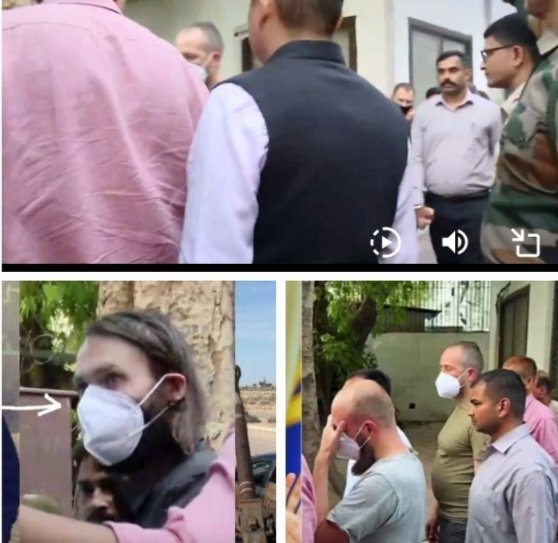
Shimla/New Delhi: The arrest of an American national and six Ukrainian war veterans by India’s premier anti-terror agency has triggered sharp national debate on whether or not New Delhi is underestimating a rapidly evolving security threat along its sensitive northeastern frontier.
Strategic affairs expert Brahma Chellaney has termed the episode a “security fiasco,” pointing to what he describes as a dangerous convergence of foreign fighters, advanced drone technology, and porous borders.
His remarks come in the wake of the National Investigation Agency (NIA) arresting seven foreign nationals accused of training insurgent groups in Myanmar with links to Indian outfits.
According to NIA filings, the accused — including American combat veteran Matthew Aaron VanDyke — entered India on tourist visas, travelled undetected to Mizoram, crossed into Myanmar’s Chin State, and allegedly trained ethnic armed groups.
They are charged under the Unlawful Activities (Prevention) Act including terrorist conspiracy. The nvestigators claim the group supplied drones, jamming equipment, and tactical training. It amounts to a deadly combination that can significantly enhance insurgent capabilities.
However, crucial gaps remain. The NIA has not yet made public the full extent of what was recovered from the accused. This includes the nature, scale, and technical sophistication of the drone consignments and electronic warfare tools allegedly involved in the case.
Similarly, the Ministry of External Affairs has so far not issued any formal statement either in Parliament or to the media, leaving the critical diplomatic and geopolitical questions unanswered.
A ‘Tactical Corridor’ Through India?
Investigators suspect the group used India’s northeast as a transit corridor to funnel European-origin drones and military-grade equipment into Myanmar.
Their ability to: Enter India without scrutiny, reach a restricted border state without permits, cross into Myanmar and return undetected has raised serious questions about surveillance gaps.
Chellaney has warned that the northeast risks becoming a “permissive operating environment” for foreign actors, with spillover effects already visible in states like Manipur and Nagaland.
Proxy War Fears Gain Ground
The case has revived concerns about external influence in Myanmar’s ongoing instability following the 2021 Myanmar coup d'état.
Security experts warn that the addition of foreign trainers and drone warfare capabilities could transform local insurgencies into more sophisticated, tech-enabled conflicts.
“This is no longer just about infiltration. It is about the import of battlefield expertise,” a senior analyst noted.
Social Media Silence Sparks Backlash
The episode has also exposed sharp fault lines in India’s digital discourse. Several chronic commentators and YouTubers — including Dhruv Rathee, Prashant Bhushan and Ravish Kumar — have come under criticism for what many users describe as a “selective silence” on the arrests.
Social media platforms are abuzz with accusations that influencers who are otherwise vocal on civil liberties and foreign policy issues have chosen not to engage with this development.
The reactions underline a deeper divide, with online discourse increasingly polarised and critics alleging a lack of consistency — or moral courage — in calling out sensitive national security issues irrespective of ideological positions.
At the same time, others caution against trial by social media, arguing that commentary should be based on verified facts rather than speculation, especially in a case still under investigation.
The Modi government has, in recent years, pushed to integrate the northeast into the national mainstream through infrastructure and peace initiatives.
Yet, this incident underscores a parallel challenge — evolving security threats in a region with difficult terrain and porous borders.
Despite improvements, large stretches of the India-Myanmar border remain unfenced and vulnerable, particularly in Mizoram.
The Way Forward
Experts are calling for a multi-layered response. It includes a tightened border management and surveillance. It also means a strict enforcement of permit regimes, deployment of anti-drone systems in vulnerable areas.
It means a clear diplomatic stand by coming out in public domain through official statements on the issue.
Chellaney argues that India must recognize that “the northeast is no longer insulated from external conflicts — it is becoming an extension of them.”
For New Delhi, the arrests highlight a shifting threat border region — from local insurgencies to transnational networks powered by technology and foreign expertise.
But with investigative details still under wraps and no official word yet from the external affairs establishment, the incident raises as many questions as it answers.
Will this become a turning point in India’s northeast security doctrine? Or another warning that fades without a strategic plan, remains to be seen.
#NortheastSecurity #NIA #DroneThreat #MyanmarConflict