Shah Blends Buddha’s Peace Mantra with Development Pitch on 2569th Buddha Jayanti in Ladakh. He was treated to Cultural Fest. Shah didnot Mention Ladakh's Issues including Statehood and Safeguards and Protection for Ladakhis amplified by Left Activist Sonam Wangchuk
LEH/SHIMLA: Amit Shah on Friday blended development claims with a strong cultural pitch as he began his two-day visit to Ladakh — his first after the release of activist Sonam Wangchuk — even as political questions on statehood and constitutional safeguards remain hanging.
Projecting Ladakh as a fast-transforming Union Territory, Shah said the region is “touching new heights of development,” citing that roads have doubled, bridges increased more than threefold, mobile towers are up by 90 per cent, helipads have grown six times, while distribution transformers and snow-clearing machines have each tripled.
But it was his cultural and religious messaging — delivered on the occasion of Buddha Purnima — that stood out.
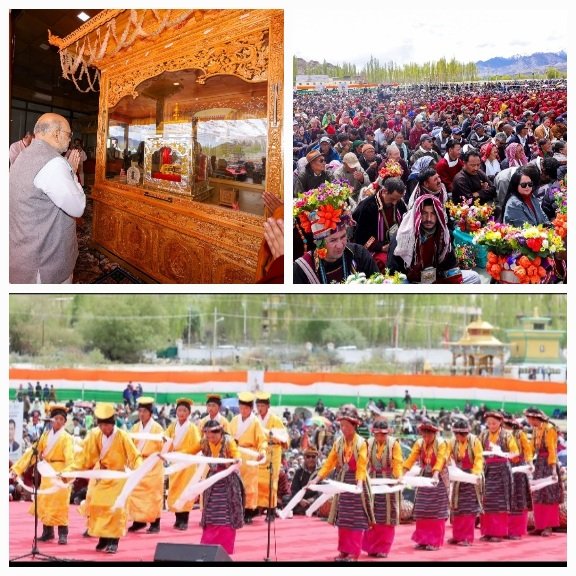
Shah said the day had acquired “special historic significance” as sacred relics of Gautama Buddha were brought to Ladakh after 75 years, calling it a rare spiritual moment for the region.
“Today is Buddha Purnima… and in a way, Lord Buddha himself is present here through his holy relics. This has elevated the importance of the day many times over,” he said, adding that decades ago, poor connectivity meant very few people could witness such relics, but today improved infrastructure allows people across Ladakh, including Kargil, to experience the spiritual energy.
Calling it “not just a religious event but a historic reunion,” Shah said Ladakh has long been a land of compassion, meditation, knowledge and cultural preservation.
Referring to visits by Dalai Lama, he said the region has played a crucial role in preserving and spreading Buddhist teachings across Asia.
He traced Ladakh’s deep Buddhist roots — from ancient trade routes linking Kashmir, Central Asia and Tibet, to the spread of Mahayana and Vajrayana traditions, and the establishment of monasteries that institutionalised Buddhism in the region.
“The message of Ladakh has always been peace and compassion. In times of conflict, this land preserved faith, and in times of peace, it carried forward civilisation,” Shah said, urging that people of all faiths be allowed to witness the relics and draw inspiration.
At the same time, he underlined recent administrative moves, including the creation of five new districts — taking the total to seven — based on geographical needs rather than population, to accelerate development in one of India’s toughest terrains.
Yet, even as Shah invoked Buddha’s middle path and India’s civilisational message of peace, the political undercurrent was unmistakable.
There was clear word on whether he would not engage with the Ladakh Apex Body or address the long-pending demands for statehood and Sixth Schedule safeguards — demands that have gained fresh push after Wangchuk’s release.
Significantly, Shah’s speech repeatedly referenced Ladakh’s religious identity — mentioning Buddhist heritage alongside local Muslim leadership — signalling what many see as a carefully calibrated outreach strategy.
Centre’s line is clear: It is showcasing development, reinforce cultural identity, and invoke civilisational legacy.
Whether that translates into political accommodation for Ladakh remains the bigger story still unfolding in the high Himalayas.
The confidence building talks with Ladakh Apex body are scheduled for May and Home Minister just struck a religious and cultural connect with the people.
Shah received a rousing reception from Ladakhis in the presence of LG V K Saxena and cultural presentations by cultural trope before he concluded his two days tour.
#AmitShahInLadakh
#BuddhaPurnimaVisit
#LadakhDevelopment
#PeaceAndProgress
#2569thBuddhaJayanti