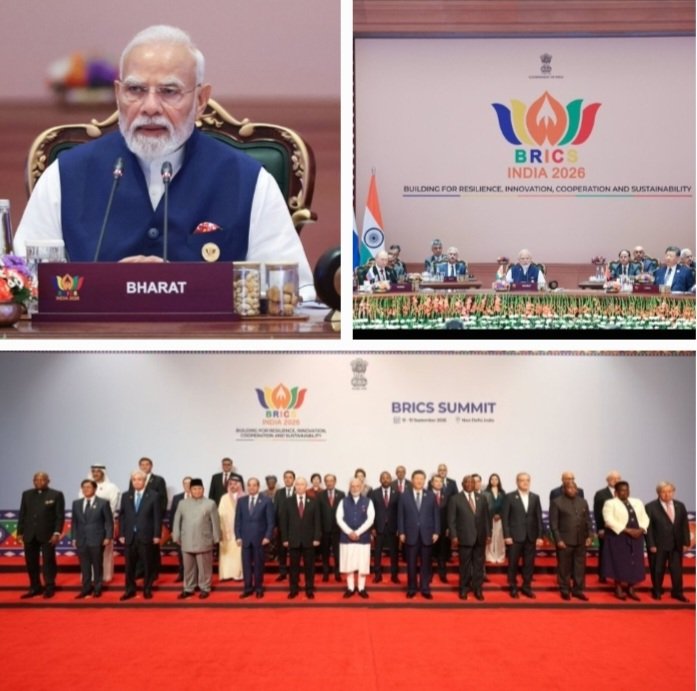
NEW DELHI: The 18th BRICS Summit in New Delhi has put the growing potential of the Global South at the centre of a push for a fairer, more representative and multipolar world order, with Prime Minister Narendra Modi, Russian President Vladimir Putin, Chinese President Xi Jinping and other leaders calling for stronger economic cooperation, greater strategic autonomy and a bigger voice for developing nations in global decision-making.
The expanded BRICS now brings together 11 countries representing about 49.5 per cent of the world's population, 40 per cent of global GDP and 26 per cent of global trade, according to the PIB. India has used its 2026 chairship to push the grouping towards practical cooperation rather than remaining only a platform for political declarations.
Prime Minister Narendra Modi set the tone by arguing that BRICS has the economic weight to produce solutions for the wider Global South. Speaking at the BRICS Business Forum, Modi pointed out that while the global economy had grown around 2.5 times over the years, the combined GDP of BRICS countries had grown about 4.5 times. “The economic strength of BRICS has grown at nearly twice the pace of the world economy,” he said.
Modi called for this economic weight to be converted into practical results, including removal of trade barriers, stronger supply chains, greater business-to-business cooperation and expansion of BRICS start-ups into each other's markets. He also stressed that global trade can progress only when “sea lanes are secure, supply routes remain open, and seafarers are safe.”
Modi's wider BRICS message has been centred on practical cooperation for a safer and more inclusive world. India has placed terrorism, cyber security, emerging technologies, food security, climate resilience, health, agriculture and digital cooperation among the areas where BRICS can deliver tangible benefits for developing countries.
Russian President Vladimir Putin presented BRICS as an emerging force against an unequal global economic system. Speaking at the BRICS business forum, Putin criticised attempts by Western competitors to preserve their former dominance, saying competition was taking “unsightly forms” and referring to attacks on industrial and logistical facilities and attempts to block transport corridors.
Putin has also backed BRICS as a vehicle for a fairer multipolar order, while Russia has advocated stronger cooperation in payments, infrastructure, technology and trade. The Russian position broadly converges with India's argument that developing economies need greater room to pursue their own growth without disruption from geopolitical rivalries.
Chinese President Xi Jinping pushed the idea of a “Greater BRICS”, seeking to transform the grouping into a more practical platform for Global South development. Xi described BRICS as a leading grouping of the Global South and called for innovation-driven development, greater self-reliance and closer economic integration.
Xi proposed deeper cooperation in artificial intelligence, including a BRICS AI Open Source Zone, while also putting forward a BRICS Special Economic Zone partnership and a BRICS Service Trade Forum. He urged members to maintain stable industrial and supply chains and cultivate an integrated market.
On the Middle East conflict, Xi urged BRICS to play a peacemaking role. He said the war “does not serve the common interests of the international community” and called for greater cooperation among BRICS members.
Iranian President Masoud Pezeshkian brought the issue of economic sovereignty directly into the summit debate. Ahead of the leaders' discussions, he called for an environment in which no country could disrupt another country's legitimate trade, a position that fits the wider BRICS push for more resilient supply chains and alternative financial and trading mechanisms. Modi, meanwhile, reiterated that conflicts must be resolved through “dialogue and diplomacy” and stressed freedom of navigation, open commerce and the safety of seafarers.
The African voice is also becoming central to the expanded BRICS. Modi told Ethiopian Prime Minister Abiy Ahmed Ali that Ethiopia's participation strengthened the collective voice of the Global South, reflecting India's effort to connect BRICS more closely with African, Asian, Middle Eastern and Latin American development priorities.
The economic architecture being discussed is equally significant. PIB says BRICS members have signed a master agreement for extending credit facilities in local currencies, while work has also advanced on financial safety mechanisms and proposals for development financing for infrastructure and sustainable development in emerging and developing economies.
Agriculture, food security and climate resilience have been brought into the same Global South framework. India has pushed BRICS Centres of Excellence on agro-ecology, a digital agriculture network using AI and geospatial intelligence, and AGRIN cooperation on seeds, genetic resources and agricultural inputs. The objective is to make developing countries more resilient to climate shocks while improving agricultural productivity and food security.
Technology has emerged as the new strategic frontier. India is pushing cooperation in AI, digital public infrastructure, critical technologies and innovation, while China has proposed an open-source AI zone. The underlying question is whether developing countries will merely consume technologies created elsewhere or acquire the capacity to develop them themselves.
The Delhi summit has therefore brought together three increasingly important BRICS objectives: a stronger Global South, a more multipolar international system and practical economic cooperation.
The differences among members remain substantial, particularly over wars and geopolitical alignments, but their shared economic weight gives the grouping an expanding ability to influence debates on trade, technology, finance, energy, food and global governance.
India's stated objective is to convert that weight into results. As India puts it, the country's BRICS chairship seeks to reinforce the grouping as a “constructive and solutions-oriented forum” and strengthen its contribution towards a more inclusive global order.
West views BRICS as an organization increasingly positioning itself as a counterweight to a Western-dominated international order, but its geopolitical power is constrained by the very diversity that gives it global reach.
Collectively, its members possess enormous economic weight, energy resources, population and diplomatic influence, giving BRICS real bargaining power in debates over trade, finance, sanctions and global governance.
Yet it is not a conventional geopolitical bloc: India and Brazil retain strong strategic and economic ties with the United States and its allies, while India’s unresolved border dispute and strategic rivalry with China fundamentally limit trust within the grouping. Russia’s confrontation with the West further exposes these divisions.
The result is a paradox: BRICS can act as a powerful coalition of countries seeking greater autonomy from Western institutions, but it lacks the shared security interests, political cohesion and strategic trust required to function as a unified anti-Western alliance.
Its real strength, therefore, lies not in acting as a single geopolitical camp, but in its ability to coordinate selectively and increase the bargaining leverage of the Global South.
#BRICS2026 #GlobalSouth #MultipolarWorld #NewDelhiSummit