DAMS UNDER THE MELTING ROOF: EXPERTS PUSH 24/7 GLOF WATCH ACROSS HIMALAYAS Mainly During the summer Months. Shalimar Declaration
SRINAGAR/SHIMLA: Himalayan experts have batted for a greater 24/7 monitoring of glacial lake outburst floods (GLOFs), warning that sudden, catastrophic breaches are rapidly becoming a recurring feature in the days to come across fragile mountain states.
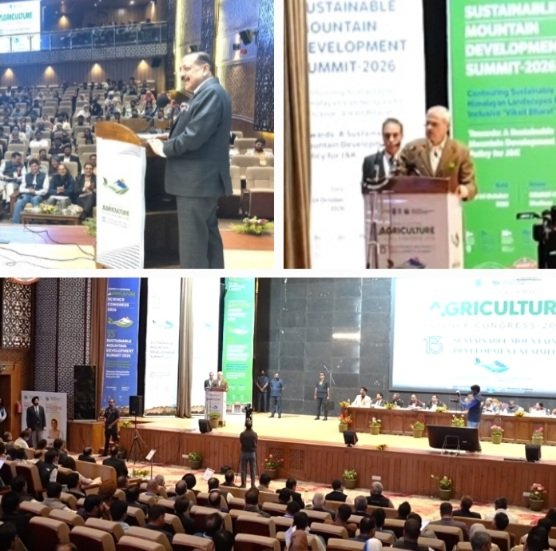
Convening at a high-level summit at the Sher-e-Kashmir University of Agricultural Sciences and Technology of Kashmir (SKUAST-K), glaciologists, climate researchers, and regional planners urged state governments across Jammu & Kashmir, Himachal Pradesh, Uttarakhand, and the Northeast, alongside the Centre, to maintain an unrelenting vigil—particularly over hydroelectric dams sitting directly below retreating glaciers.
Downstream communities and multi-billion-rupee hydropower assets face acute, compounding perils as global warming accelerates ice loss, permafrost thaw, and moraine failure.
The data and inputs accessed by HimbuMail, reveal that the catastrophic breach of South Lhonak lake in Sikkim—which unleashed a devastating flash flood down the Teesta River basin, obliterating the Chungthang dam and downstream habitations—as a grim benchmark.
In neighboring central Nepal, a glacial permafrost collapse triggered a catastrophic deluge from Gyirong down through the Rasuwa Valley, submerging thousands of homes, battering 15 hydropower projects, claiming over 3,000 lives, and leaving more than 6,000 missing.
The aggressive construction of highways and hydropower complexes directly below unstable glacial lakes has turned severe systemic risk into a "new normal," experts warned.
Inaugurating the conference organized by SKUAST-K in collaboration with the Integrated Mountain Initiative (IMI), Jammu and Kashmir Chief Minister Omar Abdullah demanded greater inter-state coordination to combat climate fallout, cautioning authorities to stay constantly vigilant against flash floods, cloudbursts, sudden downpours, and rapid glacial melt.
"We do not take care of our mountains and our environment as much as we should," Abdullah said. "We cannot stop global warming on our own, nor can we reverse it—the whole world will have to come together to address this challenge. But we can certainly take better care of our own environment."
Abdullah noted that policy blueprints cannot stay trapped in academic echo chambers: "Those recommendations need to be grounded in reality. We need to balance the need for sustainability with the need for existence and livelihoods." He added that unscientific hill blasting during road building has severely destabilized mountain slopes, triggering chronic landslides and cutting off remote valleys.
Later Union Minister of State for Science and Technology Jitendra Singh has called for protecting the Himalayan ecosystem, warning that its fragile geography makes the region vulnerable to flash floods, landslides and climate change.
Addressing the summit he said the Himalayas, stretching from Ladakh and Jammu and Kashmir to the Northeast, sustain major rivers, springs and glaciers.
He said the National Mission for Sustaining the Himalayan Ecosystem, under the National Action Plan on Climate Change, has identified three research centres at Kashmir, Sikkim and Tezpur universities.
Capacity-building in glaciology has begun in Jammu and Kashmir, while the Wadia Institute of Himalayan Geology is conducting a pilot study in 10 villages.
Singh also highlighted the Aroma Mission and Purple Revolution originating in Bhaderwah, which received national recognition through Mann Ki Baat and the Republic Day tableau.
Prof. Nazir Ahmed Ganai, Vice-Chancellor, SKUAST-K emphasized that the summit serves as a crucial bridge between scientific research and governance.
He advocated for evidence-based policymaking, resilient mountain agriculture, and vertical urban planning models to curb horizontal urban sprawl and prevent the encroachment of vital agricultural lands.
P.D. Rai, Former MP and Former President, IMI noted that Jammu & Kashmir’s emerging mountain development frameworks provide a strong template for policy advocacy and legislative safeguards that other Indian Himalayan Region (IHR) states can replic
Dr. Rajan Kotru, Lead Strategist and Councillor, IMI presented technical insights, emphasizing the shift toward inclusive green economies, regional pride, and trans-Himalayan risk assessments grounded in localized ecological realities.
Dr. S.T.S. Lepcha, President, IMI outlined the core objectives of the summit, stressing inter-state solidarity across the Himalayan states and the need for unified administrative mechanisms to address climate-induced risks.
Addressing the delegates alongside Abdullah were J&K Agriculture Minister Javid Ahmed Dar, Additional Chief Secretary Dheeraj Gupta, and Housing Commissioner Secretary Mandeep Kaur.
The Shalimar Declaration
The summit culminated in the adoption of the Shalimar Declaration, consolidating SKUAST-K’s standing as the core knowledge and research anchor for guiding sustainable action across the Himalayan arc.
There're wider calls to incorporate round-the-clock automated early warning telemetry and mandate structural safety audits for every barrage and reservoir situated downstream of glacial bodies.
#GLOFAlert #Himalayas #ClimateCrisis #HimbuMail