
SRINAGAR/SHIMLA/NEW DELHI:
The internet hummed. Screens lit up across digital feeds. High-society circles in the capital paid close attention.
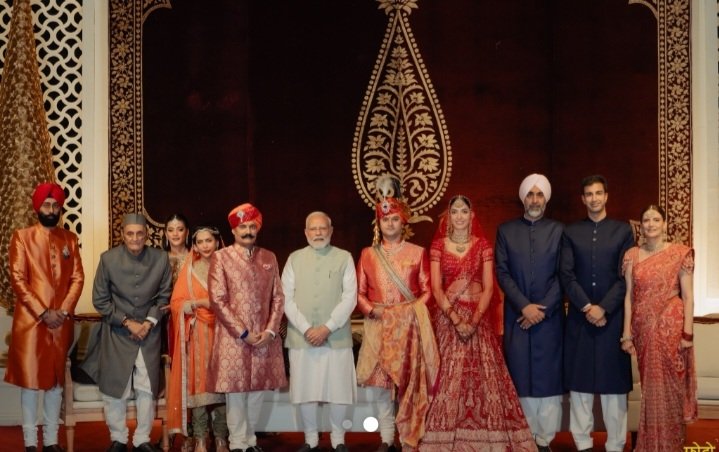
When Rajkumar Martand Singh—heir to the historic Dogra dynasty of Jammu and Kashmir and grandson of veteran statesman Dr. Karan Singh—married Rhea Badal, daughter of prominent political figure and former Punjab Finance Minister Manpreet Singh Badal, it transcended a simple ceremony.
It became the defining cultural and political crossover of the season.
Dressed in a heavy red and gold embroidered bridal lehenga, Rhea embodied a striking royal elegance, while Martand Singh cut a sharp, majestic figure in a traditional red-and-gold sherwani paired with a regal safa and kalgi.
It connected the high northern mountains with the agricultural heartland of Punjab. It joined yesterday's monarchy with today's democracy. And then, the Prime Minister made his entrance.
The Room Came to a Halt
The capital’s social calendar hit its absolute peak. Descendants of former royal houses mixed freely with heavy-hitting political figures. Jammu and Kashmir Chief Minister Omar Abdullah, accompanied by NDTV anchor Nidhi Razdan following their much-discussed secret marriage, moved through the dazzling lights of the power corridors.
This high-profile union has caught the intense attention of the Himalayan state and the entire country, drawing the gaze of everyone present alongside senior leaders like Sukhbir Singh Badal, Harsimrat Kaur Badal, and Union Minister Jyotiraditya Scindia.
Then Prime Minister Narendra Modi arrived.
Making his way through the gathering, he walked directly to elder statesman Dr. Karan Singh to offer his respects before stopping to bless the bride and groom. Digital networks immediately registered the surge of comments.
The parents voiced their feelings without reservation. The bride's father shared his deep emotions publicly, reflecting on the moment:
"As a father, you always dream of the perfect blessings for your daughter... Knowing how punishing his schedule is, it breaks my heart to think he must have sacrificed his sleep and rest hours just to stand with my family. His incredible humility completely bowled us over and moved us to tears. Thank you Prime Minister Sahib, for making a father’s dream come true."
Vikramaditya Singh, groom's father expressed similar sentiments regarding the hospitality and honor:
"It was a great honour to receive the Hon’ble Prime Minister... His gracious presence, blessings for the newlyweds and warm greetings to the family made the occasion truly special and memorable."
Observers naturally wondered about the nature of the union—whether it stemmed from strategic alignment or personal affection and love romance.
The historical foundation runs deep. Established by Maharaja Gulab Singh in the nineteenth century under the Treaty of Amritsar, the Dogra house once governed the vast Himalayan frontier.
Dr. Karan Singh later made the shift into the modern republic, serving as head of state and a cabinet minister.
Over generations, the family's matrimonial alliances have woven a vast network across northern India.
It is connected with the Maratha royal lineage of Gwalior through the groom's mother (Chitrangada Raje, daughter of the late Madhavrao Scindia), tying into Punjab's former Patiala ruling family of Capt Amrinder Singh through the groom's sister (Mriganda Singh, married to Captain Amarinder Singh's grandson Nirvan), and now joining forces with the influential Badal political family.
Whether viewed as a masterstroke of regional bridge-building or simply a modern romance, the capital's elite and the digital public reached a single conclusion: this was the ultimate match of the year.