
The emissions threaten air quality, water security, glaciers and public health in this Himalayan state, warns the report
Shimla: February 24:
A new scientific assessment has warned that non-CO₂ emissions in Himachal Pradesh could rise sharply in the coming decades.
The report projects up to a 40 per cent increase in pollutants such as nitrous oxide and particulate matter by 2047 if no additional measures are taken.
These emissions threaten air quality, glaciers, water security and public health in this Himalayan state.
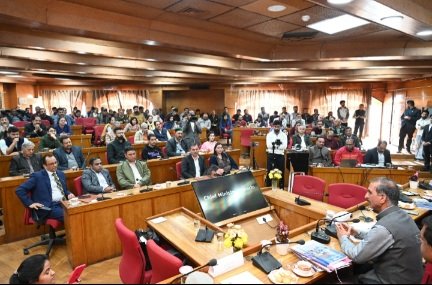
The report was released by Chief Minister Sukhvinder Singh Sukhu here today. Its findings underline the urgency of action. as as these short-lived climate pollutants are emerging as a serious challenge even for green and low-industrialised states like Himachal as well.
The assessment identifies transport, construction, agriculture, waste and biomass burning as key sources.
The report highlights methane, nitrous oxide, black carbon and particulate matter as major non-CO₂ pollutants.
It warns that under a business-as-usual scenario, air quality pressures will intensify across the state.
Experts say controlling these pollutants can deliver quick climate and health benefits.
Addressing the gathering, CM outlined steps already taken by the state to cut emissions.. He said the state government had adopted a long-term strategy to cut these emissions through structural changes in transport, energy and forests.
The report also lays out pathways to reduce methane, black carbon and other short-lived climate pollutants.
Sukhu said Himachal was already facing the consequences of climate change.
“Cloudbursts, landslides, land subsidence and extreme rainfall are no longer isolated events. These are clear warning signals,” he said.
He added that ecological damage in mountain states impacts the entire country.
The Chief Minister said a major intervention was the shift from diesel to electric public transport.
“Diesel buses are being phased out, and 300 electric buses will be on Himachal roads this year alone,” Sukhu said.
He said the move would substantially cut black carbon and other non-CO₂ emissions.
Sukhu said the government was promoting green hydrogen, solar and hydropower, while incentivising private investment.
“People, industries and investors are being encouraged to set up clean energy projects with full policy support,” he said.
He added that decentralised energy would reduce environmental stress in fragile regions.
On rooftop solar, Sukhu said households could earn up to ₹8 lakh annually for 25 years through power generation.
“Our goal is to ensure that green energy directly benefits citizens,” he said.
The Chief Minister said forest conservation remained central to Himachal’s climate strategy.
“The state aims to raise forest cover beyond 30 per cent by 2048,” he said. He added that forests are the state’s strongest natural shield against climate shocks.
Sukhu said the report would guide future policies and strengthen Himachal’s climate roadmap. “As a responsible government, we cannot afford complacency,” he said.
“Himachal is committed to greening its economy and protecting its mountains.”
The findings will be integrated into our State Action Plan on Climate Change and sectoral policies, officials said.
Given the track record, Himachal faces challenges posed by the emissions from non-CO2 pollutants, considering the increasing footprints of PM due to surge in tourists and local traffic that is bound to increase in times to come.