219 Hanging Glaciers, 25 Dangerous Lakes: Report Redflags Rising Climate Disaster Risk in Uttarakhand. Is Uttarakhand CM Listening?
DEHRADUN, SEPTEMBER 5:
Uttarakhand is facing a growing climate-disaster threat as retreating glaciers, unstable hanging ice, expanding glacial lakes and increasingly erratic weather converge with rapid infrastructure and tourism expansion in fragile Himalayan terrain, a new report has warned.
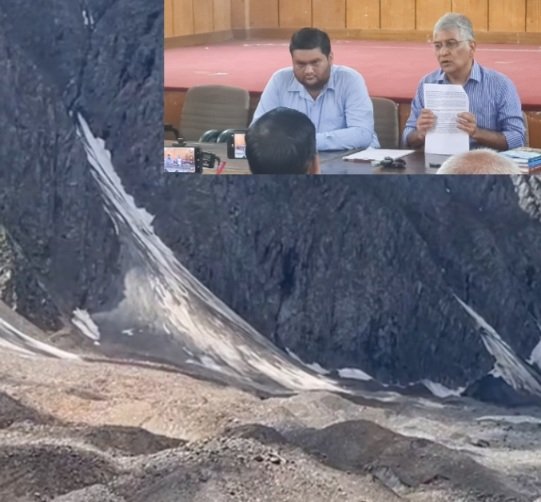
The report, “Uttarakhand at a Climate Crossroads – What Four Years of Disaster Reporting Tell Us About Glaciers, GLOFs and Avalanches,” was released at the Press Club, Dehradun, by Anoop Nautiyal and Praveen Upreti.
Prepared by the Social Development for Communities (SDC) Foundation under its Uttarakhand Disaster and Accident Analysis Initiative (UDAAI), it analyses disaster developments documented between October 2022 and June 2026.
The media-based analysis identifies five key patterns and five priority recommendations, drawing on 28 media updates and cross-referencing them with findings from institutions including ISRO, NDMA, Wadia Institute of Himalayan Geology, ICIMOD, IITs and universities, Nautiyal said.
One of its strongest warnings is the gap between risk identification and action. NDMA has identified 13 potentially dangerous glacial lakes in Uttarakhand, including five in the highest-risk category. The report cites Vasudhara Lake, where a risk assessment had been completed but an early-warning system had reportedly not been installed months later.
A 2026 study cited in the report has identified 219 hanging glaciers in the Alaknanda basin, with around 30 per cent concentrated in the upper Alaknanda near Badrinath and Mana.
The mapped glaciers cover about 71.7 sq km, with an estimated 2.4 cubic km of ice volume, including nearly 0.7 cubic km described as unstable hanging mass vulnerable to collapse.
Glacier retreat is also continuing across the Char Dham region. The report cites annual retreat rates of about 22.3 metres at Gangotri, 20 metres at Yamunotri, 17.3 metres at Badrinath and 14.1 metres at Kedarnath.
The wider Hindu Kush Himalaya is undergoing a similar transformation. The report notes substantial loss of glacier area and ice reserves since 1990, while more than 1,000 new glacial lakes have emerged and existing lakes have expanded, increasing the potential for GLOFs.
The changing cryosphere is being accompanied by increasingly erratic weather, including prolonged dry spells followed by intense rainfall or snowfall.
At the same time, roads, tunnels, hydropower projects, tourism infrastructure, pilgrimage activity and settlements are expanding into hazard-prone terrain, potentially increasing exposure and disaster impacts.
Report calls for action, not just risk mapping
The report’s recommendations centre on moving from hazard identification to sustained risk management. It calls for a dedicated long-term cryosphere and climate-risk programme, with high-risk glacial lakes placed under clear institutional responsibility and backed by time-bound monitoring, early-warning and downstream preparedness measures.
It also advocates integrated surveillance of hanging glaciers, unstable slopes, glacial lakes and avalanche-prone areas using satellite data, field surveys and local observations.
Major roads, tunnels, hydropower projects, tourism facilities and settlements should undergo multi-hazard and cumulative landscape-level assessments before expansion in vulnerable areas.
For the Char Dham region, the report says climate risk and carrying capacity must become integral to planning, alongside traffic, water and waste management.
It also places communities at the centre of adaptation through village-level disaster plans, trained volunteers, local observation systems and basic emergency equipment.
Expressing solidarity with Nepal over its recent disaster, Nautiyal said Uttarakhand must view developments across the Himalayan region as a warning rather than as isolated events.
“The increasing frequency and complexity of disasters should not be treated as isolated events. They are signals of a rapidly changing Himalayan environment. Uttarakhand needs greater preparedness, accountability and long-term planning, particularly when we already know where some of the major risks are.”
Nautiyal said the report would also be shared with relevant government departments and institutions for consideration and appropriate action.
In fact, August 26 disaster on the Nepal–China border has sent a warning to Uttarakhand for that matter HimachalPradeshand otherHimalayanstates.
A sudden high-altitude event triggered devastating flooding through Rasuwa’s Timure and Syabrubesi, with the Bhote Koshi and Trishuli rivers carrying the destruction downstream into Nuwakot and Dhading. As of September 5, 1,342 people are dead and 4,886 remain missing in Nepal.
The scale of the disaster underscores the SDC Foundation report’s warning for Uttarakhand, where 219 hanging glaciers and 25 dangerous glacial lakes have been identified.
The Nepal tragedy shows how a high-altitude trigger can rapidly cascade into a deadly downstream disaster, making early-warning systems and continuous monitoring an urgent requirement for Uttarakhand.
In the final analysis, the report argues that the central challenge for Uttarakhand is no longer simply recognising Himalayan hazards, but acting before a known risk turns into a disaster.
#Uttarakhand #ClimateChange #GLOF #HimalayanDisasters