From Shyamala to Simla to Shimla: After 210 Years, the Queen of Hills is Losing More Than Her Crown.
SHIMLA: More than 210 years after the British transformed the quiet Himalayan hamlet of Shyamala into Simla to escape the heat and dust of Kolkata, the erstwhile summer capital of the British Raj, Shimla stands at a defining moment in its history.
The Queen of Hills still captivates visitors with The Ridge, The Mall, Christ Church, the Gaiety Theatre, the Town Hall and its magnificent colonial skyline.
Yet behind the postcard beauty lies another Shimla—a city where heritage crumbles, forests retreat, streams disappear, traffic suffocates and governance often seems trapped between vision documents and political symbolism.
The Mall Road remains Shimla's grand theatre where history, glamour and contradictions perform every evening. Branded stores, upmarket cafés, bustling bakeries, restaurants, food streets and dazzling electronic billboards now stand alongside Gothic architecture.
Narcissistic youngsters, well-clad serving or , retired babus, business men, well-dressed modern ladies, lawyers, politicians and tourists turn the promenade into a daily spectacle, preserving the illusion that Shimla has gracefully entered the twenty-first century without losing its 'colonial soul'.
The ghost of colonial privilege has merely changed its dress code. The infamous British sign—"Dogs and Indians Not Allowed"—may have vanished, but another hierarchy survives.
Ministers, MLAs, senior bureaucrats and VVIPs in SUVs can still access and park on stretches of the otherwise sealed Mall and adjoining roads.
Residents living in these restricted wards, however, must purchase permits simply to drive to their own homes.
It is perhaps one of the few places where lawmakers have exempted themselves from restrictions while the citizens they represent pay for the privilege of reaching their own doorstep.
The Indian Coffee House continues to function as Shimla's unofficial Parliament.
Intellectuals, retired babus, AI- driven journalists, lawyers, politicians and theatre personalities, writers etc debate everything from stocks and shares and Municipal Corporation politics to Trump and Meloni, PM Modi, Sukhu, Nadda, Jai Ram, Mahajan, Anurag, Tikka and so on.
If they don't debate they happen to watch them in reels, insta and X , social media- another fetishism that plagues everybody now- and pin them down by their AI driven posts, which is now a new weapon with them.
Between cups of coffee come whispered assessments of colleagues, rivals and competitors. Every table appears convinced that it holds the master plan for the city's if not India's future.
Vision has become Shimla's most abundant natural resource. Smart Shimla, Green Shimla, Heritage Shimla, Sustainable Shimla now wiser Shimla dominate seminars, workshops, policy papers and books, for which there are no readers.
Yet while borrowed ideas continue to circulate in Gaitey Theatre, Coffee House, and conference halls, the city quietly expands in concrete, brick and mortar, pushing its fragile mountain slopes beyond their ecological limits.
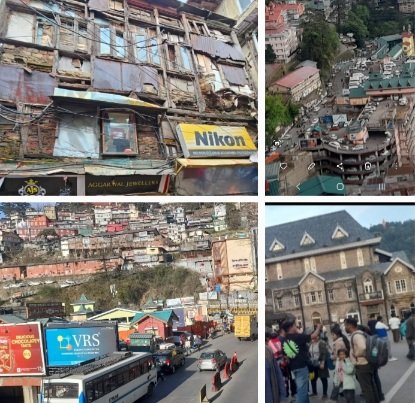
Behind the polished façade of The Mall lies a city quietly falling apart. Walk behind the elegant shopfronts and the postcard vanishes.
Rotting timber, cracked walls, rusting beams, sagging balconies and loosely nailed wooden panels support century-old buildings that appear to survive more by habit than by engineering.
Visitors admire the front elevation while remaining blissfully unaware of the decaying structures hidden just behind it.
Shimla's heritage mainly in older Bazaars has become a disaster waiting to happen. Ageing buildings with rotten beams, weather-beaten windows and obsolete electrical wiring present serious risks of collapse and fire.
Yet businesses continue uninterrupted, while authorities appear content to wait until tragedy forces action.
Heritage conservation remains stronger in speeches than on the ground. Heritage Committees, successive Mayors, councillors, the Shimla Municipal Corporation and the Urban Development Department repeatedly promise restoration.
Surveys are conducted, meetings held and announcements made. Meanwhile, deterioration quietly outpaces conservation. But ministers also remain alive talking more about it in reels and Facebook get more views and photos ops.
Ownership disputes have become the city's most convenient excuse. Many heritage buildings belong to absentee owners while tenants occupy unsafe premises under old tenancy laws. The dispute have been pending in high Court for over decades together.
Owners hesitate to invest, occupants refuse to vacate and governments avoid politically difficult decisions. Buildings often receive attention only after a fire or collapse. This is true of Old Shimla town- Lower, Middle and Lakkar Bazaars, Chotta Shimla and the like.
Shimla's green lungs are shrinking despite impressive official statistics. Nearly 30 per cent of the city's urban landscape still retains green cover.
Tree censuses have been conducted and green pockets around Nav Bahar, Jakhoo Hill and the Raj Bhavan estate have been fenced.
Yet no comprehensive ecological audit tells citizens what has happened to Shimla's birds, butterflies, native biodiversity, springs and seasonal streams, many of which have quietly disappeared beneath relentless urbanisation. Counting trees is no substitute for protecting ecosystems.
Land sharks continue to feast on the Queen of Hills. Every available green space appears vulnerable to concrete expansion even in green areas, where plot owners seek to build small houses for themselves.
Deodar and Oak trees increasingly stand imprisoned between retaining walls, widened roads and multi-storeyed buildings, their roots buried beneath cement rather than mountain soil.
Shimla's natural drainage system has become an open garbage network. More than 65 nallahs continue to drain the city, yet many now carry plastic waste, construction debris and untreated garbage.
Instead of treating these mountain streams as ecological lifelines, the city has reduced them to neglected sluiceways that overflow during every spell of heavy rain.
Engineering increasingly appears to challenge rather than respect Himalayan geography. The concretisation of the historic Combermere Nallah reflects this contradiction.
Water that once spread naturally across mountain slopes is now forced through concrete channels, accelerating runoff towards lower settlements and potentially increasing disaster risks instead of reducing them.
Traffic planning continues to produce more congestion than comfort. New pedestrian pathways have certainly improved movement in parts of the city, but bottlenecks continue to choke both roads and footpaths.
Green public transport for residents remains a pipedream, while private vehicles multiply every year.
The Lift-High Court junction has become Shimla's daily urban nightmare. The Cart Road stretch around the HPTDC Lift, the High Court junction and the adjoining parking complex continues to struggle for space due tourist traffic.
Ironically, the parking facility meant to ease congestion has itself consumed the area that should have been reserved for boarding and deboarding passengers leading them safely towards the Lift to The Mall.
The footpath is too narrow even for two people to walk comfortably, forcing thousands of pedestrians to brush past bumper-to-bumper traffic every day.
Urban planners have long argued that pushing back part of the parking area by a few feet could create a wider footpath and a safe pedestrian crossing, yet the obvious solution continues to wait.
Even Rajiv Bhawan, Congress headquarters has entered Shimla's development-versus-heritage debate.
With work progressing on a double-lane bridge and road widening along the congested Cart Road and the proposed Rodeway, concern is growing over the future conservation of the area around the building.
Infrastructure improvements are essential, but many conservationists argue they should not come at the cost of the hill identity that makes Shimla unique.
Senior citizens are paying the highest price for poor planning. Steep climbs, broken pathways, congested roads and inadequate public transport have transformed routine movement into a daily struggle.
The city once celebrated for leisurely evening walks is becoming increasingly harsh for its own ageing residents.
Commercial success often comes at the expense of public convenience. Famous bakeries, particularly Krishna Bakery, attract endless queues that spill onto The Mall and obstruct pedestrian movement.
Public space quietly becomes an extension of commercial activity while enforcement agencies appear content to look the other way.
Development is increasingly being measured in tonnes of concrete rather than ecological resilience.
The Sukhu government has drawn criticism from sections of conservationists and urban planners over what they see as continued real-estate driven expansion in and around Shimla.
The new Chief Minister's Office complex at the Himachal Pradesh Secretariat has become the most visible symbol of the government's "Vyavastha Parivartan."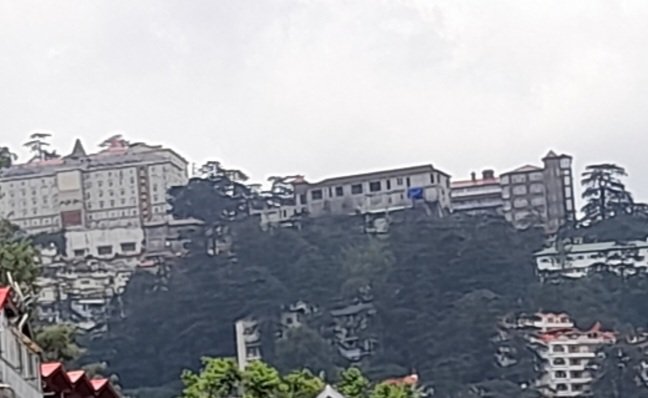
Critics argue that the imposing concrete structure has visually overshadowed the historic Secretariat building instead of complementing its heritage character.
The symbolism has become difficult to ignore. At a time when planning failures and infrastructure vulnerabilities—from the KNH-IGMC complex to recurring disasters across Himachal Pradesh—continue to raise uncomfortable questions, monumental construction projects increasingly invite debate over whether the state's development priorities are aligned with the realities of a fragile Himalayan ecosystem.
Behind the endless chatter, Shimla continues to quietly unravel. The city still has its crop of intellectuals, consultants, planners, environmentalists, theatre personalities and vision documents in abundance.
Everyone speaks passionately about saving the Queen of Hills. Yet shrinking forests, disappearing streams, illegal construction, clogged drains, collapsing heritage buildings and worsening traffic continue to define everyday life.
More than two centuries after Shyamala became Simla and Simla became Shimla, the Queen of Hills stands at a historic crossroads.
The choice is no longer between heritage and development but between thoughtful conservation and irreversible decline.
Unless governments, planners, residents and institutions begin treating Shimla as a fragile Himalayan ecosystem rather than an endless real-estate opportunity, future generations may inherit little more than a colonial façade hiding a mountain city that quietly collapsed behind its own glitter.
#SaveShimla #QueenOfHills #HeritageUnderThreat #RethinkShimla