NEW DELHI: Can India seek one more Independence Day gift from Prime Minister Narendra Modi—a political and institutional system that is cleaner, faster and more accountable, while simultaneously protecting a generation of young Indians from becoming prisoners of algorithms, the gig economy and artificial intelligence?
That question captures the deeper national churn visible on India's 80th Independence Day.
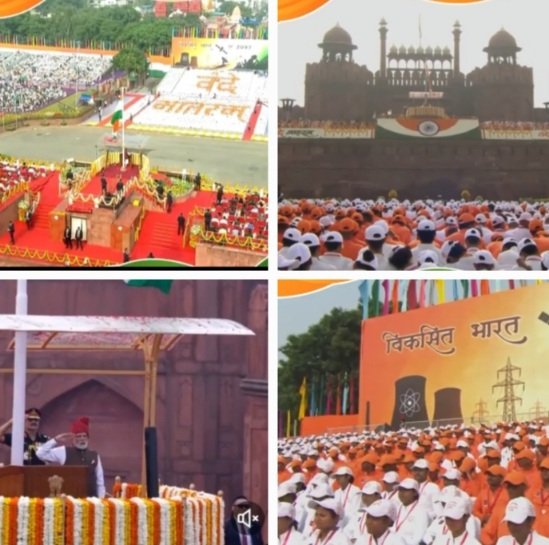
President Droupadi Murmu, in her address on the eve of Independence Day, presented the government's performance and India's long-term journey towards 2047, while Prime Minister Modi, from the Red Fort, placed youth, technology, education, innovation, self-reliance and a developed India at the centre of the next 20 years.
The Prime Minister's message to the young generation was particularly significant.
He announced an ambitious programme to provide AI-skilling opportunities to one crore young Indians within a year, besides a free online coaching network for competitive examinations by bringing together teachers and educational experts.
He also announced the Saptdhara vision, focusing on manufacturing, agriculture and food processing to innovation and technology.
He also highlighted the massive expansion of India's higher-education infrastructure, saying nearly 650 universities had been added in the last 10–12 years, taking the total close to 1,000, while medical colleges had risen from around 400 before 2014 to nearly 850.
But the country's youth challenge is no longer confined to classrooms, universities and employment exchanges.
The battle for the young Indian's mind is increasingly being fought on the smartphone.
Gen-Z has grown up in an ecosystem in which the smartphone is simultaneously a classroom, newsroom, entertainment centre, political arena, marketplace, workplace and increasingly an artificial-intelligence assistant.
Traditional institutions no longer control the flow of information. The algorithm does.
The algorithm has become an invisible editor, while the architecture of the gig economy has become an invisible employer.
X, Facebook, Instagram, YouTube and other platforms compete for attention, while the rapidly expanding platform and gig economy compete for the young person's time, skills and labour.
Content capable of provoking anger, outrage, controversy or instant emotional reaction can travel faster than patient scholarship, scientific reasoning or nuanced debate.
The concern is not that young Indians use social media or participate in the gig economy. Both have opened extraordinary opportunities.
The concern is whether the architecture of these platforms can gradually make attention, speed and engagement more valuable than creativity, reflection and independent thought.
The young Indian is increasingly becoming simultaneously a consumer, creator, worker and product.
Platforms monetise attention; gig companies monetise time and skills; AI increasingly monetises cognitive work.
The world's technology giants have created extraordinary wealth in the process, producing some of the richest companies and individuals in history.
But India's question must be larger than the size of that wealth: who ultimately controls the attention, labour, creativity and data of the young citizen?
AI makes the question even more urgent. If used intelligently, it can democratise knowledge, accelerate research, improve productivity and create millions of new opportunities.
But if it becomes merely a substitute for thinking, writing, designing, researching and creating, the danger is an intellectually dependent generation that knows how to obtain answers without learning how to question them.
Therefore, the Prime Minister's AI-skilling announcement should perhaps be accompanied by an equally ambitious national mission for critical thinking, scientific temper, creativity, entrepreneurship and AI literacy.
India does not need a generation that merely knows how to operate AI. It needs a generation capable of challenging AI, checking AI, correcting AI and ultimately remaining intellectually superior to the machine.
This does not mean closing India to global ideas. Quite the opposite. India's civilisational experience has been built through interaction, debate, questioning and assimilation.
Scientific enquiry and the willingness to challenge received wisdom have always been central to the advancement of civilisations.
The challenge is to ensure that an open mind does not become a rootless mind.
Young Indians should be able to engage with global culture without losing confidence in their own civilisational inheritance.
They should be able to question tradition without abandoning cultural memory; embrace technology without surrendering intellectual independence; and disagree with authority without becoming captive to an algorithm-driven contrarian ecosystem.
That is where the present national protests and political churn acquire a larger meaning.
The anger over paper leaks and examination irregularities, including the protest involving Sonam Wangchuk and others at Jantar Mantar, is not merely about examinations. It reflects a deeper anxiety among young people about whether institutions can be trusted to protect their future.
Similar student-led agitations elsewhere have reinforced the impression that India's young population is no longer prepared simply to accept institutional failure silently.
The same demand for accountability is visible in the debate over the criminalisation of politics.
A decriminalised Parliament would be a worthy Independence Day aspiration. The Association for Democratic Reforms has found that 251 of the 543 newly elected Lok Sabha MPs in 2024—46 per cent—declared criminal cases against themselves, while 170 MPs, or 31 per cent, declared serious criminal cases. The proportion has risen from 30 per cent in 2009 and 43 per cent in 2019.
But the distinction between an allegation and conviction is fundamental. A person facing a criminal case cannot automatically be treated as a convicted criminal. The answer, therefore, cannot simply be political disqualification on the basis of allegations.
The real answer is independent investigation and speedy, impartial justice.
Fast-track courts for cases involving elected representatives can help, but only if they possess adequate judicial capacity and are perceived to be independent.
The question of who appoints, supervises and protects such institutions is therefore as important as the speed at which cases are decided.
The same principle must apply across political parties. BJP, Congress, AAP, RJD, Samajwadi Party and every regional political formation must face the same public test.
Decriminalisation cannot become a political weapon against opponents. Nor can allegations against one party be used to excuse similar conduct by another.
The proposed Constitution (130th Amendment) Bill has further intensified this debate by proposing that a Prime Minister, Chief Minister or minister could lose office after being detained for 30 consecutive days for an offence carrying a possible sentence of five years or more.
The proposal has generated a larger constitutional debate about separation of powers, federalism, due process and the possibility of misuse of investigative powers.
That debate points to the essential safeguard: law must be strong, but it must also be politically neutral.
The national conversation therefore cannot stop with criminalisation of politics.
Citizens are asking broader questions—about electoral reform, One Nation, One Election, judicial accountability, independent policing, time-bound justice, transparency in public institutions and safeguards against the political misuse of investigative agencies.
But democracy also demands accountability from voters.
Why do political parties continue to field controversial candidates? Because many such candidates remain electorally viable.
Caste calculations, money power, local influence, patronage and the image of the strongman continue to influence elections.
The people are therefore not merely spectators in the decriminalisation debate. The ballot box is the first fast-track court of democracy.
Yet the citizen cannot be expected to replace the judiciary. A voter may reject a candidate, but only a court can determine guilt. That is why an independent police system and time-bound judicial process remain indispensable.
This brings the conversation back to the Prime Minister's Independence Day message.
If India wants to become a developed nation by 2047, development cannot be measured only through highways, semiconductor plants, defence production, manufacturing capacity, AI infrastructure or GDP.
The quality of India's democracy, the independence of its institutions and the intellectual strength of its young population are equally measures of national development.
India@80 is therefore witnessing a curious convergence of demands.
The young want jobs—but not necessarily jobs that permanently subordinate them to platforms.
They want technology—but not technology that destroys their ability to think.
They want AI—but not at the cost of human creativity. They want global exposure—but not cultural homelessness.
They want political change—but not partisan witch-hunts. They want fast justice—but not politically controlled justice.They want strong leadership—but also institutions strong enough to survive any individual leader.
And they want education that prepares them not merely to pass examinations, but to create, question, discover and lead.
That may be the real mood of India on its 80th Independence Day.
The Prime Minister has put forward a vision of Viksit Bharat@2047. President Murmu has placed before the nation the achievements and aspirations of the next phase.
Across the country, however, citizens and young people are simultaneously asking a more fundamental question:
What kind of Indian will inhabit that Viksit Bharat? A consumer shaped by algorithms?
A gig worker permanently available to platforms? An AI-dependent knowledge consumer?
A social-media warrior trapped inside an ideological echo chamber? Or a scientifically curious, culturally confident, technologically capable and intellectually independent citizen who can use every new technology without becoming its slave?
The answer may determine whether India's demographic dividend becomes its greatest strength—or its greatest missed opportunity.
The next 20 years will not merely be a race to build infrastructure and wealth. They will be a race to protect human creativity, institutional credibility, democratic accountability and intellectual freedom.
And perhaps that is the Independence Day gift India should seek—not from the Prime Minister alone, but from every political party, institution, technology company, university, civil society organisation and ultimately from itself:
A free mind in a free nation in which head is held high. Our civilization has taught it.
#IndiaAt80 #GenZ #ViksitBharat2047 #DemocraticReform