
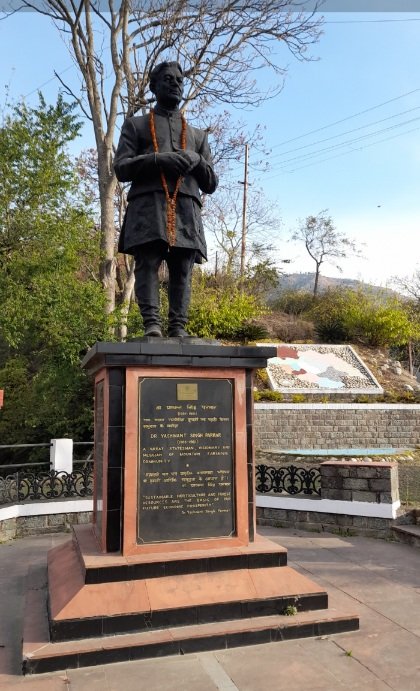
Remembering a True Titan of the Himalayas and Its People. Declare his birthplace Chanaalag as Heritage Site...
Dr Y.S. Parmar: Statesman, sociologist, scholar and son of the soil whose model of development for a self-sustaining Himachal is even more relevant today.
SHIMLA: Himachal Pradesh is gearing up to remember Dr Yashwant Singh Parmar on his birth anniversary on August 4, recalling a towering statesman whose life remains inseparable from the political awakening, development and identity of the Himalayan state.
Born on August 4, 1906, at Chanaalag in Sirmaur, Dr Parmar was much more than Himachal Pradesh's first Chief Minister. He was a Praja Mandal leader, freedom fighter, statesman, sociologist, scholar and a true son of the Himalayan soil who devoted his life to understanding and advancing the interests of its people.
Parmar emerged from the struggle against princely rule and became one of the prominent leaders of the Praja Mandal movement demanding democratic rights and an end to autocratic and feudal rule in the hill states.
He developed a larger vision—that the scattered Himalayan territories shared a distinctive geography, culture, language and social character and deserved a political identity of their own.
That vision found expression with the formation of Himachal Pradesh on April 15, 1948. Parmar became its first Chief Minister and remained at the forefront of its political journey through the crucial years that culminated in Himachal attaining full statehood on January 25, 1971.
A scholar who studied his own people
Parmar's contribution went far beyond politics. A deeply curious and academically inclined mind, he studied the social institutions, customs and traditions of Himalayan communities. His scholarly work included his important study of polyandry published as Polyandry in the Himalayas in 1975.
He was not merely a political leader speaking for the mountain people; he was a scholar trying to understand the society he represented.
His interests extended to Himachal's history, culture, language, folklore and traditional institutions, making his intellectual legacy as significant as his political contribution.
Building a state suited to the mountains
As Chief Minister, Parmar recognised that Himachal could not simply follow development models designed for the plains.
He placed roads and connectivity at the centre of development, believing that linking remote villages with markets, schools, hospitals and administrative centres was essential to transforming the hill economy. There was a just a road length of 228 km when Himachal was formed.
He also recognised the enormous potential of horticulture. His policies helped lay the foundations for the expansion of fruit cultivation and the transformation of rural livelihoods across the higher hills.
He founded the Horticulture and Forestry university at Solan. Today Himachal has a Rs 5000 crore apple economy. But much more needs to be done on this front.
His approach was essentially mountain-centric development—using the state's geography as an economic strength rather than treating it as an obstacle.
Protecting Himachal's identity
For Parmar, the creation of Himachal was not merely about drawing administrative boundaries.
He believed that the people of the hills possessed a distinctive cultural and linguistic identity that needed to be respected and preserved.
Development, in his vision, had to go hand in hand with the protection of the state's traditions, social institutions and cultural character.
One of his most consequential decisions was the land-protection framework embodied in the Himachal Pradesh Tenancy and Land Reforms Act, 1972, particularly Section 118, restricting transfer of agricultural land to non-agriculturists without government permission.
Parmar's contribution included the Nautor Act, 1968, along with land and tenancy reforms, aimed at the socio-economic uplift of landless and neglected sections of the hill population.
The experts have described the provision as a measure intended to protect Himachal's scarce land and prevent local farmers from becoming landles that in turn go a long way i checking inroads of the moneyed land sharks from outside into the state.
This combination of political identity, economic development and cultural consciousness became the hallmark of the Parmar vision.
A call to preserve his birthplace
As the state pays tribute to its founding leader, there is also a compelling case to give his birthplace at Chanaalag a permanent place on Himachal's heritage map.
Chanaalag should be declared a heritage site and developed as a dedicated “Dr Y.S. Parmar Heritage Village” and tourist heritage destination but also a place every Himachali should visit to relate to a visionary.
The village could preserve and showcase Parmar's ancestral home and memorabilia, his life and political journey, the history of the Praja Mandal movement and the evolution of Himachal Pradesh.
A heritage centre, museum, research facility and cultural interpretation space could make Chanaalag a living centre of Himachal's political and social history.
Such an initiative would be more than tourism promotion. It would be a lasting mark of respect to the true leader of the people of Himachal Pradesh and an opportunity for younger generations to understand the vision and sacrifices that went into the making of the state.
The Parmar model and the Himachal of tomorrow
The most meaningful tribute to Parmar, however, would be to take his development model forward rather than merely remember it.
The present and coming political leadership must learn from Parmar's model of development and take it forward with new vigour, fresh ideas and a renewed vision for a self-sustaining Himachal.
His emphasis on connectivity, horticulture, rural prosperity, education, local resources and the protection of Himalayan identity provides a foundation—but the challenges of the 21st century demand a new chapter.
A future Himachal must build on that foundation through sustainable agriculture and horticulture, responsible tourism, renewable energy, green transport, knowledge-based industries, water security, stronger rural economies and environmentally responsible infrastructure.
The objective should be clear: an Himachal that creates opportunities within its mountains, protects its fragile ecology and reduces its dependence on external resources.
A legacy that belongs to Himachal
More than four decades after his death on May 2, 1981, Parmar's legacy extends beyond any political party. It belongs to Himachal itself.
Parmar's governing style
The Tribune's later first-person account by a journalist who covered his government provides an excellent insight into Parmar's temperament.
When confronted with allegations that the Budget had been leaked to the Press, Parmar did not launch a political attack or threaten journalists.
He simply told the Assembly that there had been no leakage and that journalists' reports could be his intelligent guess and the matter ends there.
It is another thing today that leaders reacted sharply to media reports and even resort to lodging FIRs as well. Maybe everything has changed, even media is being branded by parties and public
Perhaps equally important was his conduct in public life. Old timers record that when he resigned as Chief Minister in 1977, he left the government vehicle and was subsequently seen travelling by public transport, buying vegetables and carrying his own bag.
Dr. Y.S. Parmar’s book, Polyandry in the Himalayas (1975). It is based on the doctoral thesis he completed at Lucknow University in 1944 and was later substantially updated to reflect social and economic changes in Himachal after Independence.
A particularly revealing passage is in his Preface, where he explains the purpose of the book:
“Polyandry is one of the rare forms of human marriage...”
He then makes clear that he was not simply reproducing his 1944 thesis: he incorporated the political, economic and social changes that had transformed the Western Himalayas after Independence.
What Parmar argues about polyandry
His study is significant because he approaches the custom sociologically and economically rather than with ridicule or moral judgement.
The introduction to the book notes that Parmar sought to understand the “logic and rationale” behind the emergence and persistence of such customs.
Dr Parmar observed that there was scarcity of agricultural land in the mountains.
The difficulty of cultivating steep and fragmented terrain.
Economic advantages of keeping brothers and family resources together.
Avoidance of excessive fragmentation of land.
Demographic factors, including differences in the male-female ratio in some Himalayan communities.
The relationship between polyandry and customary divorce known as reet.
One especially important point is that Parmar's analysis does not simply portray polyandry as a backward social practice.
He examines why a particular Himalayan society developed an institution that could help families cope with land scarcity, labour requirements and inheritanc
His resignation was presented as an example of his unwillingness to cling to office.
It is a moral duty and unflinching responsibility of the state leadership to promote his legacy at a time when the forces of crass commercialization and real estate mafias are out in the state to spread their testicle far and wide
He helped lead the struggle against princely rule, shaped the political integration of the hill states, became the first Chief Minister, championed mountain development and contributed to the intellectual understanding of Himalayan society.
It was due to Dr Parmar's vision of protecting land under Section 118 that Himachal today has a statewide network of tourism, with homestays, resorts and hotels run mostly by Himachalis. Himachal gets crores of tourists every year.
He was a politician deeply rooted in his people, a scholar fascinated by their traditions and a statesman determined to secure a distinct future for the mountains.
As Himachal remembers him on August 4, Dr Y.S. Parmar stands tall in its history as a true titan of the Himalayas and its people—the man who helped give the mountains a state, and gave that state a political, economic and cultural identity of its own.
The contemporary leaders across political parties continue to regard Parmar's foundation as the basis of Himachal's progress. In 2025, the Himachal Assembly even unanimously urged the Centre to confer the Bharat Ratna on him.
The best way to honour him is not simply to remember what he built, but to have the courage and vision to build upon it.
(The major historical events in Himachal are:
15 April 1948 — formation of Himachal Pradesh
1948 — Parmar's first administration
26 January 1950 — Himachal became a Part-C State
1952 — first elected government under Parmar
1956 — Himachal became a Union Territory
1966 — merger of Punjab hill areas
1971 — full statehood)