
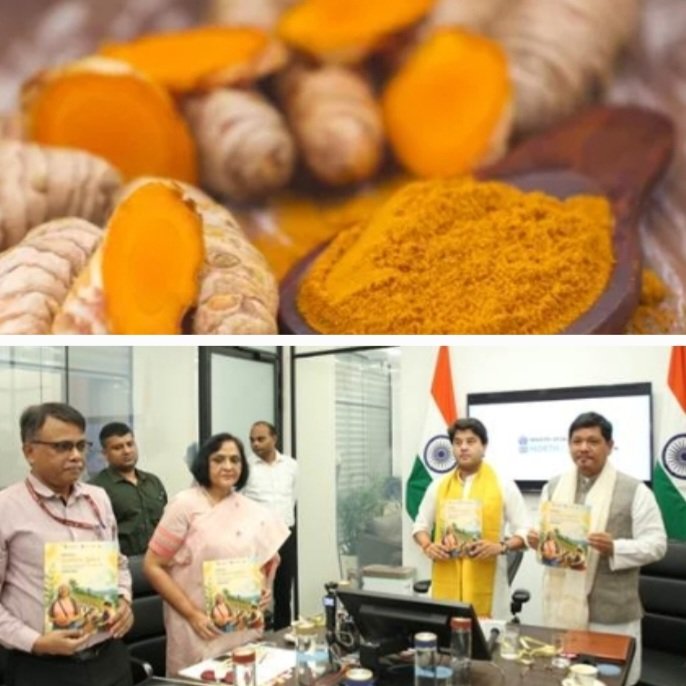
Meghalaya's Lakadong Turmeric Set to Become Global Luxury Spice Brand Under ₹175-Crore Mission. Why Himachal Pradesh is far behind?
SHIMLA/SHILONG/NEW DELHI, JULY 21:
The "Land of Clouds" is poised to emerge as the world's premier source of premium organic turmeric, with the Union Government launching the ambitious ₹175.45-crore Mission Golden Spice to transform Meghalaya's famed GI-tagged Lakadong turmeric into a globally recognised luxury spice brand.
Renowned for its exceptionally high curcumin content of 7–10 per cent—nearly four times the global average—Lakadong turmeric is now at the centre of a five-year mission aimed at creating a world-class organic turmeric value chain and delivering windfall gains to thousands of farmers across Meghalaya.
Launching the mission in the presence of Meghalaya Chief Minister Conrad K. Sangma, Union Minister for Development of North Eastern Region Jyotiraditya M. Scindia said the initiative reflects Prime Minister Narendra Modi's vision of "Atmanirbhar North East" and positions Meghalaya's unique turmeric as a flagship "Brand North East" product with immense international market potential.
The Mission Golden Spice will be implemented between 2025 and 2030 in two phases.
It seeks to expand Lakadong turmeric cultivation from around 2,500 hectares to nearly 7,500 hectares, establish integrated processing and curcumin extraction facilities, strengthen branding and exports, and build global market linkages.
Most significantly, the government aims to almost double farmers' earnings, raising turmeric prices from the current ₹30–40 per kilogram to nearly ₹80 per kilogram by 2030 through value addition and premium positioning in international nutraceutical and gourmet markets.
Scindia said Meghalaya's agro-climatic conditions give Lakadong turmeric an unmatched quality that cannot be replicated elsewhere.
He recalled that Prime Minister Narendra Modi recently showcased Lakadong turmeric during the G7 Summit, where it attracted significant interest from world leaders.
Calling Meghalaya's soil "magical", Chief Minister Conrad K. Sangma said repeated attempts to grow Lakadong turmeric outside the state had resulted in lower curcumin levels, reaffirming the crop's unique geographical identity.
He described the mission as a model that could later be replicated for other high-value Meghalaya products, including pineapple, ginger, jackfruit, honey and mushrooms.
The mission is anchored by the Ministry of Development of North Eastern Region (MDoNER) and the North Eastern Council (NEC) in convergence with several central ministries and agencies, including the Ministries of Agriculture, Food Processing and Commerce, APEDA, the Spices Board, the National Turmeric Board, ICAR, NABARD and the Meghalaya Government.
Officials said the project will bridge long-standing gaps in processing, cold-chain infrastructure, branding, GI monetisation and export readiness, enabling Meghalaya to capture the rapidly expanding global demand for premium organic turmeric and curcumin-based health products.
With its unmatched quality, certified GI status and growing international recognition, Lakadong turmeric is now set to place Meghalaya on the global map as a world-class organic luxury spice destination, ushering in a new era of prosperity for farmers across the Himalayan state.
The success of Meghalaya's Lakadong turmeric also offers an important lesson for Himachal Pradesh.
The state's indigenous turmeric, grown in pockets of Sirmaur, Solan, Kangra, Mandi, and other hill districts, is known for its distinctive flavour and medicinal properties.
Experts believe Himachal should bat for its inclusion in the Mission Golden Spice, intensify efforts to secure a Geographical Indication (GI) tag for its native turmeric, develop strong branding, promote organic cultivation and establish value-addition and processing facilities.Meghalaya's Lakadong Turmeric Goes Global; Himachal's Haldi Is Ready for the Next Leap
As Meghalaya's GI-tagged Lakadong Turmeric gains global recognition under Mission Golden Spice, Himachal Pradesh is quietly emerging as a major turmeric producer with significant untapped potential.
Turmeric is cultivated across 2,042.5 hectares in Himachal Pradesh, producing nearly 24,995 metric tonnes annually. The major turmeric-growing districts include Hamirpur, Kangra, Bilaspur, Sirmaur, Mandi and Solan.
Experts say turmeric is increasingly becoming an attractive crop for Himachal farmers because of its natural resistance to wild and stray animals, particularly monkeys, relatively low labour requirement, and long post-harvest shelf life. These advantages make it well-suited to the challenges faced by hill agriculture.
The state's naturally grown turmeric has also fetched encouraging returns this year, with prices touching around ₹150 per kilogram, reflecting rising demand for chemical-free produce.
With favourable agro-climatic conditions, growing consumer demand, and increasing farmer interest, there is a strong case for branding and securing a Geographical Indication (GI) tag for distinctive Himachal turmeric varieties.
A dedicated value-addition and export strategy could help Himachal compete alongside nationally recognised brands such as Meghalaya's Lakadong Turmeric and significantly enhance farmers' incomes.