
Eco-Friendly Bacteria Offer New Hope to Tackle Plastic Menace Across Himalayan States
SHIMLA: A promising piece of research from Himachal Pradesh University (HPU) has opened a new possibility for tackling the growing menace of plastic pollution across the fragile Himalayan region.
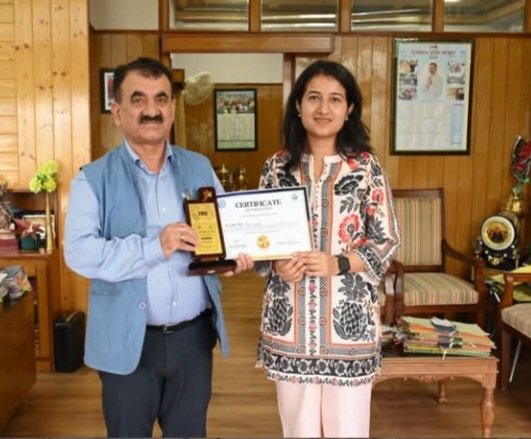
Research scholar Ria Chandel of HPU’s Department of Biosciences has won the second prize at the International Conference EnRISE 2026, held at IIT Indore, for her work on using environmentally friendly bacteria to combat microplastic pollution in agricultural soils.
HPU Vice-Chancellor Prof. Mahavir Singh congratulated Ria Chandel and her research guide Dr. Shweta Thakur for the international recognition, saying the achievement demonstrated the university’s growing research capabilities in environment and sustainable development.
He said HPU was working towards creating a strong, modern and world-class research ecosystem on its campus and hoped the achievement would inspire other researchers.
Ria Chandel, working in the Plant Physiology and Biochemistry Lab under Dr. Shweta Thakur, presented research on the potential use of eco-friendly bacteria to address the dangerous accumulation of microplastics in agricultural land.
The research received appreciation from scientists and researchers participating in the conference from India and abroad.
The real test, however, will be taking this laboratory breakthrough to the Himalayan villages, towns and farms.
If the research proves technically, environmentally and economically viable at scale, the governments of Himalayan states and HPU should work together to move it from the laboratory to the field, facilitate commercialisation and support mass production of the microbial solution.
Such a technology could potentially be made available through municipal bodies, Panchayati Raj institutions, farmers’ organisations and other local agencies across the Himalayan states, subject to scientific validation and regulatory approval.
A regional initiative involving Himachal Pradesh, Uttarakhand, Jammu & Kashmir, Ladakh, Sikkim and the Himalayan states of the Northeast could explore whether the technology can be adapted to different mountain ecosystems.
The urgency is particularly high in the Himalayas, where plastic waste can enter streams and khads, choke drainage channels, reach rivers and remain scattered along roadsides, forests, tourist destinations and agricultural fields.
A locally developed biological solution, if proven safe and effective, could become an important component of a broader strategy combining waste segregation, recycling, collection systems and scientific remediation.
Ria Chandel’s award therefore carries a larger message: Himalayan universities can generate solutions to problems confronting the mountains, but government-industry-academia collaboration is needed to convert research into public benefit.
The next step should be a structured pilot programme in selected municipalities, panchayats and agricultural areas across Himalayan states to assess the technology under real mountain conditions before considering wider deployment.
The recognition at IIT Indore has put HPU’s research in the spotlight. The challenge now is to ensure that the innovation does not stop at the award stage but becomes a scientifically validated tool for Himalayan states in their collective fight against plastic pollution.