
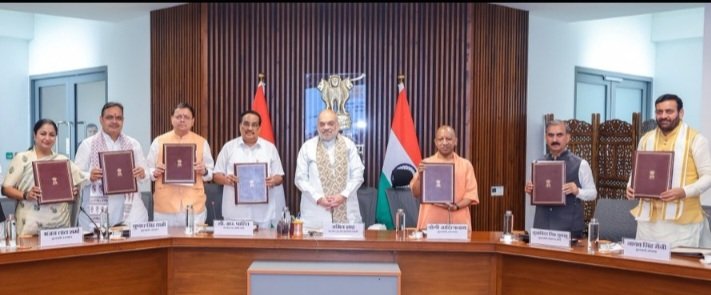
Kishau Deal: Six States Get Water, Power and Irrigation—But Who Pays the Price for this National project?
Shimla, September 15: Six states have signed the long-pending Kishau Multipurpose Project agreement, but key questions remain unanswered: how many people will lose their homes and ancestral land, how much cultivated land will be submerged, and what will displaced families receive in return?
In the presence of Union Home Minister Amit Shah and Union Jal Shakti Minister C. R. Patil, the Chief Ministers of Himachal Pradesh, Uttarakhand, Uttar Pradesh, Haryana, Rajasthan and Delhi signed the agreement on Tuesday.
The Centre described it as a historic resolution of a decades-old water dispute and an example of “Samvad se Samadhan”.
The proposed project envisages a 232.6-metre-high concrete gravity dam on the Tons river along the Uttarakhand-Himachal Pradesh border, creating a reservoir with a storage capacity of 1,562 million cubic metres.
According to the government, the project will irrigate 97,000 hectares and generate 1,476 million units of clean hydropower.
Delhi is expected to be the biggest beneficiary, while the project will also augment water availability for the Yamuna and contribute to its environmental flow.
However, the official announcement does not state how many families will be permanently displaced, how many houses will be submerged, or how much cultivated—particularly fertile—agricultural land will be lost. It also does not specify the rehabilitation, resettlement, land-for-land or livelihood package for affected families.
This omission is especially significant in the fertile Bari , Ghumanu area, where cultivated land is expected to be acquired.
For residents, the issue is not simply one of compensation. The acquisition threatens ancestral land, homes, farms and a way of life built over generations.
The central question is whether a project that supplies water to cities, irrigates land elsewhere and generates power can be considered a development success if the people living at the project site are permanently uprooted without being told clearly what they will receive.
The agreement provides greater clarity on the project's financial structure. Kishau has been declared a National Project, with approximately 90 per cent of the financial burden to be borne by the Government of India and the remaining 10 per cent by the participating states, according to the 1994 arrangement.
Amit Shah said Uttarakhand had raised certain concerns and that the Centre had assured the state that its demands would be addressed through government schemes, including assistance towards its financial burden.
The announcement, however, does not provide a comparable account of the rehabilitation obligations towards families whose land and houses will be acquired.
The project dates back to an agreement reached on 12 May 1994, under which separate agreements were to be signed for individual storage projects in the basin. After the Lakhwar and Renukaji projects moved ahead, Kishau also gained momentum. A formal agreement on Kishau was reached on 16 June 2026, followed by Tuesday's signing by the six states.
Who gets what?
The Centre has announced aggregate project benefits but has not published a state-wise allocation of water, irrigation or power. Based on the agreement and official statements, the expected benefits are:
Delhi: Amit Shah has described Delhi as the biggest beneficiary. The project is expected to increase water availability for the national capital and provide additional environmental flow for the Yamuna. Shah said 25 per cent of the water would become available through the Kishau agreement, benefiting Delhi and supporting Yamuna conservation. The announcement does not specify Delhi's exact annual allocation.
Uttar Pradesh: Uttar Pradesh is expected to receive additional water within the Yamuna basin and benefit from the project's irrigation component. No state-wise figure for its water or irrigation share has been released.
Haryana: Haryana is expected to benefit from regulated basin water availability and irrigation gains. The agreement does not state the quantity of water or irrigated area allocated to the state.
Rajasthan: Rajasthan is included among the beneficiary states and is expected to gain from additional basin water and irrigation availability. No state-wise allocation has been made public.
Himachal Pradesh and Uttarakhand: The dam will be built on the Tons river along their border, making them the project-area states and exposing them to the most direct physical consequences of the reservoir and associated infrastructure.
They are also participating states, but the Centre has not disclosed their specific water, irrigation or power shares. Nor has it published figures for submerged cultivated land, displaced families or affected houses.
The project's announced benefits—97,000 hectares of irrigation and 1,476 million units of annual clean hydropower—are aggregate figures. They do not show how much water, irrigation or power each state will receive, or how those benefits compare with the land and livelihoods that will be lost at the project site.
That missing information matters. People whose land is acquired should know which state will receive how much water, irrigation and power, as well as what compensation and rehabilitation will be provided to the communities that make those benefits possible.
Amit Shah said a major mistake had been made when Yamuna waters were originally allocated because environmental flow was not adequately considered.
The government has linked Kishau to its broader campaign to clean the Yamuna, with Shah expressing confidence that the goal can be achieved by 2029.
He also connected the Yamuna's cleanliness with the larger objective of cleaning the Ganga, since the Yamuna joins the Ganga at Prayagraj.8
The political achievement is significant: six states have reached agreement after decades of negotiations.
Shah described Kishau as the tenth water dispute to be resolved since Narendra Modi became Prime Minister, citing the Lakhwar project and Shahpur Kandi Dam agreement in 2018, Renukaji in 2019, Ken-Betwa in 2021, the Parbati-Kalisindh-Chambal link and Hathinikund-Yamuna pipeline decisions in 2024, and settlements relating to Narmada rehabilitation and the Son basin in 2026.
But for families in the reservoir zone, the agreement will be judged not by the number of disputes settled in Delhi, but by whether they can remain on their land, receive replacement land or adequate compensation if they cannot, and have their homes and livelihoods restored.
The project may deliver water to millions and electricity to the grid. The unanswered question is who will pay the permanent human price for delivering it.
#KishauProject #HimachalPradesh #Displacement #Yamuna