
Who Will Save Shimla’s Green Ridge Line from the Concrete Monsters?
HIMALAYAN IMPACT WATCH – SPECIAL REPORT–2
By Maj Gen. Atul Kaushik (Retd.)
Shimla’s green ridge is under siege. The deodars are falling, concrete is rising, and the city’s lifeline is cracking under an unchecked assault.
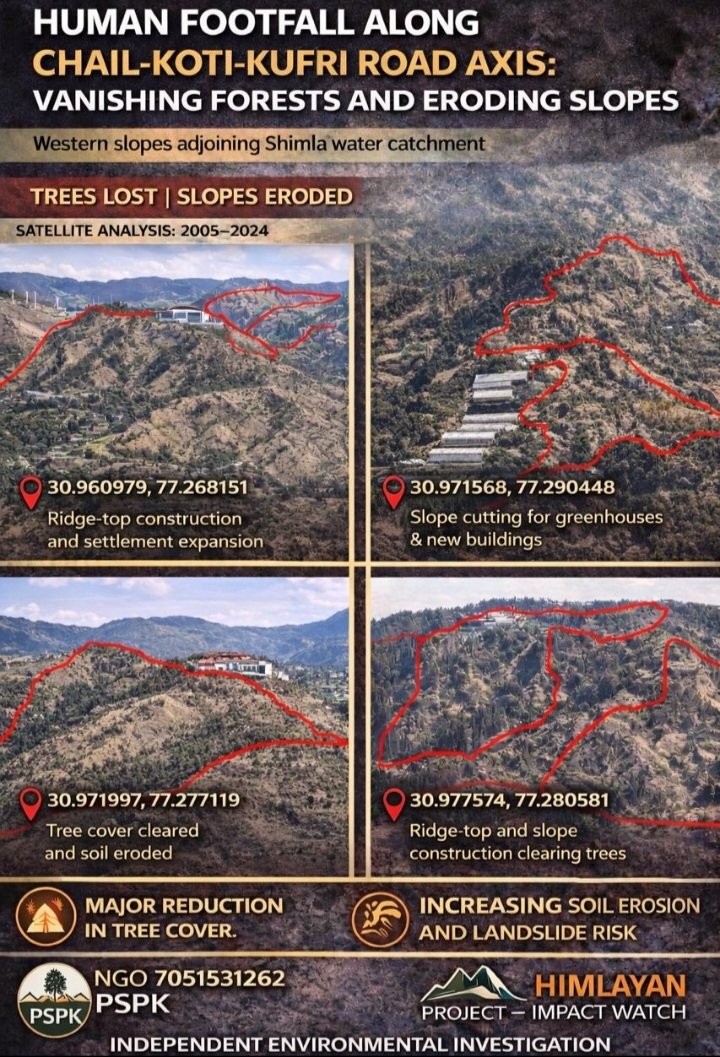
A detailed ground study by PSPK (Pahari Samaj Pariyavaran Kwach) and HimalayanWatch, carried out with field inputs from activist Raveena Chauhan who is leading protests in Chail, exposes systematic destruction across the Chail–Koti–Kufri ridge belt, including Chail, Koti, Kufri, Shilon Bagh, Craignano, Mahasu Peak slopes and adjoining forest stretches. This is not development by any stretch of imagination, it is the dismantling of a fragile mountain ecosystem.
Satellite imagery from 2005 to 2024, supported by NDVI mapping and field verification, reveals a chilling transformation across these locations. What was once a dense and continuous deodar canopy stretching from Chail through Koti to Kufri now stands carved, cut and compromised beyond recognition.
The first visible scars appeared around 2018 in pockets near Koti and Shilon Bagh, followed by aggressive road cutting and expansion towards Kufri and Craignano by 2021. Today, the ridge across Mahasu Peak slopes and adjoining catchment zones stands fractured, with bare slopes exposed and ecological stability pushed dangerously close to collapse.
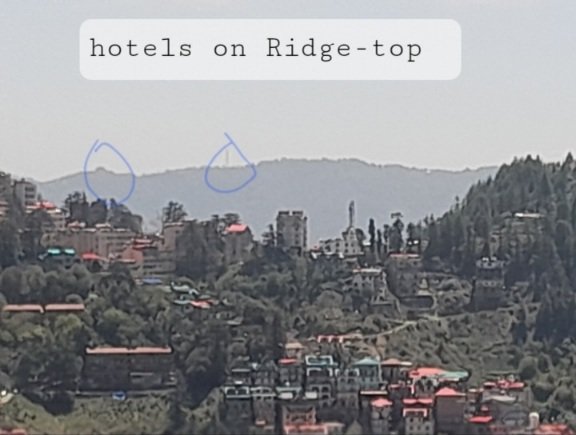
Multi-storey hotels and commercial structures now dominate sensitive stretches around Kufri, Koti and the Chail corridor, rising like concrete monsters visible from Shimla town. These structures have come up at the cost of mature deodar forests, many of which locals allege are being felled overnight in these very pockets.
The pattern of destruction across Chail, Koti, Kufri and adjoining ridgelines is neither random nor isolated. Construction begins, tree cover disappears, slopes are cut, and erosion and landslide risks multiply with every passing season.
New approach roads cutting through forests near Craignano, Shilon Bagh and upper Kufri are adding further stress to already fragile slopes. Continuous widening of roads along the Chail–Kufri tourist circuit is compounding the damage and destabilising terrain.
A formal complaint has been submitted to Deputy Commissioner Anupam Kashyap, along with representations to authorities in Shimla and Solan, the Forest Department and the Pollution Control Board. The demand is clear—immediate intervention, verification and fixing of accountability across all identified locations.
This large-scale damage raises serious legal questions under multiple environmental laws. There appears to be blatant violation of the Forest (Conservation) Act, 1980, the Environment (Protection) Act, 1986, the Himachal Pradesh Town and Country Planning Act, 1977, and provisions governing Environmental Impact Assessment notifications.
The role of regulatory bodies including Town and Country Planning authorities and RERA is now under scanner. Such widespread construction across Chail, Koti, Kufri and adjoining forest belts cannot take place without either gross negligence or silent approval.
Questions also arise on the status of mandatory compensatory afforestation in these very zones and compliance with environmental safeguards. If permissions were granted for projects in Kufri, Koti or Chail, they must be made public, and if not, then responsibility must be fixed without delay.
The ecological cost of this destruction goes far beyond visual damage. This ridge, particularly the western slopes around Kufri and Koti and forested belts near Chail, forms the backbone of Shimla’s water catchment system.
Disturbing these natural recharge zones is equivalent to choking Shimla’s water lifeline. The signs are already evident in reduced recharge from these slopes, falling groundwater levels and increasing seasonal water stress.
Slope destabilisation caused by reckless construction across Mahasu Peak slopes, Craignano forests and Koti hillsides is also heightening the risk of landslides. In a region already vulnerable to climate extremes, such interventions could trigger irreversible disasters.
Voices from the ground in Chail, Koti and Kufri reflect a deep sense of loss and anger. Residents say the green slopes they grew up with have been replaced by an expanding spread of grey concrete.
Raveena Chauhan and local communities in Chail and adjoining areas have been consistently raising these concerns through protests and representations. Their agitation is not just about trees, it is about survival and safeguarding the ecological future of the entire ridge.
This crisis is not confined to these locations alone. It is a warning signal for the entire Himalayan region where similar patterns of unregulated construction are emerging.
Unchecked and cumulative damage of this scale across Chail–Koti–Kufri will inevitably lead to water scarcity, increased disaster risks and permanent ecological loss. The science is clear, the evidence is documented, and the consequences are no longer hypothetical.
The findings of this study, backed by mapped locations and verifiable data from Chail, Koti, Kufri, Shilon Bagh and Craignano, now lie with the administration. What remains to be seen is whether there will be decisive action or continued silence.
The question before the authorities is stark and unavoidable. Will they act now, or will they watch Shimla sink under the weight of its own concrete.
#SaveShimla #HimalayanCrisis #WaterSecurity #StopIllegalConstruction
REACTIONS:
1 Authorities should have checked all aspects related to Forests and Environmental damages before granting permissions .
Violators should have been checked and penalised in the beginning.
This is a very sensitive eco zone preseved since British times to harvest the mineral water and first regulated water supply to shimla town was from small -2 water springs of this area.
This was part of urban forests which were with MC Shimla since British times but few years ago these urban forests were transferred to Forest Department.
-Dr MP SOOD, PRESIDENT, SUSTAINABLE DEVELOPMENT FORUM HP
2.Rampant, unchecked felling of trees right through dense forests, and excavation of roads wherever politicians wished, just for votes. Overnight, orders given by leaders to deploy JCB machines to please the public, and the silence of concerned officers/officials who didn't want to fall out of favor with those leaders.
Today, this is the situation across the entire state. This negligence is the reason behind the devastation of our forests, and the landslides and floods that followed are now visible everywhere. The mountains have become hollow from all sides.
Almost every family in the state owns vehicles, and wherever people live, they have built roads in the name of road connectivity without any departmental permission. On top of this, power chain machines are available in almost every household in the villages, which has made illegal felling of trees very easy.
The number of hotels in these areas is also extremely high, and road access has been provided to every hotel.
For example — Kalitibba Temple, located just above Chail, which falls completely within the Chail Wildlife Sanctuary. This temple was built without any permission, and even the road leading to it has been carved through the forests.
Today, all these problems have come together to become a problem for the entire state, which has now turned into a festering wound taking its revenge.
-A FORMER INDIAN FOREST SERVICE OFFICER, REQUESTING ANONYMITY
3 Unfortunately the carrying capacity is not ascertained for the area before development,no planning is made which leads to this type of disasters may it be a development of tourist area or residential area.
The government needs to plan first the area to be developed,must fix the carrying capacity keeping in mind the ecology,protectting greenery plan the area keeping in view the carrying capacity.
-MK SETH, PRESIDENT, SHIMLA HOTEL AND TOURISM STAKEHOLDERS ASSOCIATION
4. Very true facts and in this rat race we all have become villains now !! We can't raise our true voices to stop these acts and worst is when we are unturned by such issues going around us !! Seems in the race the sensitivity, morals have vanished and so one day will come when remorse won't be sufficient and time will fly, leaving scars of guilt.
-Dr KIMMI SOOD, EX COUNCILOR, SHIMLA MUNICIPAL CORPORATION
5.
[18/04, 7:10 am] High Court Prempal Ranta: Environment is a common heritage
Pollution Control Board must first come to a tion under Air Pollution Act,Envy Protection Act as well as under Water Pollution Act to take action under Statutory Rules
Rather builders should be held up under Polluter Pay principle to restore the loss and to pay compensation
Wider remedy is to approach Constitutional Court
5. Environment is a common heritage. Pollution Control Board must first come under Air Pollution Act,Environment Protection Act as well as under Water Pollution Act to take action under Statutory Rules
Rather builders should be held up under Polluter Pay principle to restore the loss and to pay compensation.
Wider remedy is to approach Constitutional Court Through Local bodies.
-PREM PAL RANTA, FORMER DISTRICT AND SESSIONS JUDGE, SHIMLA
6.The article published in Himbumail written by Major General Atul kaushal ( Retd) dated 17 th April 2026 regarding Builder Ravage chail - koti- kufri Ridge line, threaten Shimla water catchment: Himalayan Impact Watch Study is a matter of serious concern. Forest Preservation is required to maintain biodiversity, combat climate changes and to ensure sustainable resources for future generations. The Hon, ble Chief Minister Sukhvinder Singh Sukhu has already announced to enhance Forest cover in the state. There is dire need to check haphazard construction of multiple story Hotels and other commercial structures around kufri ,chail corridor at the cost of deodar forest. The stern action against the violations of laws concerning forest preservation should be taken to save Himalayan region strictly. Views are personal.
- D. K. MANTA, FORMER MEMBER LOKPAL MGNREGA AUTHORITY HIMACHAL PRADESH
7.Through Local bodiesThere is a well entrenched-builder mafia with close political and bureaucratic connects...Impossible without that ...
The decision to shift KNH has all the hallmarks to clear way for major construction activity at the said location...Who are the gainers,is clearly evident...
-MEMBER, INTEGRATED MOUNTAIN INITIATIVE, HIMACHAL CHAPTER