Can Voluntary Relocation Save the Himalayas’ Most Fragile Ecosystem?
SHIMLA:
The Himalayan debate is often presented as a choice between people and nature. That is a false choice. The real challenge is to find a way in which Himalayan communities can aspire to better lives without making fragile forests, wildlife habitats, watersheds and mountain ecosystems pay the price for every new road, building and commercial activity.
This is where a difficult but potentially important question deserves a place in the public debate: can voluntary ecological relocation, backed by exceptionally generous rehabilitation, ever become a legitimate conservation option for the most fragile Himalayan landscapes?
India has relocated communities for dams, highways, railways, defence installations and other projects considered necessary in the larger public interest.
We have accepted that, in certain circumstances, a larger public objective can require people to move. Conservation raises a different but equally serious question: could there be exceptional places where moving a willing community, giving it a substantially better future and permanently restoring its old landscape to nature serves the larger ecological interest?
This is not a proposal for forced eviction. It is not an argument that forest dwellers are responsible for environmental degradation. Nor is it a suggestion that Himalayan villages should be emptied in the name of conservation.
It is an argument for recognising that some landscapes may eventually reach an ecological threshold where modern settlement patterns and the survival of a highly sensitive ecosystem can no longer comfortably coexist.
A traditional Himalayan village may once have functioned with a relatively small ecological footprint. Families depended on forests, springs, agriculture and local resources. But aspirations have changed, as they should.
People want better hospitals, schools, roads, internet connectivity, employment, transport and housing. Young people want opportunities. Tourism creates new possibilities. Homestays, shops and small businesses can become important sources of income.
None of these aspirations is unreasonable.
The problem begins when every legitimate aspiration translates into permanent physical intervention in an already fragile landscape.
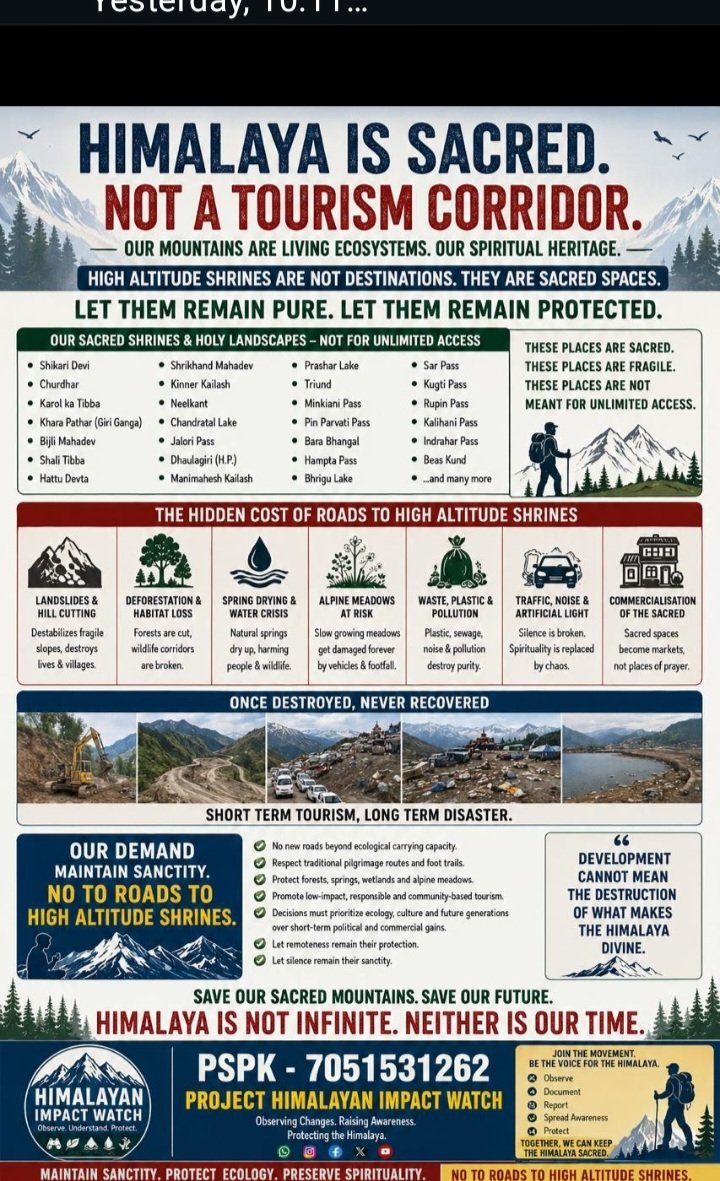
A road needs widening. Widening requires slope cutting. Slope cutting removes vegetation. More road access brings more vehicles. More vehicles create demand for parking. Tourism brings hotels, homestays, restaurants and waste.
More construction increases water demand. More people and vehicles bring noise and artificial lighting. Natural drainage gets disturbed. Construction debris reaches streams. Wildlife movement becomes increasingly difficult.
Each intervention may appear manageable when considered separately. Together, they can fundamentally alter an ecosystem.
A sanctuary can therefore remain a sanctuary on a government notification while gradually losing the ecological characteristics for which it was protected.
That is the point at which the development debate needs to become more sophisticated.
Should every modern facility necessarily be taken to every settlement, regardless of ecological sensitivity?
Or can society sometimes tell a community: we will give you better facilities, better housing, better livelihood opportunities and greater economic security somewhere more suitable, while restoring this exceptionally fragile landscape for future generations?
If such an idea is ever considered, the first principle must be dignity.
A family should never be made to feel that it is being punished for having been born in a protected landscape. Relocation cannot mean simply offering compensation and expecting people to rebuild their lives from scratch.
It would require secure land and housing, healthcare, quality education, water, sanitation, connectivity and sustainable livelihoods.
Most importantly, families should emerge economically stronger, not weaker.
The objective should be simple: nobody should become poorer because they voluntarily chose to participate in conserving an irreplaceable ecosystem.
Such communities could even be recognised as conservation partners, with long-term benefits, livelihood guarantees and perhaps a continuing role in monitoring and protecting the landscape they helped restore.
But there must also be a second principle: not every forest village should even be considered for relocation.
Many Himalayan communities have lived alongside forests for generations. In several places, traditional knowledge and community stewardship have helped protect landscapes rather than damage them.
Their presence may be compatible with conservation, and in some cases removing communities could itself cause social and ecological disruption.
Protected forests, reserved forests, wildlife sanctuaries, national parks and eco-sensitive zones also operate under different legal frameworks.
Communities may possess statutory, customary or recognised rights that cannot simply be brushed aside because an area has ecological value.
Therefore, location alone cannot become the justification for relocation.
Any such decision would need rigorous ecological assessment, recognition of rights, independent scrutiny, transparent criteria and genuine participation of the affected community.
It would have to be selective, scientific, voluntary and rights-based.
And there is another condition that cannot be compromised. If a community voluntarily leaves land specifically to save an ecosystem, that land must never quietly return to the development market.
Imagine relocating families from a fragile forest because roads, buildings and human activity are damaging the habitat, only to see hotels, resorts, commercial complexes or other major projects appear there later.
That would not be conservation. It would simply be another form of land transfer.
Land vacated for ecological restoration must remain protected permanently. Roads and other disturbed areas should be restored wherever possible. Native vegetation should return.
Natural drainage should be revived. Wildlife corridors should be reconnected. Watersheds should be allowed to recover.
The real test of ecological relocation would therefore begin after people leave.
The government, too, cannot demand ecological sacrifice from villagers while exempting itself from the same discipline.
If a village road is considered environmentally damaging, government departments must examine their own road-building practices.
If construction is restricted for residents, tourism projects cannot receive preferential treatment. If vehicles are a problem, visitor traffic must also be regulated. If waste threatens a watershed, the responsibility cannot be placed only on local households.
Nature does not recognise the difference between damage caused by a villager, a contractor, a government agency, a hotel or a tourist. It responds to the cumulative impact.
This is particularly important in the Himalayas because the mountains are not merely scenic landscapes.
They are living ecological systems that regulate water, support biodiversity, sustain agriculture and provide critical services far beyond the communities that live within them.
Yet conservation cannot become an excuse for keeping mountain communities poor.
A resident of a remote Himalayan village should not have to remain without proper healthcare, education, connectivity or economic opportunity simply because development is difficult in that location.
The answer may sometimes be technology. Telemedicine can reduce the need for large physical facilities. Digital education can supplement local schools.
Carefully designed transport systems can improve access without opening every slope to unrestricted construction. Decentralised infrastructure can reduce ecological pressure.
In many places, people and nature can coexist. In some places, development can be redesigned.
And perhaps, in a very small number of exceptional cases, the ecological stakes may become so high that voluntary relocation deserves consideration.
That should not be seen as failure. If a family moves voluntarily into a safer, better-serviced and economically more secure environment while an endangered forest is allowed to regenerate, both people and nature may gain.
The Himalayan development model has for too long been caught between two extremes: either infrastructure is pushed into fragile landscapes in the name of development, or conservation is presented as a reason to restrict the aspirations of local people.
There is another possibility.Give people choices. Give them security. Give them better opportunities.
And where they voluntarily choose to move for the larger ecological interest, give nature a permanent right to recover the land they leave behind.
That could represent a new social contract between Himalayan communities, governments and nature.
The question is not whether people are more important than forests, or forests more important than people.
The question is whether we are intelligent enough to protect both.
We did not create the Himalayas. We inherited them. The mountains, forests, rivers, springs and wildlife corridors existed long before our roads and buildings, and they will hopefully exist long after many of today's structures have disappeared.
Our generation therefore has two responsibilities: to ensure that Himalayan communities get the dignity and opportunities they deserve, and to ensure that development does not consume the ecological foundations upon which those opportunities ultimately depend.
Perhaps the measure of Himalayan civilisation will not be how many roads we build, how many hotels we construct or how far concrete reaches.
Perhaps it will also be measured by the landscapes we have the wisdom to leave alone.
And if there are places where nature needs a second chance, perhaps we should have the courage to give people a better one too.