Kashmir Returns to the Global Film Map as International Film Festival Revives Cinema, Tourism and Confidence
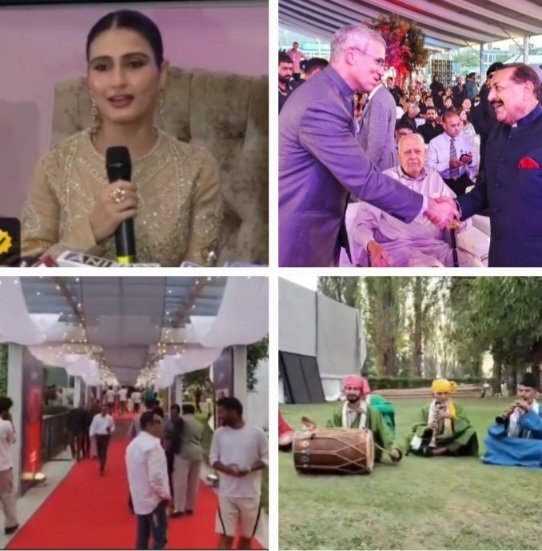
Srinagar: Kashmir is once again opening its doors to the world of cinema. The first International Film Festival of Jammu and Kashmir (IFFJK), inaugurated in Srinagar by Chief Minister Omar Abdullah, has brought filmmakers, actors, technicians, critics and cinema enthusiasts from India and abroad to the Valley, marking what organisers describe as a new chapter in Jammu and Kashmir's long association with the film industry.
Held from September 7 to 10 under the theme “Rang-e-Cinema”, the four-day festival is being organised by the J&K Department of Information and Public Relations in collaboration with the National Film Development Corporation. More than 1,100 entries from 80 countries were received, with 135 films, including 60 foreign films, shortlisted for screening.
India leads with 64 films, followed by France with 13, Iran with eight, Argentina and Spain with four each, while Brazil, Germany, Russia and the United States have three films each. Films from Türkiye, South Korea, Sweden, Qatar and Colombia are also being screened.
The scale of participation gives the festival a significance far beyond a cultural event. It places Kashmir directly before filmmakers and creative professionals from across the world at a time when Jammu and Kashmir is seeking to rebuild its position as a major destination for film production, tourism and cultural exchange.
Chief Minister Omar Abdullah, while inaugurating the festival at the Sher-i-Kashmir International Convention Centre, said the event was intended to remind the Indian film industry of Kashmir's historic place in cinema.
“Before Switzerland and other countries, films were made in Kashmir,” Abdullah said, expressing hope that the festival would encourage filmmakers to return to the Valley.
Abdullah also emphasised the economic dimension of bringing cinema back. The government's film policy provides financial incentives and production subsidies linked to shooting days and local expenditure, while encouraging employment of local artists, technicians and crews. Plans include strengthening post-production facilities, film studios, equipment banks and film education institutions.
For Kashmir, cinema is therefore being positioned as an economic and tourism multiplier rather than merely entertainment. Every production brings filmmakers, actors, technicians and support staff, while locations showcased on screen can create a lasting international tourism footprint.
The festival gives visiting filmmakers an opportunity to see Kashmir first-hand—its lakes, mountains, meadows, heritage, architecture and cultural life—potentially converting cinematic exposure into future shooting schedules and tourism flows.
Union Minister of State Dr Jitendra Singh, who also participated in the inauguration, described the festival as a reflection of the changing environment in Jammu and Kashmir and an opportunity for its young people and artists.
He said the prevailing normalcy had made it possible to organise a cultural event of this scale and expressed gratitude to Prime Minister Narendra Modi and the J&K government headed by Omar Abdullah.
Singh recalled the period when cinema halls in the Valley closed one after another and said Kashmir had nevertheless retained an “inseparable relationship” with Indian cinema. He remembered a time when film shootings took place in Kashmir's streets, gardens and scenic locations, with hotels and houseboats filled with people from the film industry.
He also recalled the shooting of Kabhi Kabhie in Kashmir, including the sequence featuring Amitabh Bachchan singing “Main pal do pal ka shayar hoon” before students of Government College for Women, Srinagar.
Singh used the history of Kashmiri participation in Indian cinema to underline the region's contribution to the country's film culture, referring to artists including Raaj Kumar, Jeevan, Sapru and Om Prakash, besides filmmaker Vidhu Vinod Chopra.
The festival is also giving Kashmir's own filmmakers a platform. Five J&K films have been selected for the competitive J&K Select Section: Searching for the Grandpa, Arifa, Batt Koch, Tasrufdaar (Djinns of Kashmir) and Naqsh-e-Daur. Their stories explore family, memory, displacement, identity, heritage and resilience, bringing local experiences into the wider international cinematic conversation.
The international jury itself reflects the festival's global ambition. It is headed by acclaimed cinematographer-director Santosh Sivan and includes Oscar- and BAFTA-winning sound designer Resul Pookutty, German film curator Dorothee Wenner, media entrepreneur Keiko Bang and National Award-winning filmmaker Himansu Sekhar Khatua.
One of the festival's most visually striking initiatives is “floating cinema” on Dal Lake, where audiences will watch films against the backdrop of Kashmir's iconic landscape.
Screenings of classic films shot in the Valley—including Junglee, Arzoo, Kashmir Ki Kali and Kabhi Kabhie—are intended to reconnect contemporary audiences with the cinematic history of Kashmir.
The festival has also attracted prominent names from Indian cinema. Filmmakers including Vidhu Vinod Chopra, Ramesh Sippy and Sriram Raghavan, along with cinematographer Santosh Sivan, were present at the inaugural ceremony, while actors and artists joined filmmakers and officials at the event.
Spanish filmmaker Anna Saura underlined the importance of such platforms from an international perspective, saying film festivals are vital not only for India's cinema industry but also for filmmakers from countries such as Spain.
She noted that festivals can help filmmakers secure recognition, support and opportunities while promoting their cinema across borders.
Her observation captures the larger opportunity before Kashmir. A film festival can become a bridge between a destination and the global creative economy.
If filmmakers leave the Valley convinced that Kashmir is accessible, welcoming and production-friendly, the festival could translate into actual shoots, employment and investment.
The cultural symbolism is equally significant. For years, Kashmir's image in the outside world was dominated by conflict. The festival offers a different frame: filmmakers arriving from different countries, audiences watching films, artists exchanging ideas and Kashmir's landscape once again becoming a backdrop for stories rather than merely a subject of news.
The festival thus represents a confidence-building exercise through culture. It seeks to demonstrate that the Valley can host an international gathering while simultaneously reconnecting itself with an industry that once made Kashmir one of India's most recognisable cinematic landscapes.
Kashmir's return to cinema could ultimately become Kashmir's return to the global tourism imagination. The mountains, Dal Lake, houseboats, gardens and valleys that once drew film crews can now be presented to a new generation of international filmmakers and audiences.
The challenge will be to sustain this momentum beyond the four-day festival—by bringing regular productions back, building local technical talent, expanding film infrastructure and ensuring that Kashmiri artists and businesses benefit from the revival.