
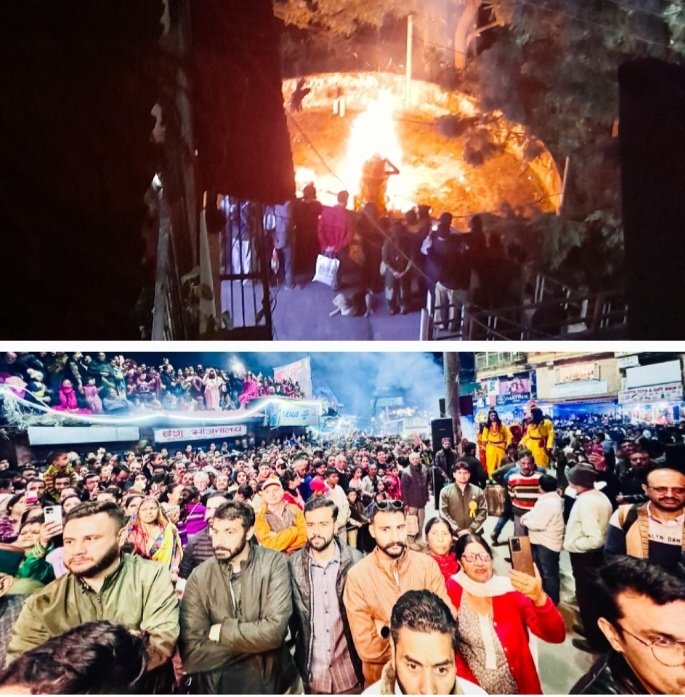
Dussehra 2026: Ravana Burns Across India as Kullu’s Grand Weeklong Festival Begins at Dhalpur Maidan
SHIMLA, October 20: As effigies of Ravana, Meghnath and Kumbhkaran went up in flames across India on Tuesday, Dussehra celebrations once again brought the familiar message of good prevailing over evil. But the smoke rising from the celebrations also revived a difficult question: can a festival that symbolically burns negative energy avoid adding to the pollution burden ahead of Diwali, the festival of lights, just 20 days away?
In Himachal Pradesh, residents gathered for effigy-burning ceremonies in Shimla and other towns, while the International Kullu Dussehra is set to begin at Dhalpur Maidan on Wednesday with the Rath Yatra of Lord Raghunath.
The Kullu festival will continue until October 27 and is expected to draw more than 300 village deities, along with their attendants, musicians and devotees.
In Shimla, celebrations were held in several of the city's 30 municipal wards. Jakhu, Sanjauli, Summer Hill, Kanlog and Bhalu Ganj were among the localities where residents gathered to watch the ceremonies.
Chief Minister Sukhvinder Singh Sukhu, along with MLAs Anirudh Singh, Harish Janartha and DC Shimla Anupam Kashyap and others offered prayers at Shri Hanuman Temple in Jakhu and set fire to the effigies of Ravana, Meghnath and Kumbhkaran. He prayed for the prosperity of Himachal Pradesh and its people.
Extending greetings on Dussehra, Sukhu said the burning of Ravana should be seen as an opportunity to resolve to eliminate personal and social evils and oppose injustice.
Fire as symbolism, pollution as a concern
The flames of Dussehra are traditionally understood as a symbolic cleansing of negative energy. The burning of Ravana represents the destruction of arrogance, greed, dishonesty and other destructive forces, while the light and warmth of the fire are associated with hope, renewal and the emergence of new energy.
Environmental activists, however, point out that the symbolism cannot be separated entirely from the physical consequences of large-scale celebrations.
Effigy burning can release smoke, particulate matter and chemical residues, particularly when effigies contain plastics, synthetic materials, paints, fireworks or metal components.
The impact may be temporary, but it becomes more significant when combined with traffic emissions, waste burning and other sources of pollution during the festive season.
The concern is likely to intensify as Diwali approaches. The festival of lights, celebrated around 20 days after Dussehra, brings another wave of fireworks, decorative waste and air-quality problems in many cities.
Environmental groups have therefore urged organisers and local authorities to use eco-friendly materials, regulate the size and composition of effigies, prevent the use of hazardous substances and ensure proper disposal of the remains.
The debate is not simply about stopping traditional celebrations. It is about finding ways to preserve their cultural and spiritual meaning without creating avoidable harm to public health and the environment.
What Dussehra signifies
Dussehra, also known as Vijayadashami, derives its name from the defeat of the ten-headed Ravana and the victory of righteousness. In the Ramayana tradition, the festival commemorates Lord Rama's victory over Ravana and the restoration of righteousness after the abduction of Sita and the conflict that followed.
The festival also carries a wider religious significance. In the Shakta tradition, Vijayadashami marks the culmination of Navratri and celebrates Goddess Durga's victory over the buffalo demon Mahishasura.
Across different regions, the festival therefore represents the victory of divine power, truth and justice over arrogance, oppression and destructive forces.
The burning of Ravana's effigy is intended to convey a moral message beyond the mythology. The ten heads are commonly interpreted as representing human weaknesses and negative tendencies that must be overcome.
The symbolism, however, acquires real meaning only when people also confront dishonesty, greed, intolerance, abuse of power and injustice in their own lives.
This is where the annual celebration meets an uncomfortable reality. The effigies are destroyed within minutes, but the social problems they symbolise continue throughout the year.
Crime, corruption, deception and hostility cannot be eliminated through ceremonial acts alone. The values associated with Lord Rama require sustained commitment to truth, accountability, compassion and fairness.
The ideal of Ram Rajya, frequently invoked in public discourse, consequently demands more than religious symbolism. It implies a society in which governance serves the public, justice is accessible, the vulnerable are protected and those in authority are accountable for their actions.
Modi calls for renewed resolve
On the national front, Prime Minister Narendra Modi extended greetings to the nation on Vijayadashami, expressing hope that the festival of joy and faith would infuse new strength into people's resolve and bring happiness, good fortune and success into their lives.
In his message, the Prime Minister wished that the occasion would strengthen people's determination and enrich their lives. The message placed emphasis on the spirit of faith and renewed resolve associated with the festival.
The larger challenge is to translate such resolve into public and private conduct. The ideals of righteousness celebrated on Dussehra are relevant not only to individual morality but also to public institutions, political life and social harmony.
Jammu and Kashmir stresses truth and communal harmony
Lieutenant Governor Manoj Sinha extended greetings on Vijayadashami, describing the festival as a symbol of the triumph of good over evil, truth over untruth, and dharma over adharma.
He said the life of Maryada Purushottam Bhagwan Shri Ram exemplified these enduring values and inspired people to lead virtuous lives. He wished for peace, happiness and prosperity for all.
Chief Minister Omar Abdullah also extended greetings on Maha Navami and Dussehra, expressing hope that the festivals would strengthen communal harmony, brotherhood, mutual respect and peaceful coexistence in Jammu and Kashmir.
The messages underline a dimension of Dussehra that extends beyond the burning of effigies: the need to sustain trust and coexistence in a diverse society.
The festival's moral message can be measured not simply by the enthusiasm with which it is celebrated but by the willingness to uphold these values in everyday life.
Kullu Dussehra begins Wednesday with Raghunath Rath Yatra
While Dussehra celebrations conclude across much of the country on Tuesday, the International Kullu Dussehra is set to begin at Dhalpur Maidan on Wednesday, October 21, and continue until October 27.
The week-long festival will get underway with the ceremonial Rath Yatra of Lord Raghunath, the presiding deity of Kullu. The chariot procession marks the beginning of one of the Himalayas' most distinctive religious and cultural gatherings.
More than 300 village deities, accompanied by their traditional attendants, musicians and devotees, are expected to congregate at Dhalpur Maidan. Their decorated palanquins, traditional instruments, ceremonial processions and distinctive local customs transform the valley into a meeting ground for the region's living religious traditions.
The gathering is not merely a festival for spectators. The deities and their followers represent village communities from across the valley, bringing together traditions that have shaped Kullu's social and cultural identity over generations.
According to the established tradition, the deities pay obeisance to Lord Raghunath and participate in the ceremonies surrounding the chariot procession. The festival culminates in the ritual of Lanka Dahan on its seventh day, October 27, symbolising the defeat of evil and the restoration of righteousness.
Kullu's celebrations are distinctive because they begin after Vijayadashami, when Dussehra festivities elsewhere are drawing to a close. The tradition is associated with the 17th-century history of Raja Jagat Singh, who installed the idol of Lord Raghunath and acknowledged the deity as the ruler of the valley. Since then, the festival has developed into a major expression of collective faith, local identity and cultural continuity.
The congregation also highlights the diversity of Himalayan religious traditions. Each deity arrives with a following and a local history, making the festival an occasion for communities to reaffirm their relationships with their deities and with one another.
Festival becomes an economic lifeline
Beyond its religious significance, Kullu Dussehra provides a major seasonal commercial opportunity for local residents, artisans, traders and small businesses.
The fairgrounds at Dhalpur attract sellers of handloom products, handicrafts, traditional garments, household goods, decorative items and local produce.
Local artisans and weavers use the festival to reach customers beyond their immediate markets, while traders from other parts of the country set up stalls to benefit from the large crowds.
Food vendors, transport operators, accommodation providers, shopkeepers and other service businesses also benefit from the increased movement of visitors. For many small traders, the festival offers a concentrated opportunity to generate income and establish contacts with customers.
The economic value of the event, however, depends on how widely these benefits are distributed. Greater tourist footfall does not automatically translate into higher earnings for local producers if most spending is captured by larger commercial operators or outside sellers.
Ensuring fair access to stalls, promoting locally made products and providing adequate facilities for small vendors can help the festival deliver more lasting benefits to the valley.
The challenge is to retain the cultural character of the fair while allowing its commercial activity to support local livelihoods.
The same livelihood question applies to the wider fireworks and crackers industry. Crackers factories continue to operate because they support thousands of families involved in manufacturing, packaging, transport, retail and related work across India. For many workers, the festive season is not merely a cultural occasion but a crucial source of annual income.
That reality makes the pollution debate more complex. Environmental activists are right to raise concerns about air quality, toxic emissions and public health, but any transition towards cleaner celebrations must also account for the workers and communities dependent on the industry. Safer production standards, cleaner technologies, regulated manufacturing and alternative employment opportunities can help reduce pollution without abruptly destroying livelihoods.
Tourists combine Kullu festivities with Manali and Durga Puja
The festival also coincides with the autumn tourism season in the Kullu-Manali region. Tourists visit the valley for its mountain landscape, local culture and religious celebrations, while the festive period provides an additional attraction for visitors planning trips around Dussehra and Durga Puja.
Visitors from West Bengal are among those drawn to the region during this period, combining holidays in Kullu-Manali with the festive atmosphere associated with Durga Puja. The overlap creates opportunities for the tourism industry, including hotels, restaurants, travel operators, taxi services and local guides.
For the region, the opportunity extends beyond the immediate festival week. A well-managed event can encourage visitors to explore nearby destinations, purchase local handicrafts and experience the cultural traditions of the valley.
At the same time, the arrival of large crowds places demands on traffic management, sanitation, waste disposal, public safety and the preservation of public spaces. The long-term success of the festival will depend on balancing visitor numbers with the needs of local residents and the fragile mountain environment.
The real test begins after the flames die down
From Shimla's neighbourhood celebrations to the mass congregation at Kullu, Dussehra brings communities together around a shared moral narrative.
The burning of Ravana's effigy offers a dramatic conclusion to the day's ceremonies, while Kullu's week-long festival carries the tradition forward through the Rath Yatra, the gathering of deities and Lanka Dahan.
Yet the deeper significance of Vijayadashami lies in the conduct it inspires after the festivities end. If truth is to prevail over falsehood, justice over injustice and goodness over evil, these principles must be reflected in personal behaviour, public administration and social relationships.
The flames can consume an effigy and symbolically burn negative energy, but they cannot independently eradicate corruption, violence or deception. Nor can a festival fire, by itself, resolve the environmental pressures created by repeated celebrations. That requires action, accountability and a willingness to confront wrongdoing while adopting cleaner and safer practices.
The livelihoods connected to crackers and festive manufacturing also deserve consideration. A responsible transition should reduce pollution while protecting workers and families who depend on the industry.
The goal should not be to place culture and livelihoods on one side and the environment on the other, but to create celebrations that are spiritually meaningful, economically inclusive and environmentally safer.
Dussehra's enduring message therefore, is not simply that evil was defeated in the past. It is that every generation must continue the struggle to uphold righteousness in the present—by rejecting social evils, protecting public health, supporting dignified livelihoods and ensuring that the light of new energy does not come at the cost of a darker, more polluted future.
#Dussehra2025 #KulluDussehra #Vijayadashami #GoodOverEvil