
Himalayan Skies Under Siege. Shut the lights on Hilltops or face annihilation of birds and biodiversity. If we don't lift the Siege our biodiversity is bound to face imminent disaster.. A Must-Read Article by a renowned " Bird Soldier ", Maj Gen Atul Kaushik.
SRINAGAR/SHIMLA: Why the Future of Migratory Birds May Depend on the Darkness We Are Losing?
The room fell silent when a vast flyway map flashed across the screen during the National Symposium on Avian Biology at Sher-e-Kashmir University of Agricultural Sciences and Technology on May 15.
The presentation by Dr Taej Mundkur, a senior advisor Wetland International based in Netherlands revealed invisible aerial highways stretching from the Arctic tundra to the Indian Ocean, carrying millions of migratory birds across continents every year.
What struck me most was the realization that the Himalayas are not remote mountain barriers but living ecological corridors linking Siberia, Mongolia, Tibet, Central Asia and the Indian subcontinent. Somewhere beneath those ancient migratory pathways lies Himachal Pradesh, quietly functioning as part of a global system of survival and movement.
For migratory birds, Himachal is not peripheral geography but an active section of the route itself.
The valleys of Lahaul-Spiti, Kinnaur, Baspa and Sutlej, along with Kangra wetlands and Shimla’s ridge forests, serve as critical resting, feeding and navigational landscapes across one of the harshest mountain terrains on Earth.
The presentation explained how migratory species depend upon wetlands, forests, river corridors, ridge thermals and uninterrupted ecological connectivity to complete their journeys.
What appears to us as untouched wilderness is actually living infrastructure supporting biological movements older than human civilization.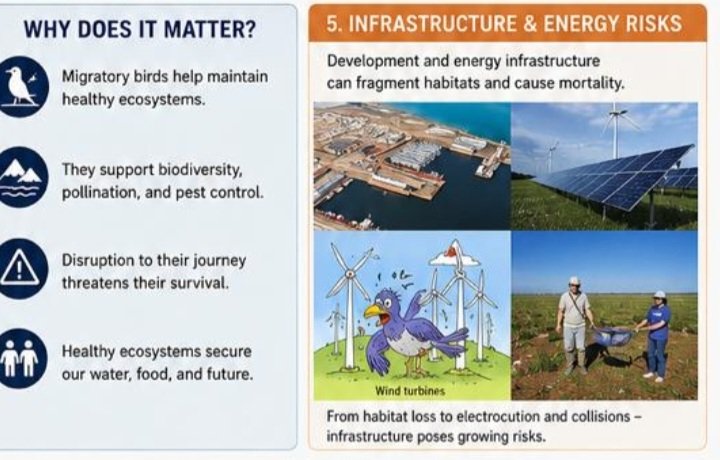
Then came a disturbing image of thousands of birds circling helplessly inside a beam of urban light, drawn away from natural pathways into human settlements.
The slide carried a stark warning that urban glow attracts birds into illuminated environments where collision risks and disorientation rise dramatically.
At that moment, the discussion stopped being theoretical because Himachal’s mountains are rapidly losing their natural darkness.
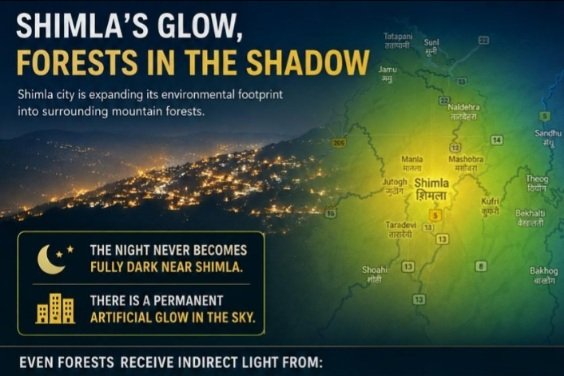
Satellite illumination maps now show expanding night glow spreading outward from Shimla, Solan, Baddi, Chail, Kufri and growing tourism corridors into forests and catchment zones that once remained naturally dark.
Even protected Himalayan ridges today sit beneath an artificial sky created by highways, hotels, ridge-top settlements and expanding urban clusters. This transformation is not merely cosmetic because migratory birds rely on stars, moonlight, geomagnetic orientation and natural darkness to navigate across continents.
When mountain landscapes remain permanently illuminated, birds become disoriented and migration routes begin to fragment under continuous ecological stress. Collision risks increase while feeding, resting and behavioural rhythms become disturbed across entire migratory systems.
The Himalayan terrain intensifies the problem because fog and cloud cover reflect artificial light back into valleys, creating glowing atmospheric traps for nocturnal migrants. In fragile mountain ecosystems, even small increases in illumination can travel farther and scatter more intensely due to altitude, moisture and reflective terrain.
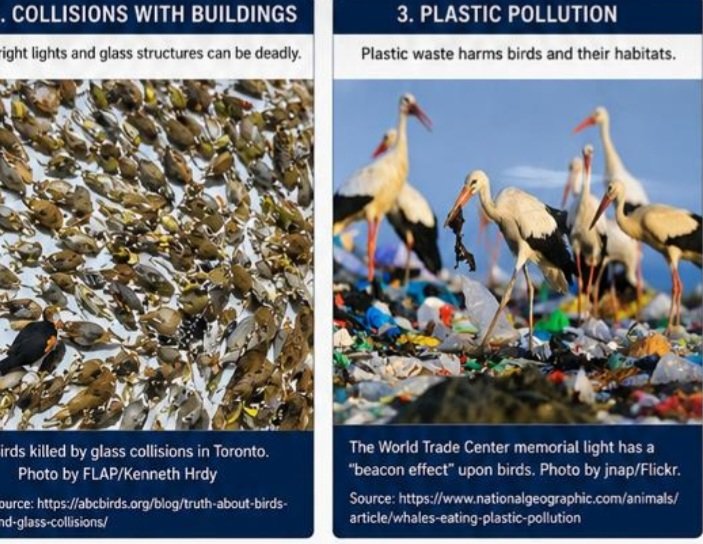
Several slides presented examples from across the world showing migratory birds killed after crashing into illuminated glass buildings and urban infrastructure. Others highlighted how power lines, reflective surfaces, wind turbines, plastic pollution and expanding night illumination are simultaneously disrupting migration corridors across continents.
What became increasingly clear was that these are no longer isolated environmental concerns but interconnected pressures acting upon already fragile ecological systems. The Himalayas occupy a uniquely sensitive position because they are biodiversity zones, climate-regulating landscapes, water catchments and international migratory corridors all at once.
What happens in Himachal therefore does not remain local because ecological disruptions in mountain passages ripple across entire flyways. A degraded wetland in Kangra may erase a vital resting stop for birds travelling thousands of kilometres, while illuminated ridges in Shimla can alter nocturnal navigation patterns across mountain corridors.
This is why the pace and pattern of mountain development now demand deeper ecological scrutiny. Expanding road construction towards Chail-Koti-Kufri, Karol-ka-Tibba, Churdhar and Shalli Tibba is steadily fragmenting naturally dark Himalayan corridors that once allowed uninterrupted migration.
The illumination surrounding Jakhu ridge after large-scale tree cutting has become symbolic of how rapidly the mountain skyline itself is changing. What earlier disappeared into darkness after sunset is now permanently visible from surrounding ridges under artificial lighting.
Artificial lighting continues to be treated as a harmless marker of development despite mounting evidence of its ecological costs. Studies increasingly show that excessive night illumination disrupts insect populations, nocturnal pollinators, predator-prey balance and broader ecological rhythms essential for biodiversity survival.
One of the strongest messages emerging from discussions around the Central Asian Flyway is that conservation itself must evolve beyond traditional protected boundaries. Ecological connectivity, dark sky preservation, migratory pathways and urban illumination now need to become central components of environmental planning.
The night sky itself must be understood as habitat because for migratory birds darkness is not emptiness but ecological infrastructure. Flooding mountain landscapes with artificial illumination means altering biological systems that have guided migration naturally for thousands of years.
The Himalayas still retain something increasingly rare in the modern world through connected forests, elevated dark corridors and ecological continuity. Yet the growing illumination visible across Himachal’s ridges signals that the ecological identity of the mountains is changing far faster than public policy currently acknowledges.
The question before Himachal is no longer whether development should happen because that transformation is already underway. The real challenge is whether mountain development can remain ecologically intelligent while preserving the fragile systems that allow life to move safely across the Himalayan night sky.
Perhaps the future of migratory birds in the Himalayas will depend not only on forests and wetlands protected on the ground but also on whether we learn to protect the darkness above them. In the end, the battle for biodiversity in the mountains may become as much about saving the night as saving the land itself.
For all who care about nature and biodiversity and the authority in India and abroad it is as simple as this: Lift the Siege on Himalayan Skies Before the Mountains Fall Silent.
About the Writer:
Maj Gen Atul Kaushik, SM, VSM (Retd), is a decorated Indian Army veteran and former Commandant of the High Altitude Warfare Institute, Gulmarg, who is now widely recognised as a renowned “Bird Soldier” championing Himalayan ecology.
Shimla- based expert now leads environmental advocacy through his NGO PSPK, focusing on migratory bird corridors, dark sky conservation and protection of fragile mountain ecosystems, while also collaborating with HimBumail(https://www.himbumail.com) on Himalayan environmental awareness initiatives.
#HimalayanSkies
#DarkSkyConservation
#CentralAsianFlyway
#SaveMigratoryBirds