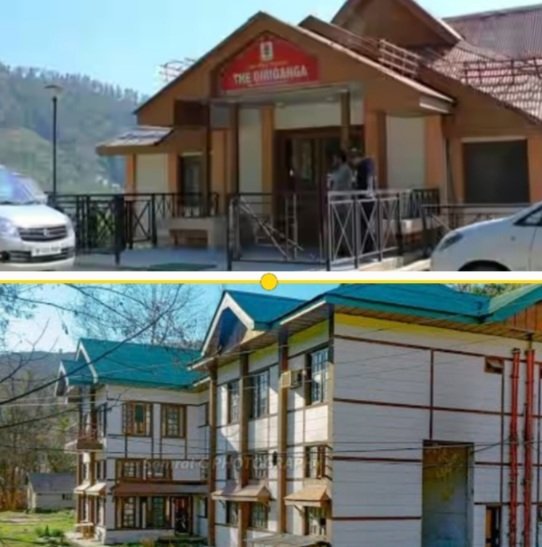
 Shimla/Dharamshala, June 15: In a significant austerity measure that underscores the worsening financial health of the Himachal Pradesh Tourism Development Corporation (HPTDC), the corporation has withdrawn all discount and concessional facilities being extended to its Chairman, Managing Director, Board of Directors and accredited media persons with immediate effect.
The decision, communicated through a notification issued by HPTDC Managing Director Rajiv Kumar on Monday and accessed by HimbuMail, comes against the backdrop of mounting financial pressures on both the state government and the loss-making tourism corporation.
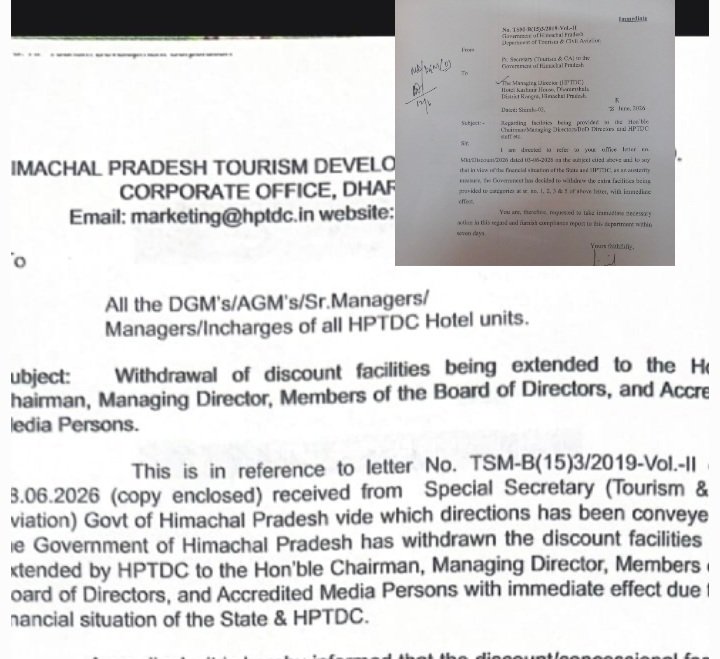
The order cites directions conveyed by the Special Secretary (Tourism and Civil Aviation), Government of Himachal Pradesh, and states that all discounts being enjoyed by these privileged categories stand withdrawn with immediate effect due to the "financial situation of the State and HPTDC."
All Drawing and Disbursing Officers (DDOs) and hotel unit in-charges have been directed to ensure strict compliance and not allow any concession to the specified categories from the date of issuance of the letter.
A Corporation Under Pressure
The move is being viewed as more than a routine administrative decision. It comes at a time when HPTDC has been facing intense scrutiny over its financial performance despite owning some of the most sought-after hospitality properties in Himachal Pradesh.
The corporation operates hotels, resorts and restaurants at prime tourist destinations including Shimla, Manali, Dharamshala, Dalhousie, Chail, Kasauli, Kullu, Sarahan and Keylong. Yet, several of its units have struggled to generate profits consistently.
Ironically, many private hotels operating in the same destinations have been reporting healthy occupancies and profits while HPTDC has continued to grapple with operational inefficiencies, rising employee costs and maintenance burdens.
High Court Had Sounded the Alarm
The issue of loss-making HPTDC units has repeatedly come under the scanner of the Himachal Pradesh High Court.
In previous hearings, the High Court had expressed concern over the continued operation of units running in losses and reportedly questioned why public money should be used indefinitely to sustain unviable establishments.
The court had gone to the extent of suggesting closure or restructuring of chronically loss-making units if they failed to improve their financial performance.
The court's observations had put the spotlight on the corporation's business model and its ability to remain financially sustainable despite possessing valuable tourism assets.
End of a Culture of Concessions?
Tourism industry observers say the withdrawal of discounts may appear minor in monetary terms but carries a strong symbolic message.
For years, concessions and discounts to privileged sections have been viewed by critics as part of a culture that burdened public sector enterprises while offering little commercial benefit in return.
With the state government itself battling fiscal constraints and implementing expenditure-control measures across departments, the continuation of such concessions was becoming increasingly difficult to justify.
The latest order signals that HPTDC is now being pushed towards a more business-oriented approach where every room sold and every service provided must contribute to revenue generation.
But Will This Be Enough?
Industry experts caution that ending concessions alone will not transform HPTDC's fortunes. Will its order be binding on all? But HPTDC has not cleared whether the concessions will be given to political class for holding press conference or marriage parties in HPTDC units?
The files will go for approval to MD/Chairman as individuals concessions is one thing and other occasions are another, explained officials.
Visitors frequently raise concerns regarding inconsistent service standards, delayed maintenance, ageing infrastructure, housekeeping issues and uneven food quality across some units.
While several HPTDC properties continue to enjoy excellent reputations, others have struggled to keep pace with the expectations of modern tourists.
The challenge becomes even more glaring because many HPTDC hotels occupy locations that private operators can only dream of acquiring today.
"Prime location alone is no longer enough. Tourists expect quality rooms, professional service, digital booking convenience and value for money," said a tourism stakeholder familiar with the sector.
Scope for a Turnaround
Tourism experts believe HPTDC still possesses significant strengths.
Its network spans virtually every major tourist circuit in Himachal Pradesh. Many of its hotels offer unmatched views and strategic locations. The corporation also enjoys strong brand recognition among domestic travellers.
If coupled with professional management, better marketing, aggressive online promotion, service quality upgrades and tighter financial discipline, HPTDC could potentially emerge as a profitable public sector enterprise.
The withdrawal of concessions may therefore be seen as the first step in a larger effort to plug revenue leakages and improve financial accountability.
The Bigger Question
The real test, however, lies ahead.
Will the end of discounts for privileged categories merely save a few lakhs, or will it mark the beginning of deeper reforms in HPTDC's functioning?
As Himachal's flagship tourism corporation attempts to fight financial headwinds, stakeholders will be watching closely to see whether the organisation can convert its enviable property portfolio into a sustainable and profitable business model.
For now, one thing is clear: the era of subsidised hospitality for select categories at HPTDC appears to have come to an end, and the corporation has been forced to confront an uncomfortable reality—prime assets alone do not guarantee profits.
But Will HPTDC implement it in letters and spirits or is it just a short-lived hogwash? WIll political and media sections obey it or browbeat it and force the Sukhu government to revert its notification. These questions hang in air to find answers as of now.