

Conservation Efforts Bring New Hope for Cheer Pheasant in Himachal
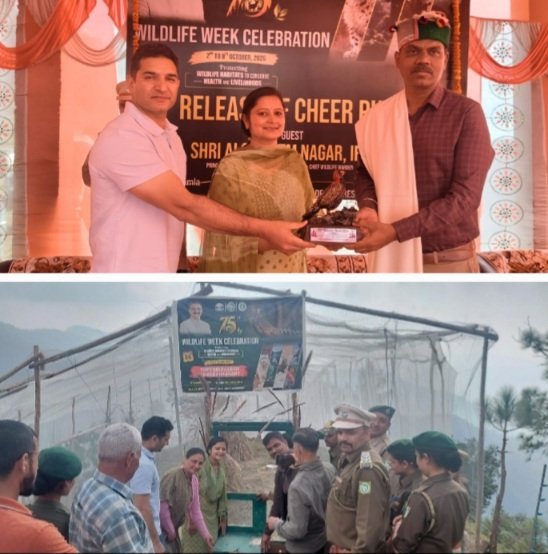
SHIMLA, OCTOBER 6: Himachal Pradesh’s sustained conservation efforts have brought fresh hope for the recovery of the threatened Cheer Pheasant, with nine captive-bred birds being soft released at Moi Jubbar in Koti, Shimla, on Tuesday.
The release of two families of Cheer Pheasants marks another step towards rebuilding the species’ population in its natural habitat and expanding the state’s reintroduction programme to a third site.
The birds, brought from the Cheer Pheasant Conservation Breeding Programme facility at Chail, were soft released by APCCF (Wildlife) K. Thirumal in the presence of Conservator of Forests, Wildlife Circle (South), Shimla Preeti Bhandari, wildlife officials, Koti Gram Panchayat Pradhan Pratibha, local residents and forest staff.
The nine birds will initially remain inside a soft-release enclosure for about a month. This will allow them to acclimatise to the local terrain, weather and forest conditions while developing essential survival skills.
During this period, the birds will be closely monitored as they learn to identify natural food, respond to predators and adapt to the surrounding habitat. Once acclimatised, they will be released into the wild.
The latest release gains significance against the encouraging survival record of earlier releases. Cheer Pheasants released during 2023 and 2024 recorded survival rates of around 92% and 100%, respectively.
More importantly, conservation teams have found evidence of captive-bred birds interacting and interbreeding with wild Cheer Pheasants. The subsequent successful hatching of chicks has provided one of the strongest indications yet that the reintroduction programme is helping captive-bred birds integrate with natural populations.
Moi Jubbar is the third release site under the state’s Cheer Pheasant Reintroduction Programme. Earlier releases were undertaken at Seri and Shilli Mehli in Shimla.
The Cheer Pheasant, scientifically known as Catreus wallichii, is classified as Vulnerable on the IUCN Red List. Its numbers have declined because of habitat degradation, fragmentation and increasing human pressure on its natural range.
The Forest Department’s programme combines captive breeding, habitat management, soft release, post-release monitoring and participation of local communities to establish viable populations of the species in the wild.
Speaking on the occasion, K. Thirumal stressed that restoring threatened species to their natural habitats requires not only scientific conservation but also sustained support from local communities. He appreciated the wildlife wing, conservation breeding team, field staff and residents involved in the programme.
The evidence of survival, natural breeding and chick hatching has given the conservation programme a significant boost, raising hopes that Cheer Pheasant populations can gradually recover across suitable habitats in Himachal Pradesh.
The initiative is also in keeping with the theme of Wildlife Week 2026—“Protecting Wildlife Habitats to Conserve Health & Livelihoods”—putting the focus on protecting the habitats on which threatened species ultimately depend.
#CheerPheasant #WildlifeConservation #HimachalPradesh #WildlifeWeek2026