Samridh Himachal 2046: Seminar Questions Conventional Development Model, Calls for Multisectoral Approach.
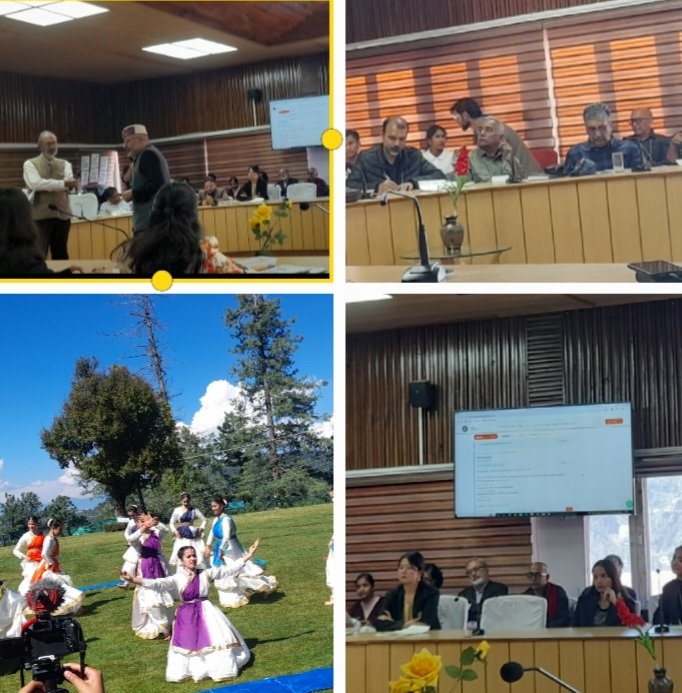
SHIMLA — The three-day seminar on “Satat, Samridh and Swalamb Himachal” at MSHIPA brought together former chief secretaries, administrators, academics, military professionals, social-sector leaders, environmental experts, lawyers and grassroots practitioners and media to examine whether Himachal Pradesh’s present development model can meet the challenges of the next two decades.
The discussions questioned an infrastructure-heavy and GDP-driven approach to growth, while focusing on ecological fragility, climate disasters, hydropower risks, fiscal pressures, demographic change, drug addiction, health, tourism, horticulture, human capital and the widening gap between policy formulation and implementation on the ground.
DG MSHIPA Rupali Thakur and Joint Director Prashant Sirkek outlined the Samridh Himachal Mission 2046, which is being conceived a year ahead of the Government of India’s Viksit Bharat 2047 goal.
The first part of the exercise has examined what Himachal needs in areas including development, horticulture, new knowledge hubs, cold chains, value addition and new economic opportunities.
MSHIPA clarified that Samridh Himachal 2046 is not intended to tinker with or dilute Section 118. Rather, the approach is to examine Himachal’s problems through multiple sectors and build a coordinated framework addressing the state’s economic, social, environmental, demographic, governance and infrastructure challenges.
Former Chief Secretary and former President of IMI Ramesh Negi raised one of the strongest concerns over the conventional development model, particularly hydropower.
He said that with rising risks from Glacial Lake Outburst Floods (GLOFs) and climate-driven disasters, hydropower can no longer automatically be treated as a safe option.
Negi pointed to the fragile and seismically sensitive character of the Himalayas and cited the figure that the Himalayan region accounts for about 39 per cent of disaster losses in India despite covering around 18 per cent of the country’s area.
He argued that such risks must be factored into decisions on large infrastructure projects.
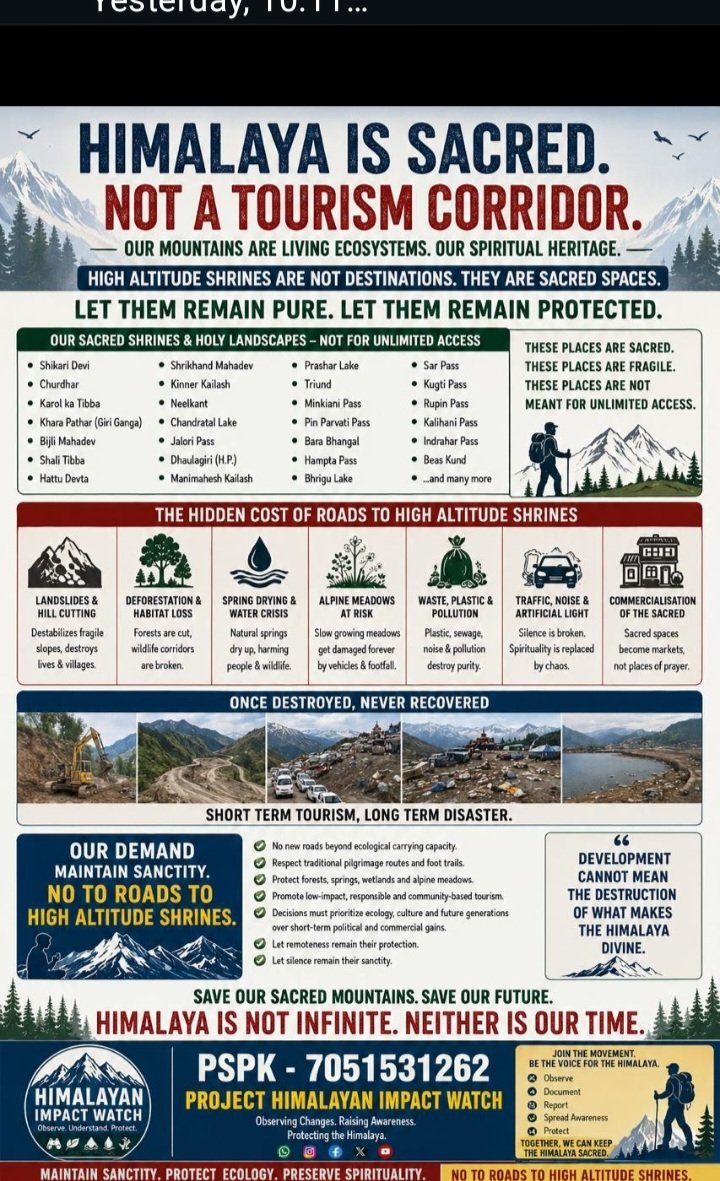
Major General Atul Kaushik, SM, VSM, CEO, PSPK Green Spirituality, questioned the GDP-driven growth model, arguing that a consumption-led economy can encourage greater consumerism and pressure on natural resources.
He said nature should be treated as a prime stakeholder in development, rather than merely as a resource from which economic value is extracted.
The ecological debate extended beyond hydropower. Speakers questioned whether roads, buildings and other infrastructure should continue to be treated as the principal indicators of development when mountain ecosystems are already under pressure from construction, changing rainfall patterns, landslides, floods and other extreme events.
Former Chief Secretary Prabodh Saxena identified a different but interconnected set of challenges — disasters, limited financial resources, health problems, demographic change, low fertility and drug addiction.
Saxena noted that some emerging health problems were associated not with poverty but with prosperity and changing lifestyles.
He also highlighted Himachal’s low fertility rate and suggested using the 1990s as a reference period to assess how the state has changed and what it actually needs now, including a discussion on opening up new economic opportunities.
The financial sustainability of the state emerged repeatedly during the discussions.
CAG Auditor raised concerns over limited internal revenue, committed expenditure and the continuing burden of salaries, pensions and interest payments. The question was whether Himachal can sustain an infrastructure-intensive model without simultaneously creating stronger revenue-generating activities and improving expenditure efficiency.
Dr Vaneet Jishtu, a field Botanist brought attention to the state’s natural resources, native vegetation and traditional knowledge, arguing for greater recognition of resources that can generate livelihoods without undermining ecological systems.
The discussion also questioned the way tourism is being developed. Speakers argued that Himachal cannot rely merely on promotion and construction but needs carefully managed eco-tourism, adventure tourism, wellness tourism and heritage tourism that generate local livelihoods while respecting carrying capacity.
Col HS Chauhan former Director AIMAS Manali with extensive experience in adventure activities and village-level work highlighted the need to train local youth rather than simply opening trails and tourism facilities.
Adventure tourism, homestays and other emerging sectors, he argued, require specialised skills, safety awareness, hospitality training and community participation.
The issue of local participation ran through the seminar. Speakers pointed out that Panchayati Raj institutions exist, but villagers are not always adequately involved in development decisions and discussions.
Political divisions, lack of awareness and weak understanding of government processes can prevent communities from participating effectively.
The discussions also highlighted the changing character of Himachal’s villages, including migration, empty houses, declining local populations and children becoming increasingly disconnected from traditional community life and the surrounding environment pursuing career outside the State and abroad.
Social-sector leader Anshu Gupta of Goonj and Magsaysay Award recipient brought an external perspective to the disaster debate, citing floods in Nepal and the 2023 Kedarnath tragedy in Uttarakhand as warning signs for Himalayan communities.
His intervention underlined the need to learn from disasters elsewhere rather than waiting for similar events to expose vulnerabilities in Himachal.
Deepak Sanan, former Additional Chief Secretary, contributed to the debate on governance, institutions and the implementation gap, while Deven Khanna, lawyer and associated with the Shimla Collective, brought legal and civic perspectives to questions of environment, governance and public accountability. He cited how wildlife sanctuaries are being fiddled with pruned dislodging wildlife.
Dr Anourita, a college principal, stressed the importance of training and capacity building of politicians and elected representatives, arguing that development policies cannot be effectively implemented if decision-makers at different levels lack the knowledge and institutional capacity required to understand emerging challenges.
Organiser Abhishek, a civil society leader based in Solan other participants also emphasised the importance of bringing professionals, civil society organisations and local communities into the development process rather than leaving policy discussions confined to government offices and seminars.
The debate further touched upon research, knowledge and skills. Speakers argued that Himachal needs new knowledge hubs and stronger research capacity if it wants to move towards a knowledge-based economy rather than remain dependent on conventional sectors.
The same principle was applied to horticulture. Instead of merely increasing production, SAMRIDH HIMACHAL proponents called for stronger cold chains, processing, value addition, branding, logistics and market linkages, so that a larger share of the economic value generated by Himachal’s agricultural and horticultural produce remains within the state.
A recurring concern was that Himachal often produces raw material while value addition and higher-end processing take place elsewhere. The proposed knowledge and value-chain approach therefore seeks to connect farmers, technology, processing, storage, markets and local enterprises.
The seminar also questioned whether environmental protection should remain a separate departmental concern. Speakers argued for development planning in which forests, water, geology, climate, settlements, infrastructure and livelihoods are considered together.
The second and third days of the programme would shifted the discussion to ground, focusing on local people, their lifestyles and the impact of development on communities. Participants from different fields examined how the work of one sector affects another, and how decisions taken at the policy level eventually alter village life, natural resources and local economies.
The organisers also used informal interaction, outdoor activities and open discussions to encourage participants to understand the landscape and communities beyond formal presentations.
The programme included an open dialogue, stargazing, hiking and dance performances cresting Panch Tatvas intended to encourage interaction among participants from different backgrounds.
It was whether the state can create a multisectoral development model in which economic growth is considered alongside ecological limits, disaster risk, public finances, demographic change, health, human capital, local participation and institutional capacity.
The Samridh Himachal 2046 exercise, as clarified by MSHIPA, is consequently being positioned not as an exercise to alter Section 118, but as an attempt to bring together these otherwise separate questions and identify practical solutions for Himachal’s long-term development.
The challenge now is implementation. As the discussions repeatedly underlined, ideas generated at conferences will have limited impact unless they travel from policy rooms to ground zero — villages, Panchayats, farms, forests, tourism destinations and local institutions — with civil society, professionals, administrators, elected representatives and communities working together.
This version keeps all the major speakers and interventions in one narrative, while making the final paragraphs carry the second/third-day “ground connection” theme and the MSHIPA clarification on Section 118.