
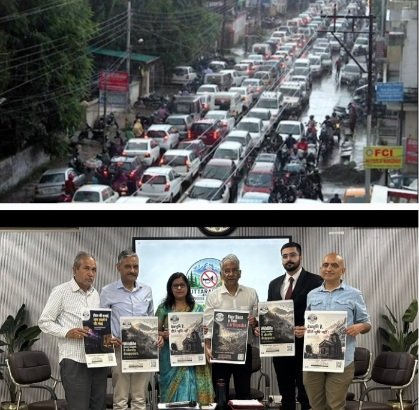
Noise Rules on Paper, Noise Menace on Dehradun Streets. All complaints and memorandum fell on deaf ears of the Dhami Government and its agencies.
DEHRADUN, September 24, 2026: Horns blaring through traffic, loudspeakers booming from public and religious events, DJs and music systems operating at high volume, and fireworks adding to the din are increasingly making life difficult for residents across Dehradun, even as the agencies including pollution regulator responsible for controlling noise pollution face public ire over enforcement.
The issue came sharply into focus at a public awareness discussion organised by Uttarakhand Against Noise Pollution (UANP) in collaboration with the Doon Library and Research Centre, where nearly 100 citizens gathered to discuss the growing noise menace and the legal remedies available to them.
The discussion exposed a widening gap between noise-control rules on paper and enforcement on the ground.
The Noise Pollution (Regulation and Control) Rules, 2000 require authorities to enforce prescribed ambient noise standards and specifically include noise from vehicular movement within the measures for noise abatement.
For residential areas, the prescribed limit is 55 dB(A) during the day and 45 dB(A) at night. The rules define daytime as 6 am to 10 pm and night-time as 10 pm to 6 am.
Yet residents say excessive honking, modified exhausts, pressure horns, loud music and amplified sound continue to add to the miseries of law abiding citizens in the city.
The problem becomes particularly acute in congested residential areas where traffic noise combines with sound from commercial establishments, weddings, religious events, restaurants, homestays and other venues.
The Uttarakhand Pollution Control Board, Dehradun traffic police and the Municipal Corporation are among the agencies expected to play a role in addressing different dimensions of the problem.
The Noise Rules place responsibility for enforcement on the designated authority, while the rules also require the State Government to take measures to control noise arising from vehicular movement.
The question raised by citizens is therefore not whether regulations exist, but how consistently they are being enforced.
Traffic noise remains one of the most visible forms of the problem. Uttarakhand Traffic Police itself states that reducing noise and air pollution is part of its objectives.
Its published guidance says vehicles should not cause undue noise, prohibits multi-toned horns producing harsh, shrill, loud or alarming sound, and identifies excessive vehicle noise as a form of noise pollution.
The issue of pressure horns has also acquired a specific legal dimension in Uttarakhand. In a 2024 order, the Uttarakhand High Court directed senior police officers to ensure that horns are not used in silence zones or during night hours in residential areas except during public emergencies, noted that pressure horns are banned in the state, and directed enforcement against violations.
Despite this framework, residents attending the Dehradun discussion described a city where the repeated use of horns and high-volume sound has become part of everyday life.
The loudspeaker issue is equally stark. Under the Noise Rules, loudspeakers and public-address systems require written permission from the competent authority. Their use is prohibited between 10 pm and 6 am, subject to limited exemptions for specified cultural or religious occasions.
Citizens at the meeting said the problem is not confined to a particular category of activity. Residents living close to religious places, restaurants, homestays, wedding venues and other establishments spoke of recurring disturbance from loudspeakers, DJs, music systems and fireworks.
UANP co-founder and social activist Anoop Nautiyal said the collective has submitted around 30 representations to government and civic authorities, including the Chief Minister’s Office, Chief Secretary, Municipal Commissioner, Uttarakhand Pollution Control Board, District Magistrates and senior police officers in different districts.
The collective has also taken up complaints involving establishments in and around Malsi, including Taj Mussoorie Foothills, Fairfield by Marriott and Nukkad Restaurant & Bar, according to the organisers.
Nitin Ahlawat, co-founder of UANP, said the objective was not to oppose weddings, celebrations, religious activities or businesses but to ensure that such activities comply with applicable noise regulations and do not impose prolonged disturbance on surrounding residents.
Advocate Pranav Puri explained the legal framework and told participants that citizens have specific remedies when noise crosses prescribed limits. Under the Noise Rules, a person can complain to the competent authority where noise exceeds the applicable ambient standard by 10 dB(A) or more, and the authority is required to act on such a complaint.
The rules also provide the authority with powers to prohibit, control or regulate continuing music, loudspeaker use or other noise-producing activities when they cause or threaten annoyance, disturbance, discomfort or injury to people living nearby.
The discussion brought out the human cost of what is often dismissed as an ordinary urban nuisance. Maj. Gen. Atul Rawat (Retd.) said persistent noise had affected residential life to such an extent that he had spent substantially on soundproofing his windows.
Vinesh Rawat spoke about the impact of loud music and fireworks on his young grandchildren.
Karuna Thapliyal described her experience of living near a homestay in the Kuthal Gate area, saying persistent noise became so difficult to manage that she eventually sold her house and moved elsewhere.
Residents from areas around Tapkeshwar Mandir also raised concerns over recurring loud music and loudspeakers.
One participant described an incident in which an elderly person had to spend the night at a neighbour’s house because a loudspeaker installed close to his boundary wall continued disturbing him late into the night.
The accounts underline a larger civic problem: noise pollution is often treated as an unavoidable part of city life until it reaches the point where residents are forced to complain, relocate or spend their own money to protect their homes from noise.
UANP managing editor and co-founder Keerti Ahlawat, who moderated the discussion, said the objective was to move the conversation beyond individual grievances and help residents understand how violations can be identified, documented and taken up with the appropriate authorities.
Participants were advised to maintain records of the date, time, location, duration and source of excessive noise and, where possible, preserve timestamped photographs, videos, decibel readings and copies of complaints. Collective complaints from affected residents were also encouraged.
The discussion also highlighted the need for stronger coordination between the pollution-control authorities, police and municipal agencies. While each agency has defined responsibilities, residents said the absence of visible and sustained enforcement leaves them repeatedly dealing with the consequences.
The organisers said the campaign would next move into schools and colleges to create awareness among young people about noise pollution and responsible civic behaviour. UANP also plans to encourage neighbourhood volunteers to document recurring problems and engage with authorities through institutional and legal channels.
For Dehradun residents, however, the immediate question remains whether the city’s noise regulations will move beyond official documents and become visible enforcement on the streets. With legal standards already prescribing limits, regulating loudspeakers and providing mechanisms for complaints, the growing public concern is increasingly centred on implementation rather than the absence of rules.
#Dehradun #NoisePollution #Uttarakhand #CivicIssues