
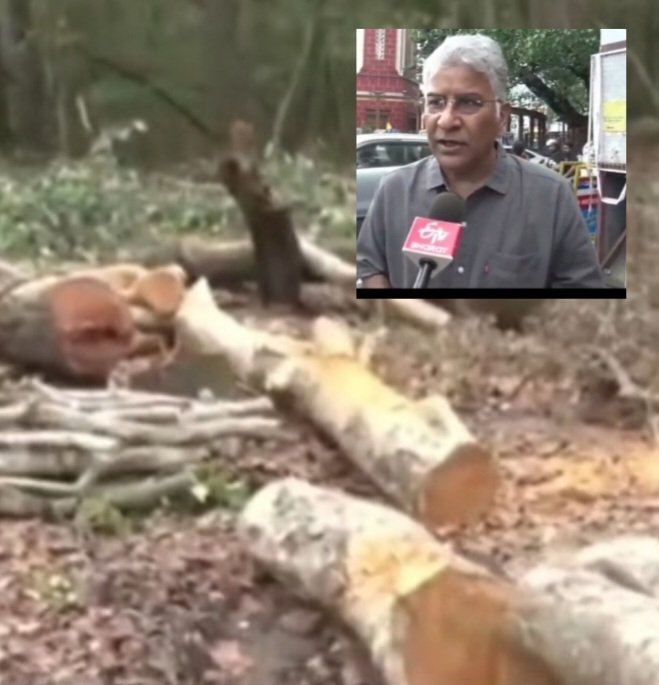
Doon Valley at a Crossroads. Nearly Half of Uttarakhand's Forest Diversion Concentrated in Dehradun, Ecologists Raise Red Flag
DEHRADUN, JULY10: The real estate sharks have set their eyes on Doon Valley. The massive diversion of forest land in Dehradun district has triggered fresh concerns among environmentalists, who warn that the Doon Valley is once again paying the price for an increasingly Dehradun-centric development model driven by infrastructure expansion and an aggressive real estate boom.
An RTI-based analysis by Anoop Nautiyal, President of the SDC Foundation, Dehradun, reveals that more than 46,000 hectares of forest land have been diverted for non-forest purposes across Uttarakhand during the last 25 years—an average of nearly five hectares every day.
What has alarmed conservationists is that 47 per cent of the state's total forest diversion has taken place in Dehradun district alone, despite the district accounting for only about six per cent of Uttarakhand's geographical area.
Calling the figures deeply disturbing, Nautiyal said they point towards a highly skewed pattern of development where the ecological cost is being borne disproportionately by the Doon Valley.
"This is not merely a statistic; it is a warning signal. Dehradun has become the epicentre of forest diversion in Uttarakhand. The valley's forests are steadily giving way to roads, construction projects, commercial expansion and urban sprawl," he said.
Environmentalists believe the ongoing National Highways Authority of India (NHAI) four-laning project between Dehradun and Rishikesh has further strengthened the perception among land developers that the Doon-Rishikesh corridor is the state's most lucrative real estate destination.
Improved connectivity is expected to accelerate demand for residential townships, luxury housing, hospitality projects and commercial establishments along the corridor.
According to ecologists, the Doon-Rishikesh region has increasingly become the preferred destination for real estate investors because of its strategic location.
Besides being within convenient reach of Delhi, the region serves as the gateway to the Char Dham pilgrimage and the internationally renowned spiritual centres of Rishikesh and Haridwar.
They fear that this combination of religious tourism, infrastructure expansion and speculative land investment is placing unprecedented pressure on forests and agricultural land.
Experts argue that the concentration of development in Dehradun reflects a lopsided policy approach that risks undermining the ecological resilience of the Himalayan state.
They warn that continued diversion of forests could lead to shrinking green cover, declining groundwater, fragmentation of wildlife habitats, higher urban temperatures and increased vulnerability to floods and landslides.
The concerns are particularly significant because the Doon Valley has witnessed a similar ecological crisis in the past. Indiscriminate limestone mining had devastated the valley during the 1980s before judicial intervention halted mining operations.
In 1989, the valley was recognised as one of India's first Ecologically Sensitive Areas, marking a landmark victory for environmental conservation.
Conservationists now fear that while mining may have receded, the new threats are far more complex.
They say rampant urbanisation, expanding highways, unchecked real estate development and continuous forest diversion are gradually eroding the ecological safeguards that earlier generations fought hard to secure.
Nautiyal has called for a comprehensive review of forest diversion policies and urged the Uttarakhand government to adopt a more balanced regional development strategy so that economic growth does not remain concentrated in Dehradun at the cost of its forests.
He has Uttarakhand CM Pushkar Singh Dhami to review the reckless cutting of forest in the name of infrastructure development and save ecology of Doon Valley.
"The future of the Doon Valley cannot be determined solely by the demands of the real estate market. Development must respect ecological limits if Uttarakhand is to safeguard its natural heritage for future generations," he said.
The RTI findings revealed Uttarakhand's development trajectory is becoming excessively centred on the Doon Valley. The ecologists warn that unless corrective measures are taken, the state risks sacrificing one of its most ecologically significant landscapes to unplanned urban expansion.