
Flames, Plastic Waste and Trucks in the Giri Riverbed at the Renuka Ji Fair Ruin Environment
RENUKAJI:
Sacred Fair, Messy Aftermath: What I Witnessed on the Giri Riverbed and Fairgrounds at Renuka Ji
By the CEO, Pahari Samaj Paryavarni Kawach Foundation (PSPK) | Shimla / Sirmaur
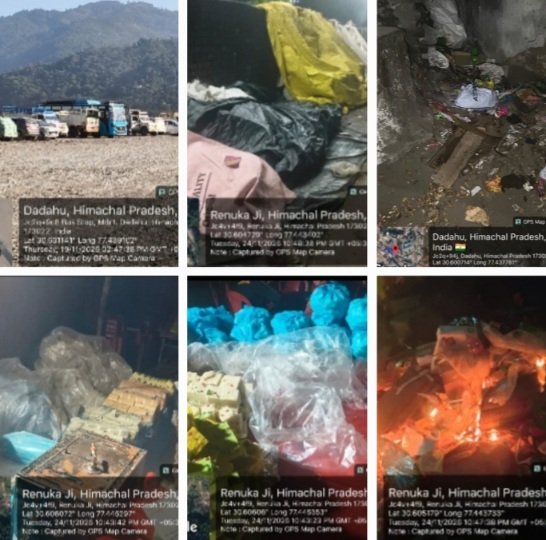
SHIMLA / SIRMAUR — Between November 18 and November 24, I walked the fairgrounds of Renuka Ji and the river corridor at Dadahu with our inspection team and volunteers to see how one of Himachal Pradesh’s most revered cultural gatherings was handling its environmental footprint. Using dated, location-tagged camera photographs across four days of field visits (excluding unrelated Nahan Chaugan photographs), I documented a stark contrast between a sacred pilgrimage and what was happening on the ground: widespread plastic coverings on temporary stalls, scattered packaging in market lanes and near Dadahu, an active late-night refuse fire on November 24, and dozens of vehicles parked or operating on exposed gravel along the Giri riverbed—including a goods vehicle standing in shallow flowing water.
In sharing this first-hand account, I am careful to separate what my camera directly captured from what still requires official verification. Photographs alone do not establish the identity of individuals responsible, the chemical composition of burning material, total waste quantities, or breaches of specific court orders or statutory limits.
Yet what I witnessed convinces me that festival management must be assessed by its environmental aftermath, not merely by visitor numbers and daytime sanitation arrangements.
How My Four Days of Field Inspections Unfolded
Across the week, my team and I tracked conditions around Renuka Lake, the temple precinct, market passages and Dadahu:
November 18: I visited the Renuka Lake and temple area as well as Dadahu, spoke with local officials and shopkeepers, and observed clean working toilets, clear signage, stocks of alternative disposable plates, lake lighting, reported Pollution Control Board sound-monitoring near the temple area, and early Giri riverbed parking, including a nighttime goods truck at 8:32 PM.
November 19: Volunteers from our foundation ran a plastic-free awareness drive with banners and visitor outreach, while my daytime location-tagged photographs recorded rows of passenger and commercial vehicles on exposed Giri riverbed gravel, fruit and sugarcane-juice vending on the gravel, and a goods pickup standing in shallow flowing river water.
November 23: Location-tagged photographs from Dadahu (around 30.600213° N, 77.437419° E) showed a large pile of charred mixed waste beside a structure, underscoring the need to check for repeated open dumping or burning.
November 24: During afternoon and late-night rounds, I recorded widespread riverbed parking, litter near the Dadahu bus-stand area and fair stalls, heavy use of synthetic sheeting, active sweeping alongside mixed refuse, and an active waste fire late at night.
Flames in the Night and Waste Hotspots in Dadahu
The most troubling scene I encountered came on the night of November 24 at 10:47:38 PM in Renuka Ji (30.605179° N, 77.443733° E), where I photographed live flames burning inside a pile of discarded packaging and mixed waste.
Seen alongside the charred mixed refuse photographed in Dadahu on November 23, the evidence points to the need to investigate repeated open dumping or burning.
While laboratory testing or closer inspection is required to identify exact materials and emissions, authorities must halt open burning, identify who is responsible for these burn sites and document enforcement action.
Walking through market lanes and Dadahu late on November 24, I saw plastic films, food wrappers, disposable cups and mixed debris scattered around roadside structures near the Dadahu bus stop, opposite the Civil Hospital, at the base of a wall, along the Sangrah–Renukaji–Nahan Road and near the Dadahu river corridor.
In one spot in Renuka Ji at 10:47 PM, I photographed a sanitation worker actively sweeping a pathway beside a mixed heap of green plant matter and plastic carry bags—showing that sweeping was taking place, yet organic and plastic wastes were piled together without separation.
I also received a local report alleging that waste from a scrap-handling area near the river is disposed of toward the river, an allegation that requires site inspection and verification alongside public release of collection logs, waste transport records and end-disposal receipts.
Cars, Trucks and Stalls on the Giri Riverbed
Along the Giri river corridor at Dadahu across November 18, 19 and 24, I watched exposed river gravels turn into a sprawling parking ground and informal vending zone. Rows of cars, tourist minibuses and heavy goods trucks sat across the cobble bed in daylight and after dark, alongside a mobile fruit-selling truck and a motorized sugarcane-juice press set up directly on the gravel.
On the afternoon of November 19, between 2:49 PM and 2:53 PM (30.601589° N, 77.439883° E and 30.601574° N, 77.439741° E), I photographed a commercial goods vehicle standing with its wheels in shallow flowing river water while a person stood beside it in the active channel.
Those images prove entry and presence in flowing water, though not whether fuel or oil leaked. Occupying active and seasonal river channels risks blocking water flow, compacting the riverbed, introducing fuel or solid-waste pollution and exposing visitors to sudden-flow hazards—while certified boundary marking and written permissions are needed to confirm whether specific parcels fell inside prohibited river land, a regulated floodplain or licensed parking zones.
Plastic Sheeting, Lake Lighting and Administrative Steps
Temporary shops across the fairground were extensively lined or covered with blue, yellow, black, red, green and translucent synthetic sheets, while loose clear films, wrappers and bags appeared around stalls, along brick market passages and on paved fairground roads.
I am careful to note that plastic sheeting actively covering stalls or stored goods is not abandoned waste, and calling the event a “plastic festival” is an advocacy description of the visible scale of plastic use rather than a weighed waste audit—yet both active sheets and discarded scraps need a clear recovery and disposal plan.
Around Renuka Lake, officials explained to me that artificial lighting was installed for visitor security and night or early-morning bathing.
An ecological light assessment is needed to document lamp orientation, colour temperature, operating hours and affected habitats, while instrument readings, methodology and compliance findings from Pollution Control Board sound-measuring gear reportedly placed near the temple precinct should be obtained directly from the Board.
At the same time, I want to acknowledge several positive steps our team observed:
Functional, clean public toilets and informative signage
Restrictions on commercial vending close to the temple and wildlife area, alongside a separate exhibition zone
Stocks of alternative disposable serving plates
However, whether those alternative plates were certified compostable and collected separately from plastic waste is not yet established, while local shopkeepers’ requests to reconsider restrictions affecting longstanding businesses should be addressed through transparent, nature-friendly zoning rather than ad-hoc riverbed use.
Records I Am Requesting and the Action Timeline PSPK Demands
On behalf of PSPK, I am requesting that the district administration—and, where appropriate, the Hon’ble High Court’s Amicus Curiae—obtain source records and a time-bound, verifiable action-taken report answering six core questions:
Who authorised and demarcated Giri riverbed parking, temporary kiosks and vending sites, and on what dates
What quantities of wet, dry, plastic and hazardous waste were generated, collected, transported and processed, backed by weighbridge slips, manifests and contractor details
Whether enforcement notices or prosecutions were initiated for open burning, dumping and unauthorised riverbed activity, with inspection dates and action-taken reports
What revenues were collected from shop allotments, kiosks, parking and other concessions, and what funds were earmarked for ecological safeguards and restoration
What noise readings were measured at the temple area, the applicable standards and the operating conditions for sound systems
When temporary materials were removed and whether riverbed, forest-edge sites and access roads were independently checked for residual debris
To ensure real-time accountability, PSPK demands concrete, time-bound action:
Within 48 hours: Photograph and remove waste accumulations, halt open burning immediately, secure riverbank waste hotspots and inspect temporary waste-storage areas.
Within seven days: Conduct a joint, location-tagged inspection by the sub-divisional magistrate, local body or panchayat, state pollution control board, forest and wildlife authorities, police and river-revenue officials; document all commercial and parking permissions; and release findings.
Within 30 days: Publish a waste-flow reconciliation, a certified site map and a post-event ecological restoration report.