Ladakh Can Breathe Easier as Glacier Melt is Put to Productive Use
LEH: Ladakh can breathe a little easier on the water front, as a series of practical initiatives to capture glacier melt, revive irrigation systems and strengthen agriculture begin to change the picture in parts of the Union Territory.
The change, however, is gradual and Ladakh’s larger water challenges remain. What stands out is a growing focus on simple, low-cost and gravity-based solutions to make better use of water that would otherwise flow unused into the Indus.
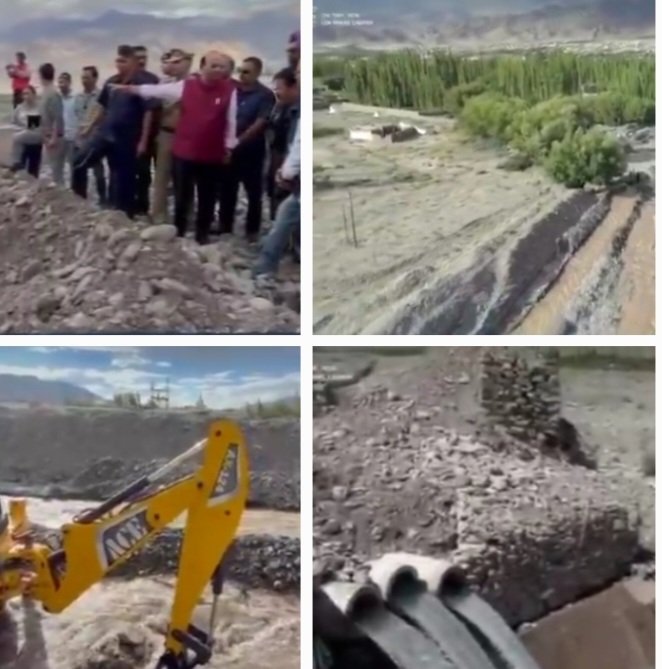
Under the present administration headed by Lieutenant Governor V.K. Saxena, one of the significant interventions has been the diversion of water from the Stok Nallah into the long-defunct Igoo-Phey Irrigation Canal.
Around 25 cusecs out of the nearly 36 cusecs flowing through the Stok Nallah has been diverted into the canal.
This has increased the canal’s water availability from around 50 cusecs to nearly 75 cusecs, according to the administration.
The intervention is expected to benefit 12 villages and irrigate more than 1,000 acres of land that has historically faced water shortages.
The 43-km Igoo-Phey canal had remained underutilised for decades because of inadequate water availability.
The administration has also extended the approach to Chuchot. Following LG Ladakh’s visit to the village on August 16 and an appeal from residents, nearly 20 million litres of Stok Glacier water was diverted into the dry village canal.
Taken together, these interventions have substantially reduced the quantity of water from the targeted Stok system flowing unused into the Indus, with the administration putting the earlier discharge at nearly 90 million litres a day and the present untapped flow at around 5 million litres.
The significance lies less in the scale of construction and more in the simplicity of the intervention. Using basic earthwork and gravity, engineers have sought to take water directly to fields instead of waiting for expensive and elaborate infrastructure.
From water to better farming
The administration is simultaneously trying to improve what farmers can produce with the additional water.
A group of 18 progressive farmers from Leh and Kargil was sent to Gurukul Kurukshetra in Haryana for an exposure-cum-training programme on natural and organic farming, protected cultivation and agricultural value chains.
The objective is to introduce farming practices suited to Ladakh’s difficult agro-climatic conditions, improve productivity and enhance farm incomes. The participating farmers have also been encouraged to share their experience with others after returning.
The initiatives indicate a broader emphasis on linking water availability with agricultural sustainability and rural livelihoods, rather than treating irrigation as an isolated infrastructure issue.
A changing development narrative
The emerging approach comes against the backdrop of Ladakh’s long-standing struggle with water scarcity, harsh climatic conditions and a short agricultural season. Ice stupas pioneered by innovator Sonam Wangchuk have previously drawn national and international attention to the region’s search for unconventional water solutions.
Wangchuk, however, has yet to publicly respond to the latest changes and the administration’s efforts to harness glacier runoff through gravity-based diversions.
The developments have also attracted appreciation from Congress MP Dr Shashi Tharoor, who recently visited Ladakh as part of a Parliamentary Committee delegation.
“Ladakh promises to be a national showcase for environmental progress and sustainability,” Tharoor said while appreciating the initiatives of LG Ladakh.
The latest interventions should not be seen as an end to Ladakh’s water problems.
But they do suggest that better management of existing natural water flows, revival of neglected irrigation infrastructure and stronger agricultural practices could provide practical relief to water-stressed communities.
These initiatives have driven home the fact that not every solution requires a major project.
In a fragile high-altitude ecosystem, sometimes a carefully designed diversion, a revived canal and better farming practices can make a meaningful difference.
#Ladakh #WaterSecurity #SustainableAgriculture #VKSaxena