SHIMLA: The Himachal Pradesh Government’s Market Intervention Scheme (MIS), conceived as a support mechanism for apple growers and a way to prevent a glut of C-grade fruit from depressing market prices, is now facing a piquant situation.
An initiative meant to protect growers from market distress could end up excluding a large section of them because of stringent land-ownership verification norms.
Under the MIS, C-grade apples are procured through designated centres and subsequently used by the Himachal Pradesh Horticulture Produce Marketing and Processing Corporation (HPMC) for manufacturing its popular range of juice, jam, cider and other products.
The scheme has thus served a dual purpose—providing growers an assured outlet for inferior-grade produce while supplying raw material to HPMC.
However, allegations of manipulation in procurement have cast a shadow over the scheme. Over the years, contractors authorised to operate procurement centres have allegedly generated bills in the names of their associates, friends and relatives, causing substantial financial loss to the government. The alleged malpractice has now prompted the government to tighten verification of MIS claims.
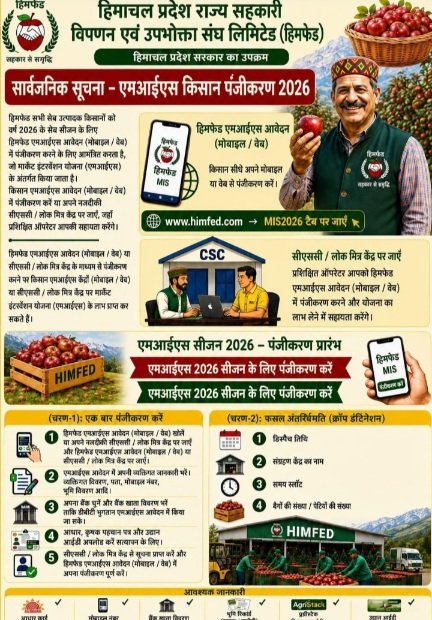
For the 2026 procurement season, growers are being asked to produce revenue and other documents, including Jamabandi and Krishak Certificate, to establish their ownership of the land before payments are released. For the 2027 season, the government has gone a step further, with farmers being required to register themselves on the HPMC and Himfed websites and upload documents establishing land ownership.
While the government’s intention to plug fake billing and prevent leakage of public money cannot be faulted, the new system has created serious practical difficulties for genuine apple growers, particularly in rural Himachal where land ownership patterns are complicated and revenue records often do not reflect actual possession and family arrangements.
A large number of orchardists are not the recorded owners of the land they cultivate. In many families, land has been divided among children, but the revenue record continues to carry the name of the father or an earlier ancestor. Similarly, generations of inheritance and family partitions have resulted in land being jointly recorded in the names of dozens, and in some cases more than 100, shareholders.
A grower may be cultivating 10 bighas of orchard land on the basis of a family settlement and physical possession, while the revenue record may still show the names of numerous members of the extended family.
Changing such records is itself a complicated and time-consuming revenue exercise, often beyond the means and capacity of small and marginal farmers.
The result could be an ironic one: genuine growers may be denied MIS payments because of deficiencies in land records, while the loophole that allegedly enabled fake procurement bills remains essentially an institutional failure at the procurement-centre level.
The Sukhu government, particularly Revenue and Horticulture Minister Jagat Singh Negi, needs to urgently address this contradiction.
Instead of placing genuine farmers in a legally and administratively tricky position, the government must first strengthen its own procurement mechanism and fix accountability at the centres.
At present, procurement centres are generally manned by a single agent, who counts the bags brought by growers and records the quantity in a register.
Such a system leaves considerable scope for manipulation if adequate independent checks are absent.
A technology-driven monitoring mechanism could significantly reduce this vulnerability.
Procurement at every centre should be videographed and digitally recorded, with details of the grower, quantity, date and vehicle documented.
Any procurement exceeding 100 bags from a single grower should automatically trigger independent verification before the bill is cleared.
More importantly, contractors found generating fake bills should face stringent action. They should be blacklisted from future government procurement and, wherever fraud is established, FIRs should be registered and the financial loss recovered.
The government’s objective should be to distinguish between fake procurement and genuine cultivation, rather than treating every grower whose name does not appear as the recorded landowner as a potential beneficiary of a fraudulent claim.
The MIS was created to protect apple growers from market distress. It should not become a system in which a genuine orchardist has to prove his ownership of ancestral land merely to sell C-grade apples to a government agency.
If HPMC wants to clean up the MIS, the priority should be to close the loopholes at the procurement centres while creating a simple, farmer-friendly mechanism for verifying genuine growers.
Otherwise, a scheme designed as a safety net for Himachal’s apple economy could gradually become inaccessible to the very farmers it was meant to protect.