
Agnihotri Promises a Greener Una, But Will the Trees Survive?
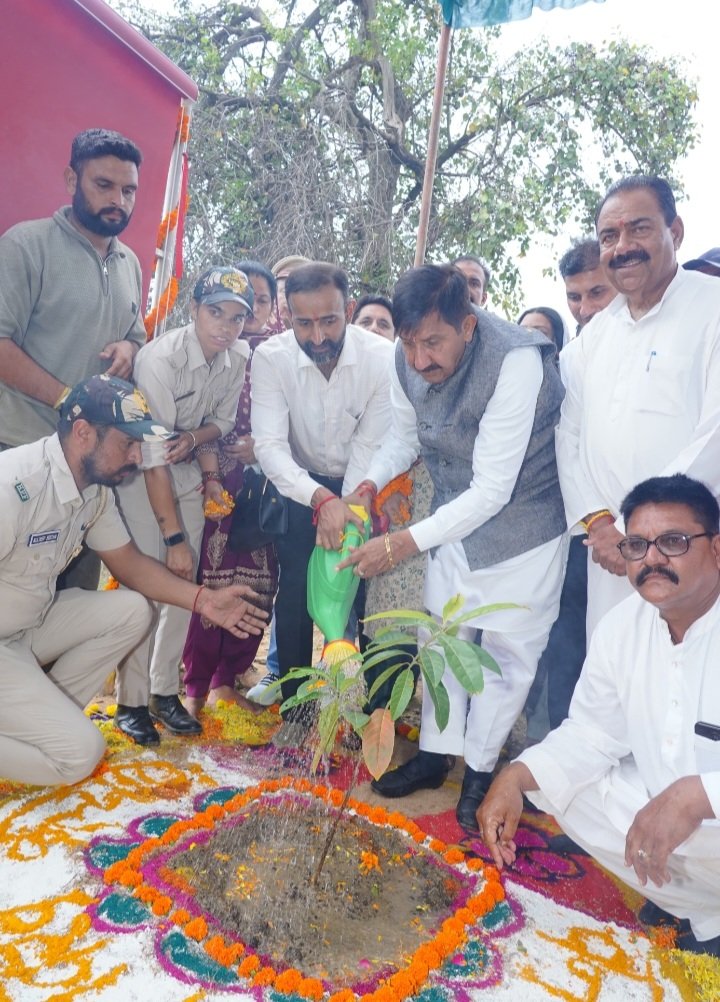
UNA: Deputy Chief Minister Mukesh Agnihotri has set an ambitious target of planting nearly two lakh saplings in Una district during 2026-27, promising greater community participation and stressing that planted saplings must be cared for until they grow into trees.
But the real test for Una’s green drive will not be the number of saplings planted or the photographs taken on plantation days. It will be the number that actually survive.
The government’s plantation figures sound impressive. Around 103 hectares are targeted for plantation this year, with nearly 2 lakh saplings proposed under different schemes, including the “Ek Ped Maa Ke Naam” campaign, Rajiv Gandhi Van Samvardhan Yojana, new plantations and compensatory afforestation linked to the Bulk Drug Park.
Yet, a critical question remains: What happened to the saplings planted under similar campaigns in previous years?
A field-level assessment of earlier plantations is needed before celebrating fresh targets.
In many plantation sites, the initial enthusiasm is visible only during the inauguration. Once the officials, politicians and cameras leave, regular watering, protection and monitoring often become the weakest links.
Survival rates in several plantation areas are reportedly nowhere near the desired 50 per cent mark and some extreme cases it is not even 10 percent.
This raises a basic issue of accountability: Should plantation success be measured by the number of saplings put into the ground or by the number that survive for three, five or even ten years?
Agnihotri himself acknowledged the importance of follow-up care, saying that ensuring saplings survive and become trees is a collective responsibility. The statement is welcome, but it needs to translate into a measurable mechanism on the ground.
Una’s plantation programme also faces a practical challenge. Young saplings need protection from cattle, stray animals, grazing and other local threats including fire and illegal felling.
Without tree guards, fencing or community-based protection, considerable public expenditure can end up producing little more than seasonal plantation statistics.
The solution cannot be left entirely to the Forest Department.
Villagers must be made genuine stakeholders in plantation protection and maintenance. Panchayats, women's groups, youth clubs and self-help groups could be given clearly defined responsibility for particular plantation patches, with survival-based incentives rather than payment merely for planting.
The proposed Rajiv Gandhi Van Samvardhan Yojana model, under which women's and youth groups can receive incentives based on survival, therefore deserves much stronger implementation and transparent monitoring.
The government should also publish year-wise survival data of plantations undertaken under earlier schemes, preferably plantation-site-wise, along with photographs and geo-tagged records.
Independent social audits involving gram panchayats could establish whether the saplings claimed on paper are actually standing in the field.
The ₹10 crore allocation for increasing green cover in Kuthar Beeth provides an opportunity to demonstrate how plantation should actually be done.
The area proposed for compensatory afforestation and the planned green belt should not become another exercise where thousands of saplings are planted but only a fraction mature.
The proposed restoration of the Kuthar Beeth pond and development of walking trails and a park can complement the plantation effort.
But landscaping and plantation should go hand in hand with long-term maintenance, water availability and protection, say NGOs.
Una needs trees, not merely plantation drives.
The district can certainly become greener if the government moves from the “plant and forget” approach to a “plant, protect, monitor and nurture” model.
Every sapling that survives represents a genuine environmental asset; every sapling that dies without follow-up is a missed investment.
The two-lakh target is therefore only the beginning. The real report card should come years later—when the government can show how many of those two lakh saplings actually became healthy, fully grown trees.