
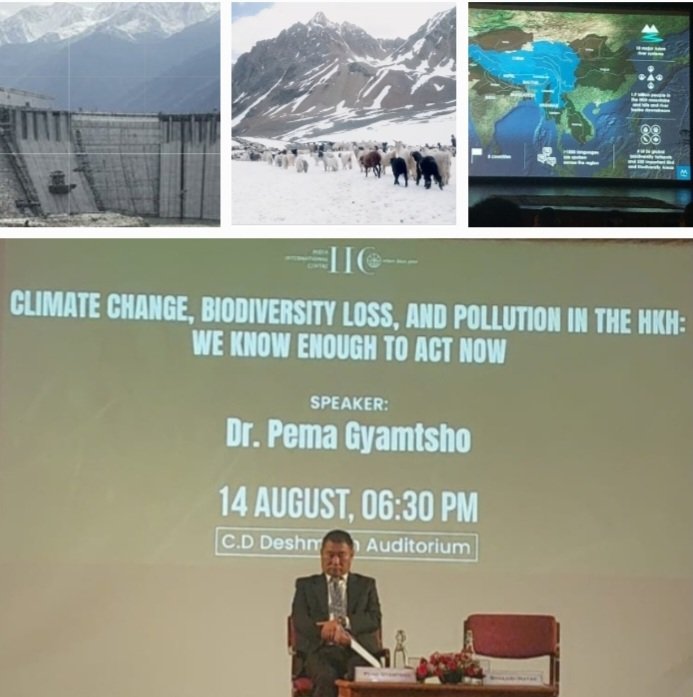
‘We Know Enough to Act Now,’ Says ICIMOD Chief on Climate Crisis in Himalayas...
New Delhi/Shimla/Dehradun– “We know enough to act now,” declared Dr. Pema Gyamtsho, Director General of ICIMOD, Kathmandu.
He was speaking at the India International Centre on Climate Change, Biodiversity Loss, and Pollution in the Hindu Kush Himalayas.
Dr. Pema called the HKH the world’s ‘Third Pole’.
“Ten major Asian rivers flow from here. They feed 1.9 billion people. Yet, poverty is high. Biodiversity is vanishing. Water disasters are rising fast,” he warned.
He cautioned policymakers against reckless dam-building in the fragile mountains.
“Do detailed basin studies. Build only in safe zones. Follow Norway’s model — many small dams, not one big one,” he urged.
He pressed HKH nations to share river flow data with downstream countries. “It’s a moral commitment. It can save lives.”
Dr. Pema also made a pitch for ‘Science Diplomacy’.
“Scientists must work together on climate issues. Persuade governments to follow science-based policies. This is the only way to protect both people and biodiversity.”
The discussion was opened by Dr. Shailesh Naik, Director, National Institute of Advanced Studies (NIAS), Bengaluru.
He set the tone. “The climate crisis in the Himalayas is not a faraway problem. It’s here. It’s now. It’s urgent.”
Dr. Pema flagged three red alerts — a high poverty ratio, rapid biodiversity loss, and an alarming rise in water-related disasters.
He cautioned governments against the casual, profit-driven push for mega hydropower projects in one of the most ecologically fragile regions on Earth.
“Every river basin in the Himalayas needs a detailed, science-led study before even a single turbine is installed,” he said, pressing for dams only in safe, stable zones.
He recommended the Norwegian model of building numerous small dams instead of one giant project, warning that big dams could prove catastrophic in the seismically active, landslide-prone mountains.
Calling for at least a moral commitment, Dr. Pema urged HKH nations to share real-time river flow data with downstream countries to prevent avoidable human tragedies.
He also rallied the scientific community to unite under what he termed “Science Diplomacy” — a collective push to ensure governments adopt climate-resilient, evidence-based policies to safeguard both people and biodiversity.
Echoing the urgency, International Mountain Initiative (IMI) President Ramesh Negi welcomed the initiatives of ICIMOD and called for comprehensive safety audits of all dams in the HKH, particularly those in high-altitude zones.
“The Himalayas cannot afford policy blunders,” Negi said. “This is about survival, not just power generation.”
#ClimateCrisis #Himalayas #ICIMOD #BiodiversityLoss #ScienceDiplomacy