
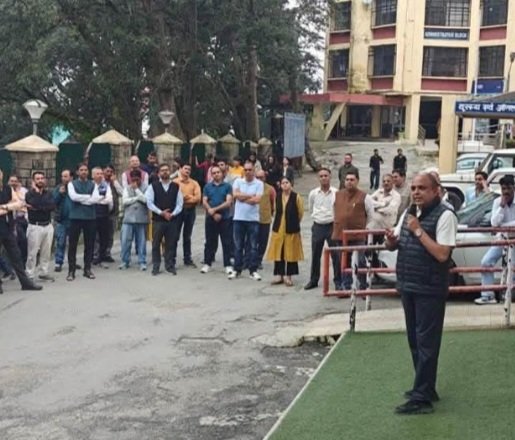
SHIMLA: The Himachal Pradesh University campus has been witnessing continuous protests over the Sukhu government's move to change the system of appointing teaching faculty, with teachers and the wider university community alleging that the proposed law will weaken the autonomy of the 56-year-old institution and bring greater government control over its functioning.
The controversy centres on the government's proposal to route recruitment of university teachers through the Himachal Pradesh Public Service Commission instead of leaving the process within the university's existing selection system.
The government says the move will bring greater transparency, ensure merit-based recruitment and prevent irregularities, while opponents see it as a direct route for political influence over academic appointments.
The university community argues that HPU was built over 56 years through the contribution and struggle of generations of teachers, students and employees and cannot be treated like an ordinary government department.
They say financial assistance from the State cannot justify direct government control over who teaches in the university.
Leader of Opposition Jairam Thakur and other BJP leaders have opposed the proposal, alleging that it will compromise the autonomy and dignity of Himachal Pradesh University.
The Opposition has accused the Sukhu government of interfering in institutions that are expected to function independently.
The government, however, has a different argument. Since the State provides substantial financial support to the universities, it maintains that it has a legitimate responsibility to ensure that public money is properly used and that appointments are transparent and free from favouritism.
The UGC position adds another dimension to the dispute. The University Grants Commission lays down minimum qualifications and standards for teachers in universities, including requirements relating to academic qualifications, research and selection procedures.
The UGC does not itself appoint teachers in State universities. Recruitment is carried out under the law and rules governing the particular university, while appointments have to comply with applicable UGC standards.
The Himachal Pradesh University Act, 1970 provides for Selection Committees for appointments and gives university bodies an important role in the appointment of teachers.
This is why teachers argue that transferring recruitment to the HPPSC would fundamentally change the existing system and give a State-controlled body a much greater role in university appointments.
Their concern is also linked to the manner in which the HPPSC is constituted. Its Chairman and members are appointed by the State Government.
Teachers fear that a recruitment system controlled by a commission whose leadership is selected by the government could eventually give the political executive indirect influence over academic appointments.
But there is another side to the controversy which the university community cannot ignore.
The existing system of university recruitment has not always been a guarantee of merit. Successive governments and political leaders have faced allegations of influencing appointments, while Vice-Chancellors and university selection committees have also been accused from time to time of favouritism and accommodating politically connected candidates.
Critics within academia argue that university autonomy has sometimes been misused. Instead of producing a completely independent academic system, it has, in some cases, allowed mediocre candidates and politically influential academicians to enter important teaching positions.
The result, they say, is visible in the declining academic environment of the university. When appointments are not based entirely on merit, research record, teaching ability and subject expertise, students ultimately pay the price.
The debate therefore cannot be reduced to whether the HPPSC is good or bad. The bigger question is whether either system can protect the university from political influence and ensure that only academically deserving candidates reach the teaching faculty.
A university teacher is not simply another government employee. Academic appointments require assessment of subject knowledge, research work, publications, teaching experience and academic contribution. UGC regulations also recognise these requirements while prescribing minimum standards for university teachers.
This raises questions about whether a general recruitment commission can adequately assess the specialised academic credentials of candidates unless university subject experts and academic bodies retain a meaningful role in the selection process.
At the same time, simply defending the present system in the name of autonomy would also be difficult if allegations of political interference, delayed recruitment and poor selections remain unresolved.
The present controversy has therefore exposed a deeper problem inside Himachal's higher education system. The choice cannot be between government interference from outside and political influence operating through university authorities from within.
The State certainly has the right to demand accountability for public money. It can investigate irregular appointments, enforce UGC qualifications, audit expenditure and take action against corruption. But financial responsibility does not automatically mean that the government should control academic appointments.
For HPU, the immediate question is whether the proposed law will make recruitment genuinely more transparent or simply move political influence from the university campus to the State-controlled recruitment commission.
For the government, the challenge is to prove that its reform is about merit and accountability rather than control.
For the university community, the challenge is equally serious: autonomy must mean academic independence and transparent decision-making, not freedom from scrutiny or accountability.
The fight over the proposed law has thus become a much larger battle over who should decide the academic future of Himachal Pradesh's universities—and whether merit will finally take precedence over political influence, whichever side it comes from.
#HimachalPradeshUniversity #UniversityAutonomy #HigherEducation #HimachalPradesh