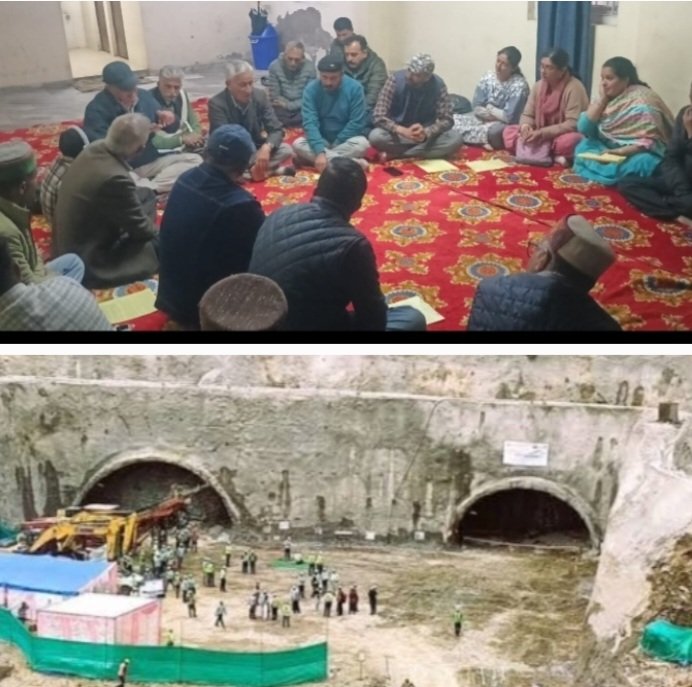
SHIMLA: Simmering public outrage over the National Highways Authority of India’s (NHAI) controversial four-lane twin-tunnel project in Sanjauli reached boiling point on Sunday, with local residents, civil society groups, and legal activists resolving to stage a massive protest rally on October 16. The move comes right on the heels of the Supreme Court-appointed High-Powered Committee’s interaction with affected residents, where citizens testified that unscientific cutting and arbitrary alignment shifts have endangered over 500 homes across the fragile hillside.
At a joint strategy meeting held in Sanjauli by the Twin Tunnel Affected Joint Action Committee (Sanyukt Sangharsh Samiti) and the Shimla Nagrik Sabha, community leaders, environmentalists, and legal practitioners declared an outright rejection of the project in its current form, demanding an immediate halt to all ongoing construction.
"Kept in the Dark": Secret Alignment Shift and 500 Cracked Homes
Speaking at the convention, members of the Sangharsh Samiti—including Govind Chitranta, Rajender Chauhan, Anshul Chauhan, and Advocate Ramesh Kumar—sharply criticized NHAI and its private contractors for bypassing public scrutiny.
"NHAI and its executing agencies altered the original tunnel alignment without issuing public notices or holding mandatory, transparent public hearings. The entire populace of Sanjauli and adjoining localities was kept completely in the dark," the Sangharsh Samiti representatives stated.
The committee underscored that the consequences of this decision were laid bare before the Supreme Court-appointed High-Powered Committee during its visit last week. Residents had informed the apex court panel that rampant, aggressive blasting and deep slope excavation have already triggered structural cracks in more than 500 houses, severely jeopardizing families in Chamiyana, Matu Colony, Shanti Vihar, and Bhattakufer.
"The quality of construction and slope stabilization has been compromised to fast-track execution," said Advocate Satish, another member of the committee. "The administration and project proponents cannot treat human habitations as collateral damage in the name of four-laning."
Ecological Fragility and the Shadow of Joshimath
Environmental expert Dr. Om Prakash warned the gathering against treating the Shimla ridges like standard terrain. "This belt sits in one of the most fragile, geologically active zones of the Western Himalayas, already burdened by heavy urbanization. Carving deep twin tunnels beneath these loose strata invites a man-made disaster," he said.
Echoing these concerns, Shimla Nagrik Sabha Secretary Vivek Kashyap and joint secretaries Pawan Sharma and Satyawan Pundir cautioned against bureaucratic complacency: "We will not allow Sanjauli to turn into another Joshimath".
In Uttarakhand, warning signs were ignored until ground subsidence ripped through homes and forced mass evacuations. The risk is not confined to one ridge or a handful of houses in Shanti Vihar—the entire Sanjauli township sits on the brink."
The crisis has also crippled the local rental economy. Fearing sudden structural collapse, tenants have begun vacating cracked buildings en masse, leaving homeowners without livelihoods while struggling to repair crumbling residences without any interim compensation from NHAI.
Core Demands Raised by the Forum
The joint committee resolved that work must freeze until all safety violations and ecological concerns raised before the Supreme Court panel are addressed:
Immediate Work Stoppage: An unconditional halt to all drilling, tunneling, and excavation work on the Sanjauli twin-tunnel stretch.
Fresh Public Hearings: Mandatory, transparent environmental and social impact hearings held strictly in accordance with statutory guidelines.
Independent Geological Audit: A comprehensive safety and structural survey of all affected ridges and structures by accredited scientific institutions rather than NHAI-appointed agencies.
Declassification of Reports: Immediate public release of the administrative and technical inquiry reports conducted so far.
Full Compensation: Immediate financial compensation and rehabilitation for families whose houses have developed cracks or suffered structural collapse.
The Action Committee declared that the October 16 rally will be completely non-partisan, cutting across political and social affiliations to defend the town's survival.
"This march will mark the beginning of a decisive civil movement to protect Sanjauli before the mountains give way," the organizers asserted.
Amid mounting public backlash over structural damage along the Sanjauli corridor, the National Highways Authority of India (NHAI) has offered to conduct a comprehensive house-to-house safety survey across the affected belt before resuming any excavation on the contentious four-lane twin-tunnel project.
According to highway officials, the planned structure-by-structure audit aims to address safety apprehensions raised by local residents and assess the ground stability of buildings falling directly within the tunnel's influence zone.
The authority plans to deploy high-resolution videography and photographic documentation to establish baseline structural health, record existing fissures, and identify properties requiring urgent slope-stabilization or structural retrofitting.
NHAI representatives indicated that expert technical institutions, including teams from the Indian Institute of Technology (IIT), would be engaged to evaluate subsurface strata conditions and pinpoint the factors driving localized ground distress.
Maintaining that public safety remains a priority, the authority stated that further construction activity will remain paused until the door-to-door assessment is completed, stabilization measures are instituted for compromised structures, and direct engagement with affected property owners is carried out.
#NHAI #Shimla #SanjauliTwinTunnel #InfrastructureSafety