New Delhi/Shimla:
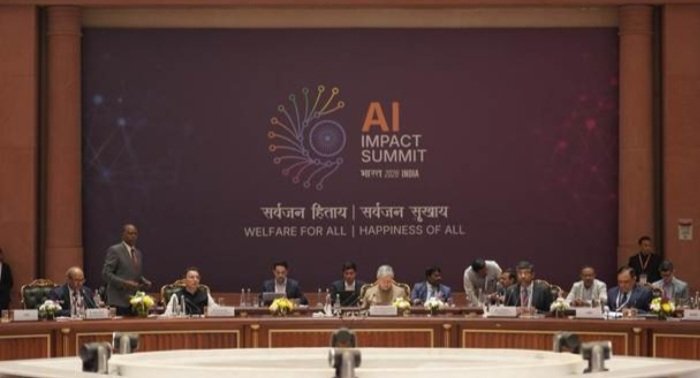
India is positioning itself as a big global voice on artificial intelligence as Prime Minister Narendra Modi inaugurates the India AI Impact Summit 2026 at Bharat Mandapam on February 19.
With the theme सर्वजन हिताय, सर्वजन सुखाय — welfare for all, happiness for all — the summit brings together more than 500 global AI leaders, over 20 heads of state and government, and senior executives from the world’s biggest technology firms.
While official messaging highlights inclusion, sustainability and innovation, the summit has also triggered a wider and more critical debate: who will ultimately benefit from the AI revolution — society at large or a small group of powerful corporations and wealthy stakeholders?
India’s vision of responsible and inclusive artificial intelligence can guide the global AI journey, Union IT Minister Ashwini Vaishnaw said at the India AI Impact Summit 2026.
He said the outcomes of seven thematic Chakras—Human Capital, Inclusion for Social Empowerment, Safe and Trusted AI, Resilience, Innovation and Efficiency, Science, and Democratizing AI Resources with AI for Economic Development and Social Good—will shape future collaboration and help build people-centric AI systems.
MeitY Secretary S. Krishnan added that while AI offers immense potential, strong governance, global standards and inclusion of all voices are crucial as the world moves from AI vision to implementation.
AI Beyond a Neutral Tool
The debate has been sharpened by growing global concern that artificial intelligence is no longer merely an assistive technology.
Historian and philosopher Yuval Noah Harari, writing recently in The New York Times, cautioned that one of the biggest misconceptions about AI is viewing it as a simple tool.
Unlike traditional technologies, Harari argues, AI systems can make decisions independently, influencing human behaviour, shaping information flows and, in many cases, replacing human judgement.
This shift, experts say, marks a fundamental break from earlier waves of technological change.
Wealth Creation and Job Losses
Artificial intelligence has existed for decades, but its rapid commercial deployment over the past few years has turned it into a major engine of wealth creation. However, evidence so far suggests that this wealth is being unevenly distributed.
Across sectors, companies are announcing job cuts while citing AI-driven efficiencies.
From customer service and media to design, finance and management functions, automation is increasingly replacing human roles.
Critics warn that AI is being used less to augment human capabilities and more to reduce labour costs, raising fears of large-scale job displacement.
At the same time, the rise of AI-generated content has sparked concerns about the erosion of creativity, originality and critical thinking, as algorithm-driven outputs begin to dominate art, communication and public discourse.
India’s Digital Dependence
The summit has also renewed questions about India’s technological sovereignty.
Despite being one of the world’s largest sources of AI talent, India remains heavily dependent on foreign platforms for browsers, cloud services, social media and AI tools.
Indian professionals occupy senior leadership positions in global tech firms, including Google CEO Sundar Pichai, whom the Prime Minister met on the sidelines of the summit to discuss collaboration in AI education and skills. Yet critics point out that most core technologies, intellectual property and data ownership remain outside India.
Citizens and policy analysts are increasingly asking why Indian innovators continue to build products for overseas companies instead of developing large-scale indigenous alternatives.
Comparisons are often drawn with countries such as China and Russia, which have invested heavily in domestic digital ecosystems to reduce external dependence.
Data, Control and Security
Concerns are also being raised about data control. With banking, governance, healthcare and personal communication now deeply integrated with digital platforms, the reliance on foreign-owned technologies has implications for privacy, economic autonomy and national security.
Experts argue that Indian user data is generating enormous value globally, while India captures only a fraction of the economic and strategic benefits. Without strong data protection regimes and public investment in domestic AI infrastructure, they warn, India risks becoming a passive consumer in the global AI economy.
Summit Agenda and Global Engagement
According to official briefings, the summit is anchored around three pillars — People, Planet and Progress — and seven working groups focusing on areas such as safe and trusted AI, inclusion, human capital and economic growth. Prime Minister Modi is scheduled to participate in the Leaders’ Plenary and a CEO Roundtable, and to visit country pavilions at the India AI Impact Expo.
On the sidelines, the Prime Minister also met Serbian President Aleksandar Vučić, with discussions covering cooperation in defence, manufacturing, digital public infrastructure and technology.
The Larger Question
Despite the scale and ambition of the summit, analysts say the core challenge lies beyond declarations and partnerships.
The central issue remains whether artificial intelligence will deepen existing inequalities or be shaped as a genuinely inclusive public good.
As AI increasingly influences economies, governance and everyday life, policymakers face growing pressure to ensure that its benefits extend beyond corporate balance sheets.
For India, the debate is no longer about adopting AI, but about who controls it, who profits from it, and how its risks are managed.
The India AI Impact Summit 2026, many argue, will be judged not by its speeches or attendance figures, but by whether it leads to concrete steps toward technological self-reliance, job protection and equitable wealth creation in the age of artificial intelligence.
#IndiaAI #ResponsibleAI #AIForGood #DigitalIndia