Road Widening, Traffic Congestion, Slope Stability and the Future of a Himalayan Capital.
18 October 2026 | Shimla, Himachal Pradesh
A City at a Crossroads
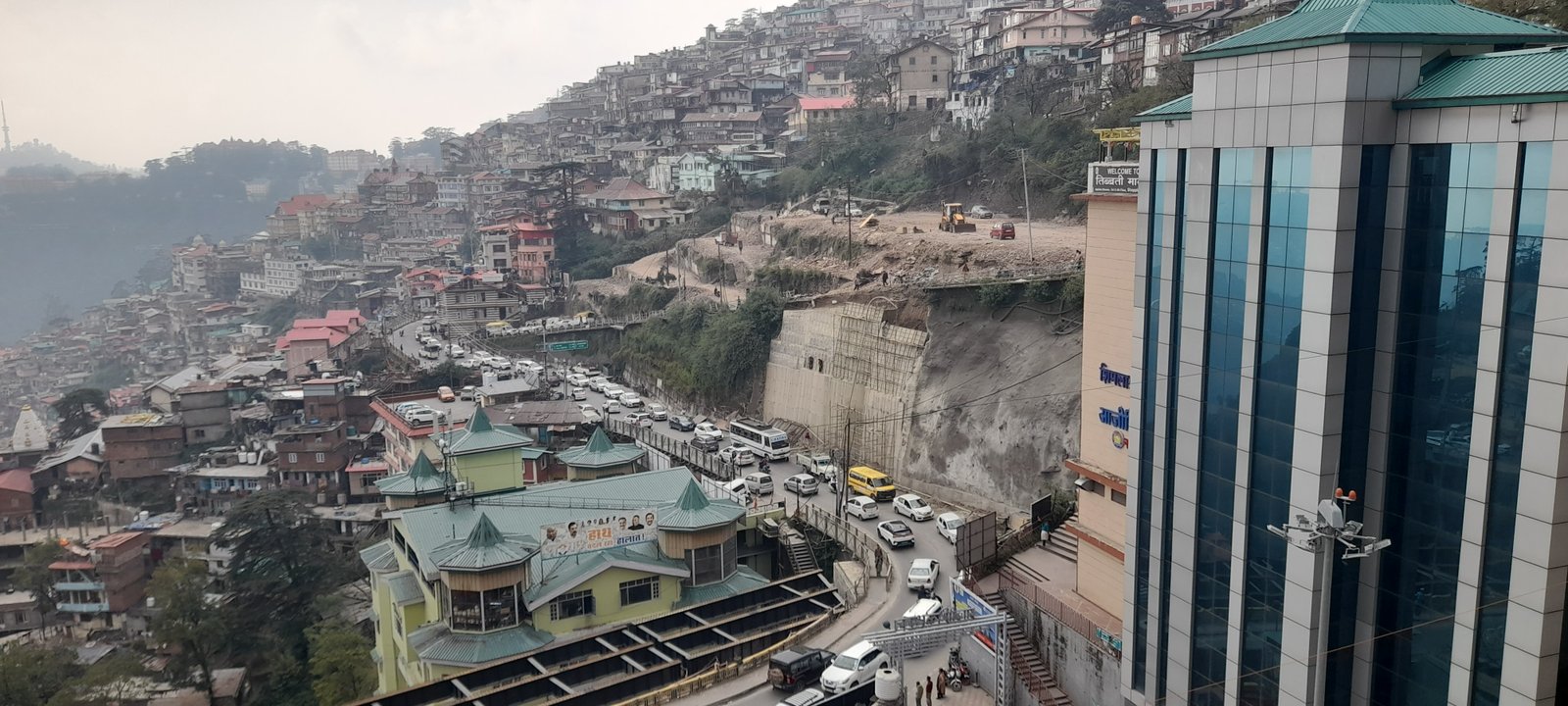
Shimla is confronting a serious dilemma. Its roads are increasingly congested, its population and tourist traffic place growing demands upon ageing infrastructure, and residents routinely experience delays along important arterial routes.
The Government of Himachal Pradesh has proposed widening portions of the existing Cart Road and Circular Road to improve traffic flow.
At first glance, the proposal appears reasonable. Wider roads should accommodate more vehicles and make travelling easier.
But should that assumption alone justify cutting into fragile hillsides, removing trees, acquiring private property, disturbing foundations, displacing families and potentially exposing established neighbourhoods to new geological risks?
The question is not whether Shimla needs better transport infrastructure. It undoubtedly does.
The question is whether extensive road widening represents the most effective, economically rational and environmentally responsible solution for a Himalayan hill town.
PSPK believes this question deserves careful scientific examination and informed public discussion before irreversible interventions are undertaken.
1. The Scale of the Proposed Project
According to a newspaper report dated 13 September 2026, the road-widening proposals encompass important stretches of MDR-66, connecting Tutikandi with Sanjauli through Chhota Shimla, and MDR-67, connecting Victory Tunnel towards Dhalli through Lakkar Bazar.
The report cites proposed acquisition of approximately 20,444 square metres of land and states that around 200 families could face displacement or significant impacts.
The official draft Social Impact Assessment available on the Shimla District Administration website refers to approximately 20,882.53 square metres across its project study area. The difference between these figures requires reconciliation against the latest acquisition notifications and final land schedules.
The implications extend beyond acquisition of vacant land. Existing homes, shops, pedestrian pathways, staircases and other structures may be affected.
For many residents, these are not merely properties recorded against Khasra numbers. They represent homes established over generations, livelihoods, family security and substantial investments.
A city cannot measure the consequences of infrastructure development exclusively in square metres acquired or compensation disbursed.
2. Does Road Widening Actually Reduce Traffic Congestion?
There is a well-established principle in transport economics known as induced demand.
When a congested road is widened, traffic may initially move more freely. However, the improvement can encourage additional vehicle journeys, attract traffic from other routes, and influence travel behaviour.
Over time, part or even all of the initial congestion relief may disappear.
In a significant 2011 study, The Fundamental Law of Road Congestion: Evidence from US Cities, economists Gilles Duranton and Matthew Turner examined the relationship between road capacity and vehicle travel. They found that increasing highway capacity was associated with substantial additional vehicle travel, thereby challenging the assumption that continually building additional road space provides lasting congestion relief.
The United Kingdom’s Department for Transport examined induced travel demand in a 2018 evidence review and revisited its implications for project appraisal in research published in May 2026.
These studies do not establish that every road-widening project is ineffective. Some targeted improvements can genuinely enhance safety, remove specific bottlenecks and improve emergency access.
Nevertheless, they demonstrate that additional road capacity must not be confused with a guaranteed long-term reduction in congestion.
Shimla must examine this evidence carefully.
A wider road approaching a narrow intersection may simply transfer the traffic queue to the next bottleneck. Increased road capacity may attract more private vehicles while congestion caused by irregular parking, pedestrian conflicts, loading activities, junction design and poor traffic management remains unresolved.
Why should a Himalayan town absorb the irreversible costs of hillside excavation without a credible forecast demonstrating enduring benefits?
3. The Geological Price of Widening Mountain Roads
Unlike a city on flat terrain, Shimla occupies steep mountain slopes, ridgelines and valleys shaped by complex geological and hydrological processes.
An existing road is not merely a strip of asphalt. It is part of an altered hillside system, often supported by retaining walls, drainage arrangements, adjoining buildings, vegetation and underlying rock formations.
To widen such a road may require cutting the uphill slope, extending the downhill edge, constructing retaining structures, or disturbing existing support systems.
Each intervention can introduce significant engineering challenges.
Excavation may destabilise fractured rock masses. Disturbed drainage may saturate vulnerable soil. Existing retaining walls may require reconstruction. Tree removal and root damage can contribute to erosion and reduce local vegetation-based protection.
Where buildings are situated immediately above or below the road, these risks become especially important.
A structure need not be demolished to become unsafe.
Even limited excavation near its foundations, supporting slope or drainage system could produce structural consequences extending beyond the acquired strip of land.
The cumulative impact of multiple widening operations along a single hillside must also be considered.
A slope may tolerate one carefully engineered intervention yet become increasingly vulnerable when subjected to repeated cutting, vegetation removal and drainage alteration.
Shimla’s history of slope failures and monsoon-related disruptions makes such questions essential to public safety.
Engineering feasibility must therefore be demonstrated before excavation, not assumed from the possibility of constructing another retaining wall afterwards.
4. Trees Are Not Obstacles to Urban Development
In mountain environments, trees contribute to the stability and functioning of the surrounding landscape.
They intercept rainfall, support soil structure through their root systems, influence local temperatures, provide habitat and contribute to the ecological character of the city.
Their stabilising influence varies with soil depth, species, rooting conditions and geology; trees alone cannot prevent deep-seated landslides.
Nevertheless, indiscriminate removal or root damage can worsen erosion and remove ecological benefits that are difficult to replace.
Compensatory plantations, wherever legally required, cannot immediately reproduce the functions of mature urban trees.
A newly planted sapling is not an ecological equivalent of a mature tree that has supported its surrounding environment for decades.
Before approving tree removal, the authorities should disclose the number, species, age or size class and location of trees likely to be affected, together with the steps considered to preserve them.
The assessment must extend beyond the number of trees directly felled. Damage to adjoining root systems, slope drainage, soil cover and associated vegetation must also be examined.
5. A Particularly Troubling Finding in the Official Social Impact Assessment
The draft Social Impact Assessment for the proposed widening of MDR-66 and MDR-67 is available through the Shimla District Administration.
It contains two findings which deserve wider public attention.
First, in its discussion of alternatives, the report indicates that no alternative to the proposed road widening was presented.
Second, under the heading concerning environmental assessment and technical feasibility, it records that the concerned agency had not provided such a report.
These statements should not be interpreted as proof that no engineering or environmental studies were ever prepared. They do, however, raise an important question:
How was the wider public interest evaluated if the assessment team had not been furnished the relevant technical information and a meaningful comparison of transport alternatives?
The assessment also acknowledges risks associated with displacement, livelihoods, compensation and environmental effects.
The public deserves clarity about what studies were available at the time of project appraisal, what additional studies have since been undertaken, and how their findings have influenced the final widening alignments.
A transparent planning process should compare not merely alternative parcels of land for acquisition, but alternative ways of achieving the underlying transport objective.
6. Displacement, Property Rights and Human Security
The potential displacement of approximately 200 families, as reported in September 2026, deserves serious attention.
Residents may lose portions of homes, access roads, commercial premises, boundary walls and land needed for structural support.
A shop may lose its viability even without total demolition. A residence may become difficult to access. A building may remain standing while its foundations or supporting slope are disturbed.
Tenants, employees and businesses may also experience consequences that are not captured simply by paying compensation to the recorded owner.
Fair compensation and rehabilitation are important legal and social obligations. But compensation alone cannot substitute for adequate assessment of physical safety, displacement and lasting livelihood disruption.
Every affected property should receive an understandable site-specific plan identifying the proposed acquisition boundary, nature of construction, safety precautions, drainage modifications and any likely structural consequences.
Residents must have an effective opportunity to scrutinise these plans and place their objections on record.
7. Is Shimla Treating the Symptoms Rather Than the Causes?
Traffic congestion is not simply a consequence of insufficient road width.
It results from the relationship between travel demand, road capacity, parking arrangements, public transport, pedestrian movement, junction design, roadside activity and the concentration of economic and administrative functions.
Before investing heavily in road widening, Shimla should examine whether the following measures could offer substantial congestion relief with less environmental disturbance:
• Reliable and frequent public transport along major corridors, with well-designed interchange points.
• Park-and-ride facilities at suitable peripheral locations, supported by dependable onward transport.
• Better management of roadside parking, loading, taxi stopping and illegally obstructed carriageways.
• Improved junction design, pedestrian crossings, traffic signalling and localised bottleneck removal.
• Safer, accessible pedestrian routes and appropriate hillside mobility connections.
• Coordinated management of tourist and peak-hour traffic, supported by real traffic data.
• Carefully selected road improvements where independent studies establish genuine safety or capacity benefits.
No single measure will resolve every traffic problem. The objective should be a coordinated city mobility strategy.
Indeed, the correct measure of transport success is not how many cars a road can hold. It is how safely, reliably and efficiently people can reach their destinations.
8. The Emergency-Access Argument Must Also Be Examined
Road widening is frequently justified by the need to improve ambulance movement, fire-service access, disaster response and evacuation.
These are important considerations, particularly in Shimla.
But they too require evidence.
An ambulance may be delayed by illegally parked vehicles or blocked intersections rather than inadequate road width along an entire corridor.
A widened road may improve emergency response in one location while increased slope instability introduces a different kind of emergency risk elsewhere.
The correct approach is therefore to identify actual emergency-access bottlenecks and develop engineering solutions proportionate to the problem.
Public safety cannot be evaluated solely by the width of the carriageway.
9. What PSPK Requests from the Authorities
PSPK proposes that the Government of Himachal Pradesh, HPPWD, Shimla District Administration and relevant planning agencies place the following information in the public domain:
1. The complete Detailed Project Report, sanctioned road alignments, cross-sections, acquisition schedules and current project status.
2. Baseline traffic surveys, congestion measurements and projected travel-time savings, including assessment of induced traffic.
3. Site-specific geological investigations, slope-stability calculations and structural safeguards.
4. Tree inventories, applicable forest permissions and plans to prevent avoidable ecological damage.
5. Property-wise acquisition and displacement details, together with rehabilitation and compensation provisions.
6. The environmental, economic and social comparison of road widening against public transport improvements and less damaging alternatives.
7. Independent safety-review arrangements and monitoring procedures for vulnerable stretches during and after construction.
PSPK also recommends meaningful public consultation, with affected residents, engineers, geologists, transport specialists and civil society representatives given an opportunity to review the findings.
Where necessary technical investigations are incomplete or credible safety concerns remain unresolved, irreversible excavation should await the appropriate studies and independent examination.
10. A Public Appeal to the Citizens of Shimla
The citizens of Shimla should neither dismiss every infrastructure improvement nor accept every road-widening proposal without scrutiny.
The city deserves better mobility, safer travel, efficient emergency services and modern public infrastructure.
It also deserves secure homes, stable mountain slopes, functioning drainage systems, healthy trees and protection from avoidable environmental damage.
These objectives need not be mutually exclusive.
Residents whose properties may be affected should obtain their relevant acquisition documents, preserve existing structural-condition records and seek clarification of the proposed construction and safety measures.
Citizens should participate in public consultations and seek access to technical documents, including through the Right to Information Act.
PSPK invites constructive participation from residents, neighbourhood associations, planners, engineers, geologists, environmental organisations and professionals committed to the long-term welfare of Shimla.
Conclusion: What Kind of Shimla Are We Building?
Cities evolve. Roads must be maintained and improved. Traffic problems cannot be ignored.
But development in a Himalayan capital must acknowledge the physical limits of its mountain setting.
The fundamental question is not whether we can cut another hillside and construct a wider road.
It is whether doing so is demonstrably necessary, safe, sustainable and more beneficial than the alternatives.
A road-widening project may create additional metres of carriageway. But if it also produces avoidable displacement, geological vulnerability, environmental loss and congestion that subsequently returns, its true cost will be considerably greater than its construction budget.
Shimla does not need roads at any cost. It needs mobility without compromising the mountains and communities on which the city depends.
Before widening roads, we must widen the scope of public discussion, scientific assessment and responsible.
Pahari Samaj Paryavarani Kawach Foundation (PSPK)
Email:
Website: https://pspkgreenspirituality.ngo
(This article presents a public-interest examination of Shimla’s road-widening proposals using available project records and published transport research. It does not suggest that any specific property has been unlawfully acquired or that any particular widening section has been established to be unsafe)